 Retro Replay Retro Replay gaming reviews, news, emulation, geek stuff and more!



Retro Replay Review
Gameplay
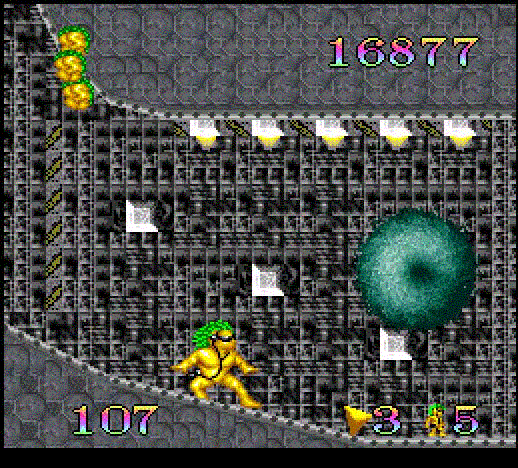
Mo Hawk & Headphone Jack stakes its claim as a protean platform hero with attitude, trading traditional runs-and-jumps for a constantly shifting set of abilities. Mo Hawk collects CDs—yes, physical discs in a pre-Napster era—while cruising through disorienting Mode 7 mazes that flip and rotate without a fixed “down” direction. Each level introduces segmented slinkies, nasty robot bugs and precarious platforms that demand quick reflexes and a keen eye for pattern recognition.
(HEY YOU!! We hope you enjoy! We try not to run ads. So basically, this is a very expensive hobby running this site. Please consider joining us for updates, forums, and more. Network w/ us to make some cash or friends while retro gaming, and you can win some free retro games for posting. Okay, carry on 👍)
Beyond the standard platform fare, Mo Hawk’s core mechanic is his rubbery, malleable body. He pours himself into narrow cracks, splatters majestically against walls, and even morphs into a defensive porcupine–koosh hybrid at the press of a button. Offensively, he can explode into a cloud of jelly gibs that decimate nearby enemies—gross, but undeniably satisfying. A well-timed transformation can clear groups of foes or activate hidden switches in the environment.
Adding an extra layer of chaos, a rare power-up replaces Mo Hawk’s feet with a chopper wheel, turning him into the hood ornament on his own motorbike. This turbocharged form rips through levels at breakneck speed, carving new routes and smashing obstacles. With support for one or two players (non-simultaneous), the game throws down a gauntlet for platforming purists and casual pick-up artists alike, testing timing, spatial awareness and an appetite for zany physics.
Graphics
On the graphical front, Mo Hawk & Headphone Jack flaunts bold, 16-bit pixel art coupled with experimental Mode 7 effects that warp and tilt the playfield. Backgrounds swirl in dizzying fashion, offering a pseudo-3D sheen that was groundbreaking for its time. Each sprite—from the cool sunglasses-clad hero to the metallic sheen of robot bugs—boasts crisp animation frames that capture every stretch, spin and splat with surprising fluidity.
The color palette leans into a radical surfer-punk aesthetic: neon purples, electric greens and hot pink accents contrast sharply against dank industrial backdrops. Level details, like conveyor belt hazards and spring-loaded platforms, pop off the screen, providing visual cues that are both functional and stylish. Environmental hazards, such as segmented slinkies and rotating fans, are rendered with enough clarity to telegraph danger without muddying the action.
That said, the frenetic nature of Mode 7 rotation can induce occasional frame drops or sprite flicker on original hardware. At full speed, backgrounds occasionally blur with foreground elements, making it tricky to judge platform spacing in high-tension moments. While these glitches are minor in the grand scheme, they do remind players of the technical limits of the era—warts and all.
Story
Mo Hawk & Headphone Jack doesn’t bombard players with deep lore or cinematic cutscenes. Instead, it relies on pure attitude and visual storytelling to set the stage. The premise is delightfully simple: a rocker‐bodied hero armed with a trusty Walkman must retrieve stolen CDs and thwart an army of mechanized pests. The game’s minimalist narrative is conveyed through brief title cards and quirky sprite interactions.
Characterization comes from design and action rather than exposition. Mo Hawk’s perpetual shades and laid-back posture scream “cool,” while Headphone Jack—his loyal audio accessory—serves as both comic relief and power-up dispenser. The interplay between hero and hardware is charmingly irreverent: one moment you’re head-banging to collect power cells, the next you’re dodging robotic scorpions in a gravity-twisted tunnel.
Although there’s no hidden dramatic twist or sprawling backstory, the game’s tone is consistent and fun. It embraces its own absurdity—the concept of a boneless wonder splatting into jelly gibs is bizarre, yet it epitomizes the creative freedom platform games enjoyed in the early ’90s. For players seeking narrative depth, the story may feel scant—but for a pick-up-and-play arcade romp, it hits the right notes.
Overall Experience
Mo Hawk & Headphone Jack stands out as a unique footnote in platforming history—an ambitious attempt to dethrone genre heavyweights with a wacky hero and experimental level design. Its blend of stretchy body mechanics, rotational Mode 7 mazes and collectible CDs creates a gameplay loop that’s as challenging as it is unconventional. Fans of fast-paced platformers will find plenty to love, though newcomers may need an adjustment period to master the disorienting stages.
On the audio-visual front, the game exudes a raw, retro charm. The pixel art is vibrant and the animations are surprisingly smooth, despite occasional slowdown in complex scenes. Musically, the rock-and-beat soundtrack (piped through Mo Hawk’s Walkman) keeps energy levels high, complementing the action and reinforcing the game’s punk-rock ethos.
Whether you’re a collector chasing obscure classics or a platformer enthusiast hungry for something offbeat, Mo Hawk & Headphone Jack delivers a blast of creativity and challenge. It may not have achieved Sonic-level fame, but its inventive mechanics and unbridled attitude make it a worthy addition to any retro gaming roster. Dust off your controller, crank up the volume, and prepare for one of the quirkiest rides of the 16-bit era.


Reviews
There are no reviews yet.