 Retro Replay Retro Replay gaming reviews, news, emulation, geek stuff and more!


Retro Replay Review
Gameplay
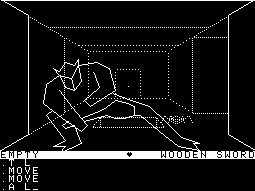
Dungeons of Daggorath blends the methodical character building of early RPGs with the immediacy of a text‐parser interface. At the top of the screen you see a first‐person wireframe view of the dungeon corridors, and at the bottom you type commands such as MOVE, TURN, USE, ATTACK, STOW, and INCANT. This hybrid approach means you’re never far from deciding whether to swing your sword at a creeping zombie or carefully invoke a spell to conserve your dwindling mana.
(HEY YOU!! We hope you enjoy! We try not to run ads. So basically, this is a very expensive hobby running this site. Please consider joining us for updates, forums, and more. Network w/ us to make some cash or friends while retro gaming, and you can win some free retro games for posting. Okay, carry on 👍)
The real‐time heartbeat mechanic pushes Dungeons of Daggorath into tense territory. As your character runs or takes damage, your virtual pulse quickens—leading to blurred vision and, if you push too far, a full blackout. While you’re out cold, monsters keep moving and can even damage you further, so pacing and managing your torches become crucial survival skills. The leaky torchlight, which dims over time and affects your line of sight, adds another layer of resource management to the dungeon crawl.
Exploration unfolds across five increasingly dangerous levels, each filled with the same monster types that gain strength—or better equipment—the deeper you go. For example, the level‐one troll carries only a club, but by level three you’ll be facing axe‐wielding brutes. Audio cues hint at hidden foes: as a monster draws nearer, its growls and footsteps grow louder, making every shadow and corner feel alive. The blend of visual, auditory, and text‐command feedback keeps you on edge throughout your descent.
Graphics
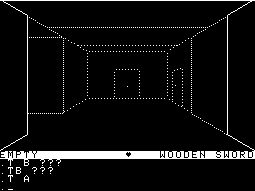
While Dungeons of Daggorath debuted in the early 1980s, its wireframe visuals still carry a distinct, minimalist charm. Corridors, doors, and monsters are outlined in simple polygons, yet the stark contrast and geometric shapes leave just enough to your imagination. The sense of being in a dark, labyrinthine dungeon comes through clearly despite—or perhaps because of—the graphical austerity.
The game’s display also cleverly communicates practical information. Your torch level is indicated at a glance, and your heartbeat pulse meter flashes in rhythm with combat stresses or sprinting efforts. These rudimentary HUD elements integrate seamlessly with the wireframe view, ensuring that you’re always aware of your light source, health, and stamina levels without breaking the game’s atmospheric immersion.
Monsters, though basic in design, feel menacing thanks to their sudden appearances in narrow corridors and their evolving armaments. The rat scurries, the goblin snarls, and the troll’s slow lumber all become memorable experiences because each creature feels distinct despite the low‐poly artistry. Far from feeling dated, these visuals help preserve a timeless sense of mystery and danger.
Story
Dungeons of Daggorath doesn’t deliver a sprawling narrative or cutscenes; instead, it relies on a classic dungeon‐delving premise. You play as an adventurer who has ventured into the dark depths beneath Castle Daggorath in search of forgotten treasure and arcane secrets. This simple setup leaves room for your own imagination to fill in motivations, alliances, and rivalries.
The text‐parser responses and occasional flavor text create emergent storytelling moments. You might find a cryptic inscription hinting at past explorers, or stumble upon a stash of scrolls that describe prior failed expeditions. Each discovery, combined with the rising tension of heart‐pounding encounters, weaves a personal saga as you push further into the unknown.
Though there’s no explicit written saga to follow, the ever‐present threat of permadeath and the high stakes of resource management give each session its own narrative arc. Every candle that flickers out, every near‐miss with a powerful troll, and every victorious incantation becomes part of your individual legend in the bowels of Daggorath.
Overall Experience
Dungeons of Daggorath stands out as a pioneering blend of RPG and text‐adventure sensibilities. Its fusion of a live command parser with a first‐person, real‐time dungeon view creates an experience that’s equal parts brain teaser and adrenaline rush. You’ll find yourself running corridors with nerves stretched thin by the ticking heartbeat meter, the echo of unseen monsters keeping you on edge.
The learning curve can be steep: mastering the text commands and memorizing which spells to cast in which situation takes patience. However, the payoff is substantial. Every successful chamber cleared, every troll defeated, and every torch relit feels hard‐earned. The scarcity of resources and the ever‐looming threat of passing out or being overwhelmed intensify each decision—whether to fight, flee, or incant.
For fans of retro dungeon crawlers and anyone curious about the roots of modern RPG mechanics, Dungeons of Daggorath offers an engrossing, historically significant adventure. It may not have the graphical polish or sprawling open worlds of later titles, but its design innovations—heartbeat tension, audio tracking, and text‐driven commands—still influence games today. If you appreciate old‐school challenge and atmosphere over visual spectacle, this dungeon will keep you hooked room after room.


Reviews
There are no reviews yet.