 Retro Replay Retro Replay gaming reviews, news, emulation, geek stuff and more!

Retro Replay Review
Gameplay
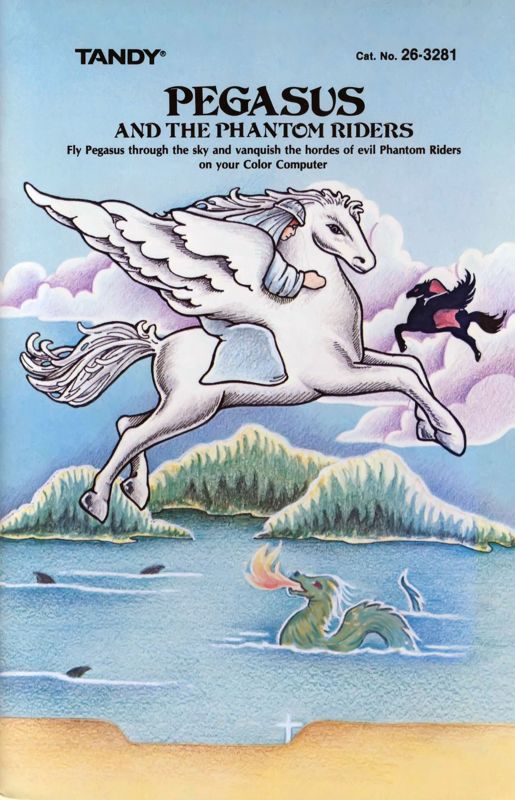
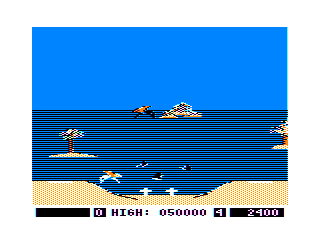
Pegasus and the Phantom Riders builds upon the foundational mechanics of the arcade classic Joust, delivering a familiar yet distinct aerial combat experience. Players control the winged steed Pegasus, using precise flapping and diving motions to position themselves beneath the ghostly riders. The core loop revolves around timing your ascents and descents so that your hooves connect just as the Phantom Riders hover above. When successful, the rider tumbles toward the ground, planting a temporary grave marker upon landing.
(HEY YOU!! We hope you enjoy! We try not to run ads. So basically, this is a very expensive hobby running this site. Please consider joining us for updates, forums, and more. Network w/ us to make some cash or friends while retro gaming, and you can win some free retro games for posting. Okay, carry on 👍)
What sets Pegasus and the Phantom Riders apart is the resurrection mechanic: if a fallen rider’s grave marker remains undisturbed, it transforms into a carnivorous plant that can spring back to life. This dynamic forces players to balance offensive strikes with defensive clean-up, ensuring that downed foes don’t re-emerge from the soil. Delaying or ignoring these markers quickly fills the screen with new threats, ratcheting up the challenge as waves progress.
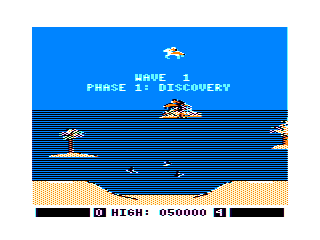
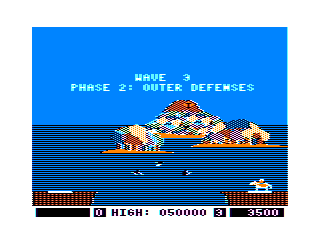
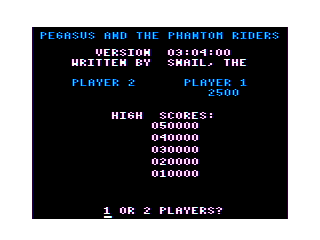
The game unfolds across three distinct phases, each comprised of multiple waves that escalate in intensity. Phase one introduces only Phantom Riders flapping in from the distant island, while subsequent phases layer in environmental hazards like fireballs and rising sea levels. In the final showdown, players must dodge fireballs, knock out riders, uproot dangerous plants, and avoid drowning if Pegasus plunges into the churning ocean. Cooperative and duel modes support two players, adding a competitive edge or a shared goal of purging the skies together.
Graphics
Pegasus and the Phantom Riders employs a clever quasi-3D effect that underscores the sense of depth as enemies emerge from the phantom island on the horizon. Sprite scaling gives the impression of fighters growing larger as they approach, while subtle background parallax layers—rolling waves, distant ruins, and shifting clouds—deepen the immersive quality of each stage. The transition from deep blue waters to craggy island peaks feels dynamic and helps communicate player progression.
The character and enemy designs lean into a high-contrast palette: the brilliant white of Pegasus’s wings pops against the spectral grays and purples of the Phantom Riders. Animation frames are smooth for key actions—flapping wings, hoof strikes, and riders tumbling through the air—but a few secondary effects, like fireballs and plant snaps, feel slightly dated by modern standards. Still, in the context of its retro-inspired aesthetic, these small quirks enhance the game’s charm rather than detract.
Particle effects are simple yet effective. Dust clouds bloom when riders hit the ground, and water splashes shimmer briefly when Pegasus dips too low. Grave markers sprout with a cartoonish “poof,” signaling the imminent threat of plant revival. These audio-visual cues are critical, helping players rapidly identify priorities in the heat of battle. While not pushing cutting-edge hardware, the graphics strike a harmonious balance between clarity and stylized fantasy.
Story
Pegasus and the Phantom Riders frames its action within a loose mythological premise: players are entrusted with guiding the divine horse Pegasus on a quest to purge malevolent spirits swarming from a phantom island. Though there is no sprawling narrative text or lengthy cutscene, the progression through increasingly hazardous skies conveys an organic story of escalation and confrontation. Each level feels like a chapter in your journey toward the heart of the island’s curse.
The Phantom Riders themselves are shrouded in mystery. Their spectral armor and tormented cries hint at a tragic backstory left deliberately vague, inviting players to project their own interpretations onto the conflict. Are these lost souls seeking redemption? Are they guardians of some hidden treasure? The game never spells it out, but the sense of an ancient curse imbues each wave with thematic weight.
Inter-player dynamics further enrich the narrative when two people join forces. Cooperative mode encourages teamwork to manage multiple threats, while duel mode transforms every encounter into a mythical contest of aerial might. These social dimensions provide emergent storytelling: tales of heroic saves, back-to-back knockouts, and comical drownings become the legends players share long after the console is off.
Overall Experience
Pegasus and the Phantom Riders offers a tightly tuned action experience that rewards precision, situational awareness, and split-second decision-making. Newcomers will appreciate its straightforward controls—flap, dive, and attack—while veteran players can master risk-reward patterns of grave-marker management and enemy prioritization. The difficulty curve is steady, with each phase introducing a fresh hazard to keep veterans on their hooves.
Replay value stems from both the varying wave configurations and the choice of single-player versus two-player modes. Speedrunners will find time trials to be an enticing challenge, aiming to clear all phases before Pegasus’s stamina bar depletes. Conversely, casual players can savor cooperative play and enjoy the thrill of synchronized hooves as they clear screen after screen of shimmering foes.
In an era flooded with sprawling open worlds and branching narratives, Pegasus and the Phantom Riders shines by embracing its arcade roots. It distills conflict into concise, action-packed sessions that can be enjoyed solo or with a friend. If you’re seeking a retro-inspired shooter with mythic flair, tight mechanics, and a gradual ramp in challenge, this title is well worth a gallop into the phantom skies.


Reviews
There are no reviews yet.