 Retro Replay Retro Replay gaming reviews, news, emulation, geek stuff and more!



Retro Replay Review
Gameplay
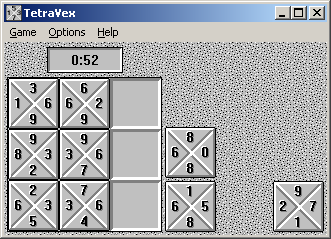
TetraVex presents a deceptively simple premise: you have a blank 2D grid—by default 3×3—and a shuffled set of numbered tiles. Each tile bears four numbers, one on each compass direction, and your objective is to place every tile so that its numbers match those of its neighboring tiles. With one tile for every grid position and a unique correct arrangement, the challenge comes from deducing where each piece belongs in the grand scheme of the puzzle.
(HEY YOU!! We hope you enjoy! We try not to run ads. So basically, this is a very expensive hobby running this site. Please consider joining us for updates, forums, and more. Network w/ us to make some cash or friends while retro gaming, and you can win some free retro games for posting. Okay, carry on 👍)
The core satisfaction of TetraVex lies in its incremental difficulty. Beginners can start with the classic 3×3 grid to get accustomed to matching numbers, but as you graduate to larger grids—say 4×4 or 6×6—the complexity ramps up quickly. Each additional row and column exponentially increases the number of potential tile permutations, turning what begins as casual tile-matching into a rigorous logical exercise.
Speed is also a factor. Many versions of TetraVex include a timer that tracks how long you take to solve the puzzle. This adds replay value for those who enjoy chasing personal bests or competing against friends. Whether you’re a casual player looking for a short mental workout or a puzzle aficionado striving for the optimal solution, TetraVex’s matching mechanics deliver a satisfying blend of strategy and pattern recognition.
Graphics
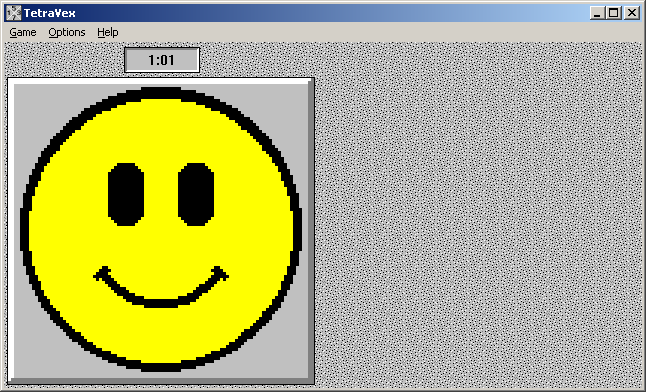
TetraVex’s visuals are clean and functional, reflecting its heritage as part of the Microsoft Entertainment Pack 3 and later the Best of Microsoft Entertainment Pack. The tiles are rendered in sharp 2D graphics, with large, legible numerals and color-coded borders that help you quickly distinguish edges and corners. This simplicity ensures that the interface remains uncluttered and that the focus stays on puzzle-solving rather than flashy animations.
Although the game’s aesthetic may feel retro compared to modern 3D puzzle titles, its minimalist design is a conscious choice that enhances clarity. By stripping away unnecessary graphical frills, TetraVex directs all attention to the tiles themselves and the numbers they bear. The result is an interface that loads quickly, responds instantly to mouse clicks or taps, and never distracts from the core gameplay loop.
For those playing the independent re-implementation included in Gnome Games, the graphics maintain the same minimalist ethos while integrating smoothly into modern desktop environments. Whether you load TetraVex on a vintage Windows machine or as part of a Linux distribution’s puzzle suite, the straightforward visuals ensure the game remains accessible and visually consistent across platforms.
Story
Unlike narrative-driven titles, TetraVex forgoes a traditional storyline in favor of pure puzzle engagement. There’s no protagonist to guide, no lore to unravel, and no cutscenes to watch—just you, the grid, and the tiles. This absence of narrative can actually be freeing, allowing players to focus entirely on logical deduction without interruption.
Still, there is a historical context that gives TetraVex a subtle backstory: its inclusion in Microsoft Entertainment Pack 3 in the early ’90s, followed by a spot in the Best of Microsoft Entertainment Pack, cements its status as a classic of casual PC gaming. For many players, the game evokes nostalgia for simpler times when puzzle collections were a staple of desktop entertainment.
Moreover, the independent re-implementation in Gnome Games carries on this legacy, bridging generations of puzzle enthusiasts. While there is no overt narrative, the game’s pedigree and its enduring appeal form a meta-story about longevity and timeless design. The tale you’re part of is one of intellectual challenge rather than heroic quests.
Overall Experience
TetraVex shines as a lightweight yet intellectually demanding puzzle that fits neatly into any gamer’s repertoire. Its intuitive drag-and-drop interface and immediate feedback loop make it easy to pick up, while the ever-increasing puzzle size keeps seasoned players engaged. Whether you have five minutes or an hour, the game adapts to your schedule and skill level.
The absence of a formal narrative is balanced by deep strategic depth. Few casual puzzle games can boast a single solution for each tile placement combined with near-infinite permutations of overall layouts. This unique combination ensures that no two play sessions feel identical, and steamrollers through straightforward pattern-matching into genuine deductive reasoning.
With its clean graphics, quick load times, and cross-platform availability—from Microsoft’s original packs to the Gnome Games suite—TetraVex remains an essential title for fans of logic puzzles. It proves that compelling gameplay doesn’t require high-end graphics or elaborate storytelling; sometimes all you need is a simple grid and a set of numbers to puzzle out. For anyone seeking a brain-teasing, pick-up-and-play experience, TetraVex is a timeless classic well worth adding to your library.



Reviews
There are no reviews yet.