 Retro Replay Retro Replay gaming reviews, news, emulation, geek stuff and more!



Retro Replay Review
Gameplay
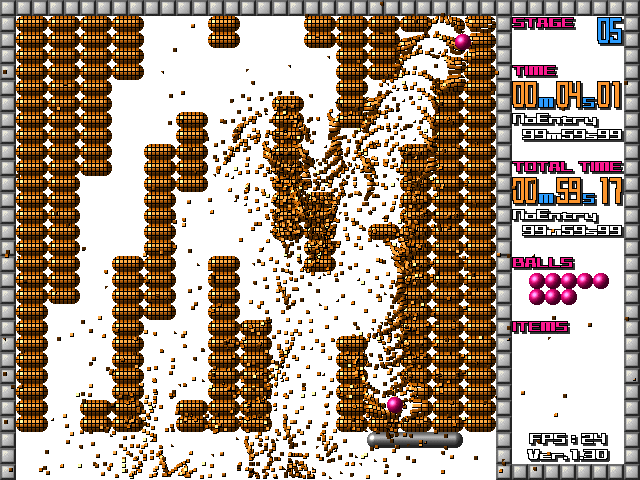
At its core, Block delivers the classic breakout formula with 50 progressively challenging stages, but it spices things up with a handful of clever twists. Unlike traditional brick-smashers, you can inject new balls into the field at any moment, keeping the momentum high and allowing for creative shot chaining. Each stage grants you eight balls, and running out doesn’t send you back to square one—you simply get a fresh set of balls to tackle the same level until you clear it.
(HEY YOU!! We hope you enjoy! We try not to run ads. So basically, this is a very expensive hobby running this site. Please consider joining us for updates, forums, and more. Network w/ us to make some cash or friends while retro gaming, and you can win some free retro games for posting. Okay, carry on 👍)
The pacing of the game is particularly engaging thanks to the variable ball speed mechanic. Balls accelerate as they near the bottom of the screen and decelerate near the top, giving you greater control over timing and angle. You can also lower the paddle by holding the right mouse button and release it to “whack” the ball, propelling it with extra force. This subtle but satisfying trick rewards precise timing and adds an extra layer of strategy.
Adding depth to the gameplay are the numerous brick types and power-ups scattered throughout the stages. From blue bricks requiring two hits, to magnetic bricks that repel balls, and basket bricks that can only be hit from above, each element forces you to adapt your tactics on the fly. Red bricks drop power-ups—everything from tiny balls that make breaking bricks harder, to infinite-ball pickups—turning each stage into a mini-puzzle where planning and reflexes go hand in hand.
Graphics
Block opts for a clean, minimalist aesthetic that keeps the focus firmly on the action. The bricks are color-coded for instant recognition—yellow for standard bricks, gray for unbreakable barriers, and so forth—while power-up icons are easy to distinguish at a glance. This clear visual language prevents confusion, even in levels bursting with multiple brick varieties.
Animations are smooth and fluid, from the satisfying shatter of bricks to the magnetic ripple effect around specialized blocks. The paddle’s springback motion is animated crisply, making the “whack” maneuver feel weighty. Combined with subtle particle effects when balls collide or bricks explode, the presentation feels polished despite its simplicity.
The UI is unobtrusive yet informative. A small timer, ball counter, and stage indicator occupy the screen corners, leaving ample room for uninterrupted gameplay. Leaderboard notifications slide in tastefully, reminding you of the top 10 times without breaking immersion. Overall, the visuals strike a careful balance between functional clarity and vibrant, arcade-style fun.
Story
As a breakout-style game, Block doesn’t weave a deep narrative; instead, it focuses on pure arcade pleasure. There’s no grand plot or cast of characters—each stage is simply another test of your precision and speed. For fans of storytelling, this might feel bare-bones, but it also means there’s no barrier to entry: you launch the game, pick a stage, and dive right into the action.
That said, the progression from stage to stage does create a light sense of journey. As you advance, new brick types and power-ups are introduced in a measured way, so you feel a steady sense of discovery. The informal “lore” lies in learning how each brick behaves and mastering the interplay between gravity flips, magnetic repulsion, and high-speed ricochets.
Ultimately, the lack of a traditional story becomes part of the charm. Block is designed for quick bursts of gameplay, and it succeeds by delivering clear objectives and measurable goals (namely, shaving seconds off your stage completion times). If you’re looking for narrative depth, you may be left wanting, but if you just want to sharpen your reflexes and puzzle-solving skills, Block has you covered.
Overall Experience
Block strikes an excellent balance between casual accessibility and competitive depth. Its infinite retry system means you’re never stuck on a frustrating checkpoint, while the stage-specific top 10 leaderboard injects a healthy dose of competition. Chasing your friends’ times—or better yet, outpacing your own personal best—gives the game impressive replay value.
The blend of physics-driven ball speed, paddle mechanics, and varied brick behaviors keeps each stage feeling fresh. Even after clearing the first 20 stages, you’ll still encounter surprises—whether it’s a blue-ball-brick spewing an endless stream of balls, or a gravity-flipping power-up that forces you to rethink every shot. These unique elements stop the gameplay loop from feeling repetitive.
For anyone seeking a pick-up-and-play arcade experience, Block is a solid choice. It’s ideal for short, focused sessions, but deep enough to keep you coming back for leaderboard bragging rights. Simple in concept yet enriched by its original twists, this breakout game manages to stand out in a crowded genre and promises hours of brick-busting fun.


Reviews
There are no reviews yet.