 Retro Replay Retro Replay gaming reviews, news, emulation, geek stuff and more!



Retro Replay Review
Gameplay
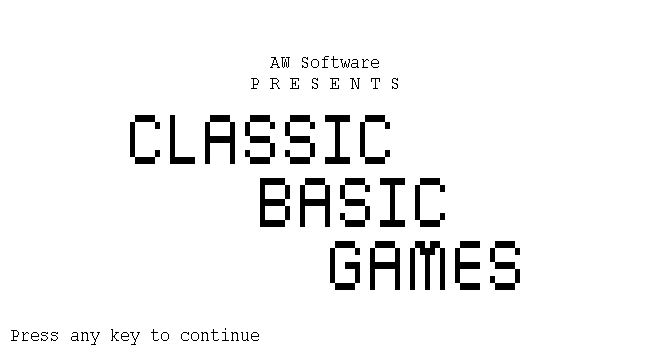
Classic BASIC Games centers on a collection of text-driven and puzzle-based titles that first captivated mainframe users in the 1960s and 1970s. From Conway’s Game of Life, which unfolds as a zero-player simulation, to the resource-management challenge of Hamurabi, the compilation offers a strikingly varied gameplay palette. You’ll find yourself switching between planning kingdom economics one moment and navigating a dark cave in Hunt the Wumpus the next—all from within the same emulator interface.
(HEY YOU!! We hope you enjoy! We try not to run ads. So basically, this is a very expensive hobby running this site. Please consider joining us for updates, forums, and more. Network w/ us to make some cash or friends while retro gaming, and you can win some free retro games for posting. Okay, carry on 👍)
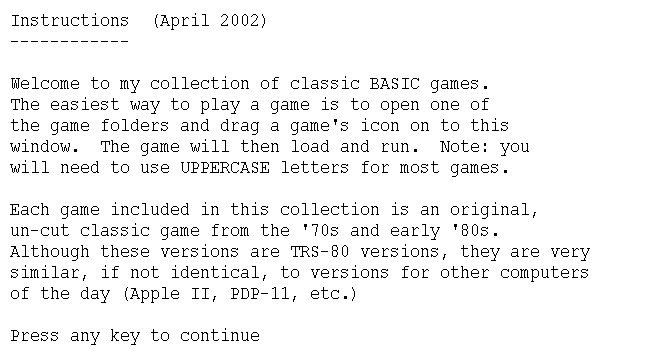
At the heart of the package is a faithful TRS-80 Level II emulator running native BASIC code. This means you’re not just playing frozen executables; you can step into the code itself. If you’re inclined to tweak game logic, add features, or trace through each line as it executes, the environment encourages hands-on experimentation. Beginners will appreciate the clear prompts and simple inputs, while hobbyist programmers will relish the chance to debug and extend vintage listings.
Many of the included programs—like Lunar Lander’s sim-style thrust controls and Star Trek’s text-map navigation—offer surprisingly deep mechanics given their minimalist presentation. Towers of Hanoi challenges your planning skills, and Eliza engages in free-form conversation that hints at early AI. The sheer breadth of genres—from strategic simulations to conversational experiments—makes every session feel fresh, even if the graphics never evolve beyond text.
Graphics
Graphically, Classic BASIC Games wears its era on its sleeve. There are no high-resolution textures or dynamic lighting effects—only crisp ASCII characters and simple line drawings. Games like Towers of Hanoi use numeric displays to represent disks, while Hunt the Wumpus relies on brief text descriptions to set the scene. It’s spartan by modern standards, but that austere presentation is part of the charm.
Some titles include rudimentary ASCII art intended for dot-matrix printer output—tiny illustrations that reproduce on paper for a tactile memento of your gameplay. These printer listings, drawn from David Ahl’s Creative Computing magazine, underscore the historical context and offer a fun throwback for collectors. If you decide to port the listing to a modern terminal, you’ll find lines of code sprinkled with “PRINT” statements that carefully craft each on-screen shape.
Although there’s no sprite animation or palette work, the emulator allows slight CRT-style artifacts and refresh cycles that faithfully mimic the original TRS-80 experience. This retro fidelity might not impress those seeking slick visuals, but for retro enthusiasts it offers an authentic window into a bygone era of computing, where every character on the screen was a glimpse into the programmer’s mind.
Story
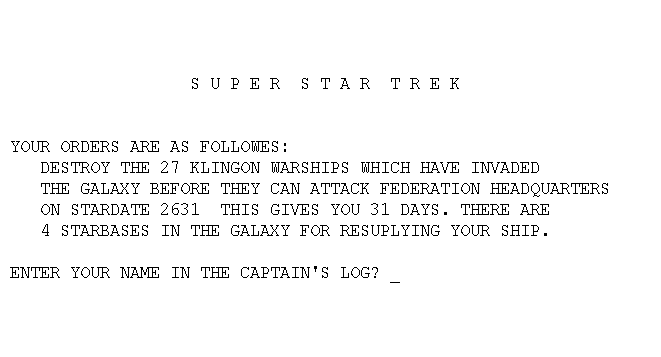
Classic BASIC Games does not present a single, overarching narrative—instead, each game tells its own micro-story. In Star Trek, you patrol quadrants to find Klingon ships, weaving a simple space opera out of text prompts and user commands. Eliza, on the other hand, simulates a Rogerian psychotherapist, generating responses that feel surprisingly personal despite being driven by pattern-matching routines.
Other titles lean heavily on abstract scenarios: Conway’s Game of Life creates emergent “storylines” as patterns evolve generation by generation, while Hamurabi places you in the role of an ancient ruler balancing grain, land, and population. In Hunt the Wumpus, you stalk a fearsome creature in a dark cave—your only clues are the occasional “breeze” of a nearby pit or the ominous “smell” of the Wumpus itself. Each program’s narrative unfolds through minimal text, leaving much to your imagination.
Although there’s no integrated storyline tying the suite together, the historical documentation and original listings provide a meta-narrative. By browsing the code printed in Creative Computing magazine, you gain insight into the minds of early hobbyists and discover the creative constraints that shaped these pioneering programs. The compilation thus becomes as much a living museum exhibit as it is a collection of fun diversions.
Overall Experience
Classic BASIC Games shines as both a nostalgic time capsule and an educational playground. Booting up the TRS-80 emulator feels like stepping into a university computer lab circa 1978, complete with blinking cursors and line numbers. Whether you’re chasing patterns in Life or negotiating grain prices in Hamurabi, you’ll appreciate the purity of design and the emphasis on player imagination.
For modern gamers accustomed to polished user interfaces and seamless tutorials, the lack of hand-holding may feel daunting at first. There is no in-game hint system, and error messages can be cryptic. However, the flip side is equally compelling: by reading and modifying the source listings, you gain a rare, hands-on lesson in programming fundamentals. This collection is as much a teaching tool as it is a source of entertainment.
Ultimately, Classic BASIC Games is best suited for retro computing enthusiasts, aspiring programmers, and anyone curious about the origins of interactive software. It’s not a flashy blockbuster release, but its authenticity and breadth of simple yet addictive gameplay make it a unique addition to any library. If you’ve ever wondered how far we’ve come since the dawn of home computing—or if you simply want to tinker with code that helped define an era—this collection delivers a deeply rewarding experience.



Reviews
There are no reviews yet.