 Retro Replay Retro Replay gaming reviews, news, emulation, geek stuff and more!


Retro Replay Review
Gameplay
Cloak of Darkness offers a tightly focused interactive fiction experience that revolves around a single, elegantly designed puzzle. The core mechanics require you to navigate through three interconnected rooms—the rain-slicked foyer of an opera house, an antechamber adorned with golden fixtures, and the private cloakroom—while managing just three tangible objects: a dark velvet cloak, a brass wall-mounted hook, and an enigmatic message. The simplicity of the setup belies the careful sequencing required to succeed; divesting yourself of the soaked garment at precisely the right moment and place is crucial.
(HEY YOU!! We hope you enjoy! We try not to run ads. So basically, this is a very expensive hobby running this site. Please consider joining us for updates, forums, and more. Network w/ us to make some cash or friends while retro gaming, and you can win some free retro games for posting. Okay, carry on 👍)
What distinguishes the gameplay here is its emphasis on precise command inputs and spatial logic. Each move must respect the order of your objectives: enter, remove, hang, retrieve. Any deviation from this sequence brings you back to the beginning, reinforcing the puzzle’s tight design. While some players may find the repetition frustrating, others will appreciate the rigor and clarity with which Cloak of Darkness teaches puzzle-solving fundamentals.
Despite its brevity, the game does a remarkable job of maintaining tension. A sense of urgency is conveyed through descriptive text and the looming presence of the rain outside. The demo’s design encourages experimentation—trying different ways to hang the cloak, examining every object in each room, and testing verb-noun combinations in the parser. For fans of classic text adventures, this distilled format serves as both a nostalgic return to roots and a masterclass in minimalist puzzle construction.
Graphics
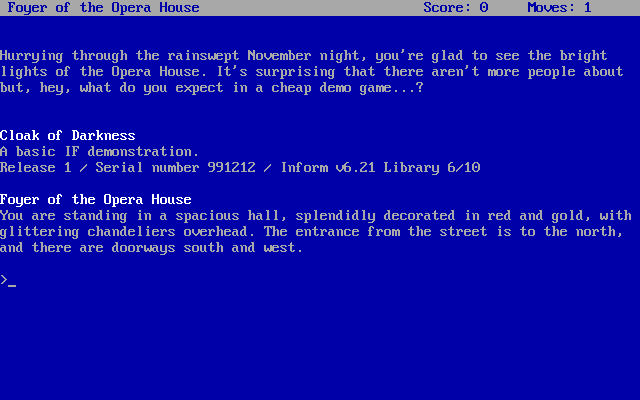
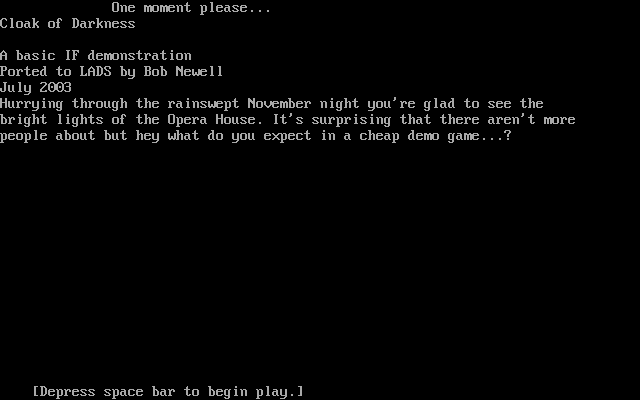
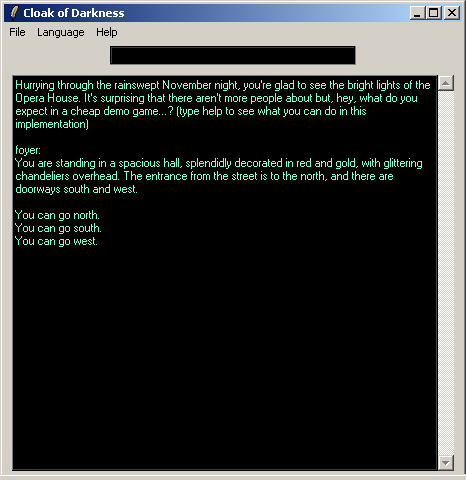
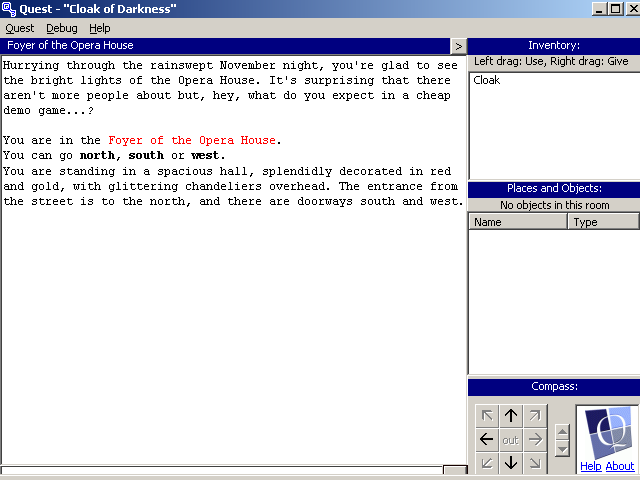
As a purely text-based interactive fiction title, Cloak of Darkness foregoes traditional graphical elements in favor of richly descriptive prose. There are no sprites, textures, or dynamic camera angles—every detail must be envisioned by the player’s imagination. This minimalism keeps the focus firmly on the narrative and the puzzle, allowing you to paint the gloomy opera house in your mind’s eye.
Though there are no images, the game’s presentation still manages to evoke a strong atmosphere. Line breaks, paragraph pacing, and occasional emphasis on key sensory details (the hush of the plush seats, the distant drip of water) serve as the game’s visual palette. For those accustomed to modern point-and-click adventures, the absence of on-screen visuals might feel like a leap of faith; yet many will find the immersive descriptions more evocative than any pre-rendered backdrop.
The user interface is straightforward and functional. A clean text window awaits your commands, with straightforward prompts guiding you through each action. While some may miss companion soundtracks or animated effects, the stark presentation aligns with the game’s demo purpose—highlighting the power of text alone to create engagement. In this environment, your own interpretive faculties become the graphics engine.
Story
Set against the backdrop of a rainy November evening, the narrative premise of Cloak of Darkness is simple but atmospheric. You burst into an opulent opera house, dripping wet, determined to shed your gloomy velvet cloak before an expectant emissary can hand you an important missive. The game stakes hinge on timing and decorum: drop the cloak, hang it, and then claim the message in the correct order or risk missing your chance entirely.
While there are no elaborate subplots or supporting characters, the sparse storyline works in service of the game’s demonstrative aims. Each line of text is carefully crafted to illustrate how different interactive fiction systems handle description, conditional logic, and parser feedback. Though some players may yearn for character backstories or branching dialogue, the austere narrative underscores the project’s educational mission.
Moreover, the theatrical setting amplifies the drama of an otherwise straightforward transaction. The golden fixtures of the antechamber, the hush of velvet curtains, and the distant rumble of thunder all contribute to a vivid sense of place. Even with just three rooms and a single puzzle, Cloak of Darkness demonstrates that a compelling narrative hook need not be sprawling—it simply must be thematically coherent and tightly woven into the gameplay.
Overall Experience
Cloak of Darkness is best viewed as a specialized showcase rather than a full-fledged commercial release. Its brevity and laser-focused puzzle design make it an ideal starting point for aspiring interactive fiction authors who want to compare systems like Inform, TADS, Hugo, and more. The annotated source codes included in various formats reveal how each environment approaches room definitions, object properties, and parser handling—an invaluable resource for developers deciding which tool fits their style.
For the casual player expecting hours of exploration and multiple branching paths, the experience may feel too concise. Yet for those with an appreciation for minimalism and puzzle elegance, Cloak of Darkness delivers a compact thrill. The game can be completed in under ten minutes once you understand the sequence, but that first successful run carries a satisfying sense of discovery and accomplishment.
Ultimately, this demo stands as both a playable narrative and a technical comparison chart in interactive form. It succeeds brilliantly on both fronts: as a mood-setting one-puzzle vignette, it intrigues and engages; as an educational artifact, it illuminates the strengths and quirks of various IF development tools. Anyone looking to dip their toes into text adventures or to evaluate authoring systems will find Cloak of Darkness an indispensable starting point.



Reviews
There are no reviews yet.