 Retro Replay Retro Replay gaming reviews, news, emulation, geek stuff and more!

Retro Replay Review
Gameplay
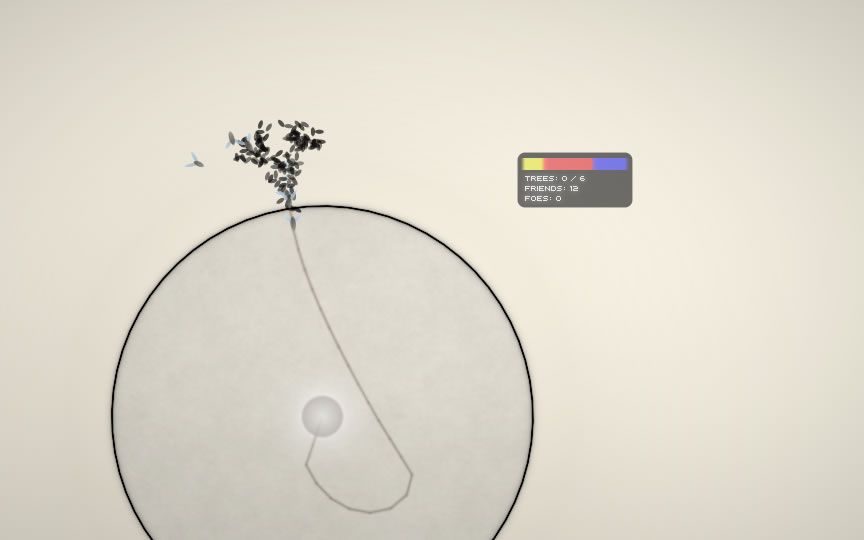
Dyson unfolds as a minimalist real-time strategy experience built around the simple yet addictive mechanic of growing and directing self-replicating seeds. Players begin on a lone asteroid with a single “seed,” which quickly sprouts into a Dyson tree—the primary resource generator. As these trees mature, they produce small insect-like seeds that orbit the asteroid and form the backbone of your expansion efforts.
(HEY YOU!! We hope you enjoy! We try not to run ads. So basically, this is a very expensive hobby running this site. Please consider joining us for updates, forums, and more. Network w/ us to make some cash or friends while retro gaming, and you can win some free retro games for posting. Okay, carry on 👍)
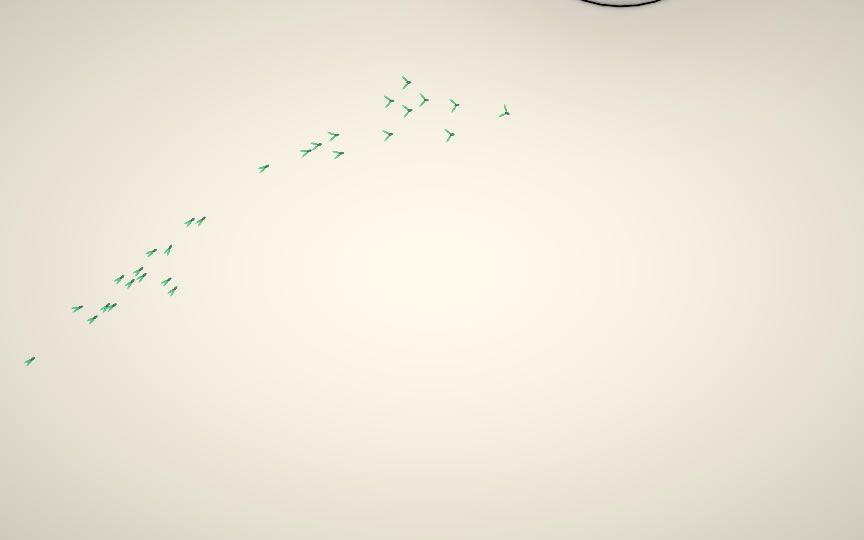
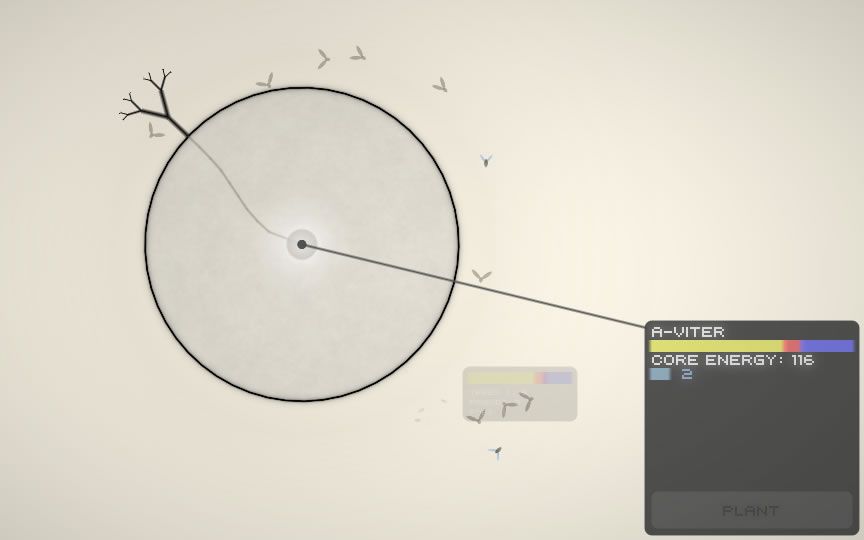
Colonization is as intuitive as it is strategic: select the number of seedlings you wish to dispatch and draw an arrow toward a target asteroid. Your fleet of seeds then swarms out, engaging any opposing seeds in battle, eradicating enemy trees, and attempting to crack the asteroid’s core to establish your own colony. Timing and resource allocation are vital, since each asteroid has a different color-based composition—energy, strength, and speed—that dictates how quickly it produces new seeds.
One of Dyson’s standout features is its seamless zoom functionality, allowing you to survey the entire asteroid belt or hone in on a solitary seed for micromanagement. This fluid camera control supports both high-level planning and close-quarters skirmishes, ensuring that you never lose sight of the broader map or the critical details of an individual attack. Meanwhile, some asteroids will eventually drain and become unusable, forcing you to weigh the risk and reward of every conquest.
Opponents in Dyson are relentless, each deploying unique seed shapes that influence their performance in battle. Victory depends on balancing offense and defense across multiple fronts—dividing your seedlings smartly between expansion and protection, reacting to enemy swarms, and positioning your trees on high-yield asteroids. Every decision feels meaningful in this tight, elegantly designed territory-control game.
Graphics
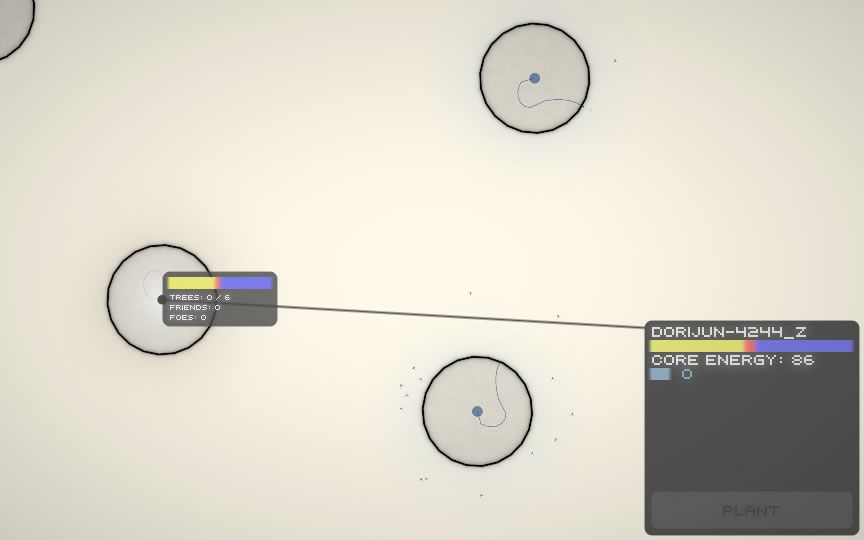
Visually, Dyson opts for a strikingly abstract style that resembles molecular structures more than traditional space graphics. Each asteroid appears as a cluster of colorful nodes, with glowing seeds orbiting like electrons around a nucleus. The result is a clean, organic look that immediately sets Dyson apart from more literal sci-fi strategy titles.
Thanks to procedural generation, no two asteroid belts look alike. The arrangement, color balance, and movement patterns are all created on the fly, lending each playthrough a fresh, dynamic quality. Even the tiny seed sprites carry distinct shapes and behaviors per team, turning each skirmish into a subtly different visual dance of geometry and color.
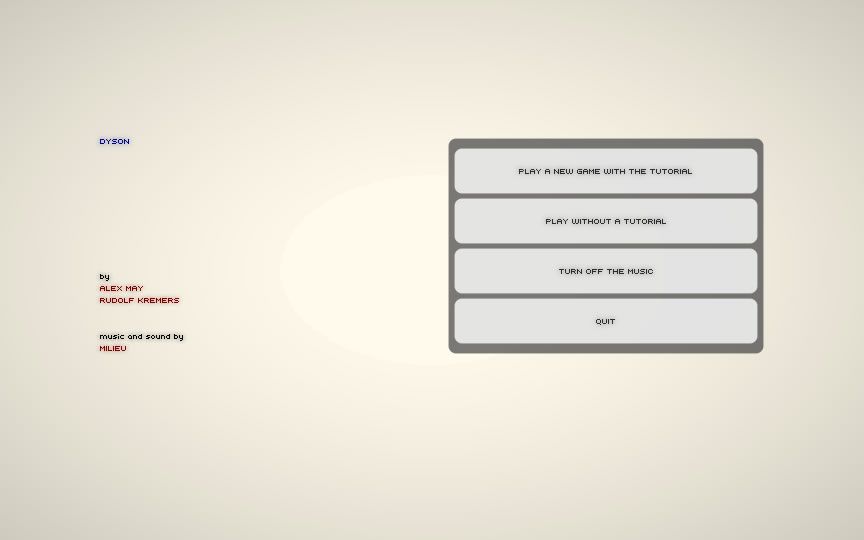
While the UI is deliberately sparse—comprising just the essentials such as your seed count, a minimal menu bar, and zoom controls—it never feels intrusive. The font and palette choices remain consistent and unobtrusive, allowing the focus to stay squarely on the animated nodes and lines that represent your growing empire. In a genre often loaded with flashy effects, Dyson’s restrained aesthetic is both refreshing and functional.
Performance is solid even on modest hardware, thanks to the low-overhead, procedurally drawn visuals. Animations are smooth, and the camera transitions glide effortlessly between zoom levels. Overall, the graphics do more than just look good—they reinforce the game’s core themes of growth, connection, and rivalry in a minimalistic cosmic garden.
Story
Dyson forgoes a traditional narrative in favor of emergent storytelling driven by gameplay. There is no spoken lore or text-heavy backstory—instead, the “story” unfolds through your strategic conquests and the silent struggle for dominance across the asteroid field. Each asteroid’s unique name and color combination add a hint of personality, suggesting fleeting lives and ecosystems that you swiftly colonize and then abandon.
This stripped-down approach places you in the role of a cosmic gardener, tasked with seeding life across barren or contested rocks. The absence of a scripted storyline invites you to create your own narrative arcs: might your initial foray into a high-energy asteroid lead to a surprise counterattack? Will a drained planet become the turning point of a comeback? These micro-stories emerge naturally from the mechanics.
Although Dyson lacks cutscenes or characters, the interplay of resource scarcity, territorial skirmishes, and ever-dwindling asteroids builds dramatic tension. Over time, you develop personal legends—“the time I held off two opponents with a trickle of seeds”—that outshine any prewritten plot. In this way, Dyson’s narrative strength lies in the moments you carve out yourself.
Overall Experience
Dyson offers a remarkably polished taste of what would later evolve into Eufloria. As a free competition entry, it stands on its own as a concise, compelling strategy game that rewards careful planning and quick reactions. Each session can be over in minutes or extend into a drawn-out battle of attrition, making it perfect for both bite-sized play and longer strategic sessions.
The learning curve is gentle but satisfying: basic controls are easy to master, yet the depth emerges as you juggle multiple fronts, adapt to varied asteroid compositions, and face off against opponents with different seed shapes. There’s a real sense of progression as you unlock new tactics and learn to read the map’s color-coded clues about production rates.
Despite its age and humble origins, Dyson’s elegant design and procedural creativity still feel fresh today. It’s an ideal introduction to the world of Eufloria for newcomers, and a nostalgic reminder of clever indie strategy for longtime fans. If you’re seeking a focused, minimalist challenge that blends organic visuals with competitive depth, Dyson is well worth your time.
Overall, Dyson proves that great strategy need not come with complex menus or hyper-realistic graphics. Its core gameplay loop—grow, send, conquer—is timeless, and its aesthetic choices reinforce a unified vision of quiet, molecular colonization. For anyone curious about procedural art in games or looking for a free yet fully formed strategy experience, Dyson remains a hidden gem.


Reviews
There are no reviews yet.