 Retro Replay Retro Replay gaming reviews, news, emulation, geek stuff and more!


Retro Replay Review
Gameplay
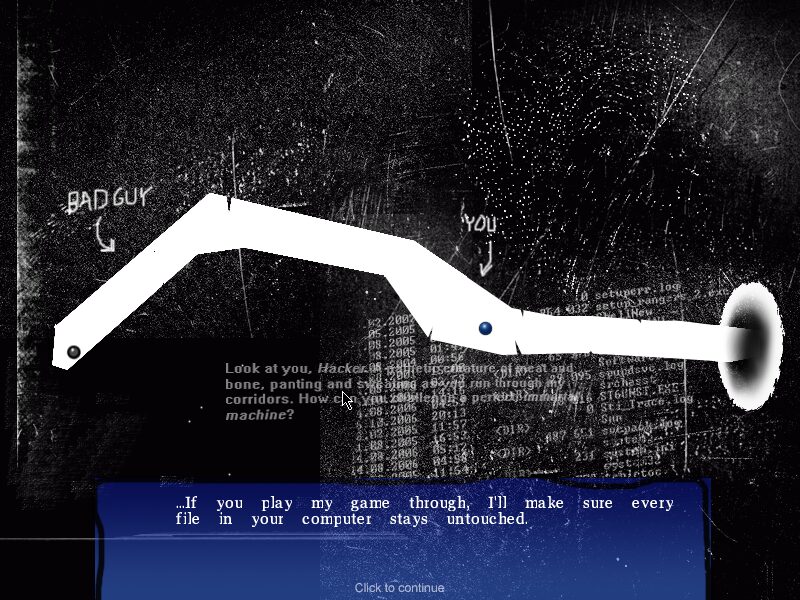
From the moment you launch Forbidden.exe, the core mechanic is deceptively simple: guide a metal orb through an ever-tightening labyrinth using only your mouse. The narrow paths demand precision and steady hands, as even the slightest brush against the walls results in a sharp feedback sound that jars you back into caution. What begins as a test of dexterity quickly evolves into a psychological trial, as each mistake is accompanied by an unsettling audio cue that ratchets up the tension.
(HEY YOU!! We hope you enjoy! We try not to run ads. So basically, this is a very expensive hobby running this site. Please consider joining us for updates, forums, and more. Network w/ us to make some cash or friends while retro gaming, and you can win some free retro games for posting. Okay, carry on 👍)
As you progress through the levels, the game introduces a relentless pursuer—a second sphere that trails your movements at an almost glacial pace. Initially you dismiss it as a gimmick, but after a few near misses you realize that one wrong turn can trigger a sudden acceleration, transforming the chase from a mild annoyance into a heart-pounding ordeal. This dynamic cat-and-mouse setup ensures that no two runs feel the same, as the stalking orb responds to your errors with punitive speed bursts.
Adding to the unease is the game’s playful suggestion that it can tamper with your computer’s file system. Brief, ominous disclaimers hint at deeper consequences if you fail to complete a maze in time. While these warnings are ultimately symbolic, they feed into the game’s overarching theme of forbidden knowledge and escalate the stakes beyond mere in-game failure. The result is a gameplay loop that blends precision control, adaptive challenge, and meta-horror suspense into a uniquely disquieting experience.
Graphics
Visually, Forbidden.exe opts for gritty, low-fi aesthetics that evoke the feeling of stumbling across a corrupted VHS tape. The mazes are rendered in stark monochrome tones, punctuated by flickering neon highlights that cast long, jittering shadows. This minimalist palette focuses your attention on the orb and its pursuer, while the rough textures and grainy overlay reinforce the sense that you’re trespassing into forbidden territory.
The UI elements reinforce the game’s unsettling mood: warning messages appear in garish red text with stuttering animations, as if the program itself is glitching. Subtle distortions—screen wobble, intermittent static bursts—keep you on edge, never quite certain whether what you’re seeing is part of the environment or a visual artifact created to mess with your perception. It’s a masterclass in atmospheric design, using restraint and imperfection to amplify unease.
Despite its deliberately archaic visuals, the game runs smoothly on most systems, with responsive mouse input and quick level transitions. The minimalist approach means there’s no extraneous graphical clutter—every line, shadow, and particle effect serves to heighten suspense. Forbidden.exe proves that sometimes the most effective horror visuals aren’t the most detailed, but those that leave room for your imagination to fill in the blanks.
Story
There’s no traditional narrative in Forbidden.exe, but the unfolding layers of meta-context create a story all their own. The game opens with a cryptic disclaimer warning you against exploring certain directories on your computer—an introduction that frames the entire experience as an illicit digital artifact. Suddenly, the feeling of being an unwelcome intruder sets the tone for what follows.
As you delve deeper into the mazes, brief textual interludes appear between levels: fragmented messages, corrupted log entries, and half-erased warnings. These snippets hint at previous players who dared to push the executable too far, only to vanish without a trace. The sense of a silent, unseen antagonist grows with each revelation, turning every puzzle completion into a hollow victory weighed down by unanswered questions.
While the story remains deliberately vague, this ambiguity is part of the appeal. You become an active participant in piecing together the game’s dark mythology—wondering whether the threats to your file system are mere theatrics or something more sinister. The lack of explicit exposition compels you to project your own fears onto the experience, making the narrative as much about your imagination as about the code on screen.
Overall Experience
Forbidden.exe delivers a pulse-raising blend of precision puzzle gameplay and psychological horror. The seamless fusion of mechanical challenge with meta-narrative tension creates an atmosphere that lingers long after you close the program. It’s not for the faint of heart, but for players who relish being genuinely unsettled, it offers an unforgettable ride.
The game’s brief runtime—typically a couple of hours for a first playthrough—makes it a concise yet impactful experience. Replayability comes from chasing faster completion times and uncovering additional lore fragments tucked away in hidden corridors. For those seeking a bite-sized horror puzzle with a unique twist, Forbidden.exe is well worth the price of admission.
Ultimately, Forbidden.exe proves that innovation in indie games often lies in how mechanics and narrative coalesce. By turning a simple maze into a vessel for creeping dread, the developers have crafted a title that feels as much like an experimental art piece as a traditional video game. If you’re ready to test your nerves and your reflexes in equal measure, prepare to dive into the forbidden.


Reviews
There are no reviews yet.