 Retro Replay Retro Replay gaming reviews, news, emulation, geek stuff and more!
Retro Replay Review
Gameplay
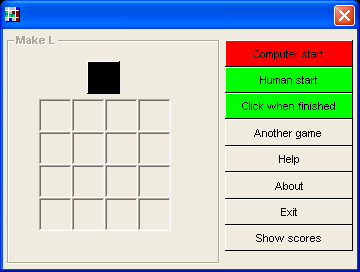
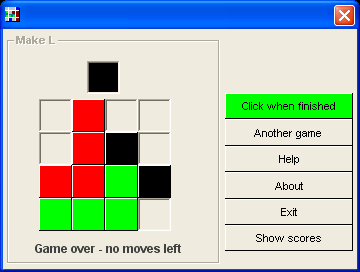
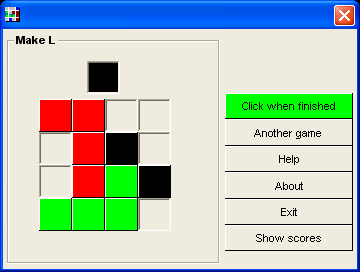
LLs delivers a deceptively simple premise that unfolds into a deep strategic experience. On a compact 4×4 grid, you and the computer each control an L-shaped piece that occupies four contiguous squares. Your objective is straightforward: reposition your L so that your AI opponent has no legal moves left. Despite the modest board size, the shifting patterns create a surprisingly rich puzzle at every turn.
(HEY YOU!! We hope you enjoy! We try not to run ads. So basically, this is a very expensive hobby running this site. Please consider joining us for updates, forums, and more. Network w/ us to make some cash or friends while retro gaming, and you can win some free retro games for posting. Okay, carry on 👍)
To prevent stalemates and open up new tactical possibilities, LLs introduces two blue neutral blocks that you and the AI can place anywhere on the grid. These neutral squares force both players to think beyond just sliding their own L, adding an extra layer of spatial reasoning. Deciding when and where to drop these blocks often determines whether you’ll trap the opponent or accidentally box yourself in.
The turn-based structure encourages careful planning rather than frantic clicking. Each move can dramatically alter the board, so you’ll find yourself weighing offensive and defensive tactics simultaneously. With every match lasting only a few minutes, LLs strikes the perfect balance between quick thinking and long-term strategy, making each session feel fresh and rewarding.
Graphics
LLs opts for a clean, minimalist visual style that prioritizes clarity over flashy effects. The playfield features a crisp grid with bold outlines, ensuring each square is easily distinguishable. Your L-piece and the AI’s counterpart are rendered in vibrant, contrasting hues, while the blue neutral blocks stand out without clashing with the overall palette.
The animations are smooth and purposeful—each slide of an L-piece or placement of a neutral block is accompanied by a subtle glide effect and satisfying click. These small touches lend a tactile feel to the digital board, reinforcing the sense that you’re physically shifting pieces around. Even on lower-end hardware, the game maintains a steady framerate, so strategy remains uninterrupted by technical hiccups.
Backgrounds and menus adhere to the same streamlined aesthetic. A muted backdrop keeps the focus on the grid, while simple icons guide you through settings and tutorials. LLs proves that strong design doesn’t require over-the-top visuals—just thoughtful execution and consistency.
Story
LLs embraces its abstract nature by offering only a light thematic framing rather than a full narrative. You’re cast as a master of spatial manipulation, locked in an intellectual duel with an unyielding AI opponent. This minimalist approach keeps the spotlight squarely on the gameplay mechanics, letting you craft your own stories of triumph and defeat.
Despite the lack of a detailed storyline, the game uses subtle touches—a muted soundtrack, brief text prompts before each match—to suggest you’re competing in a high-stakes arena for tactical dominance. These ambient cues heighten the tension without pulling you away from the core strategic loop. You won’t find cutscenes or character profiles, but LLs doesn’t need them to convey a sense of purpose.
The absence of a conventional plot means that every match writes its own narrative. Sequences of clever traps, near misses, and last-second victories become your personal legends. In a way, LLs turns you into both the strategist and the storyteller, with each game serving as a self-contained chapter in your ongoing cerebral rivalry.
Overall Experience
LLs shines as a compact yet compelling strategy title that rewards thoughtful play. Its elegant rule set and small playfield make it immediately accessible, while the nuanced role of neutral blocks provides depth for those seeking more intricate tactics. Whether you’re new to abstract board games or a seasoned strategist, LLs offers a satisfying mental workout.
Matches are brief enough to fit into short breaks, yet varied enough to invite repeat sessions. The AI presents a steady ramp in difficulty, challenging you to refine your planning and prediction skills. Even when you lose, the clarity of each turn’s consequences makes it easy to learn from mistakes and adjust your approach next time.
Overall, LLs is an excellent addition for anyone who loves pure, distilled strategy. Its minimalist presentation, smooth interactions, and cleverly designed mechanics combine to deliver a polished, addictive experience. If you enjoy games that test your spatial reasoning and keep your mind engaged, LLs is well worth exploring.



Reviews
There are no reviews yet.