 Retro Replay Retro Replay gaming reviews, news, emulation, geek stuff and more!
Retro Replay Review
Gameplay
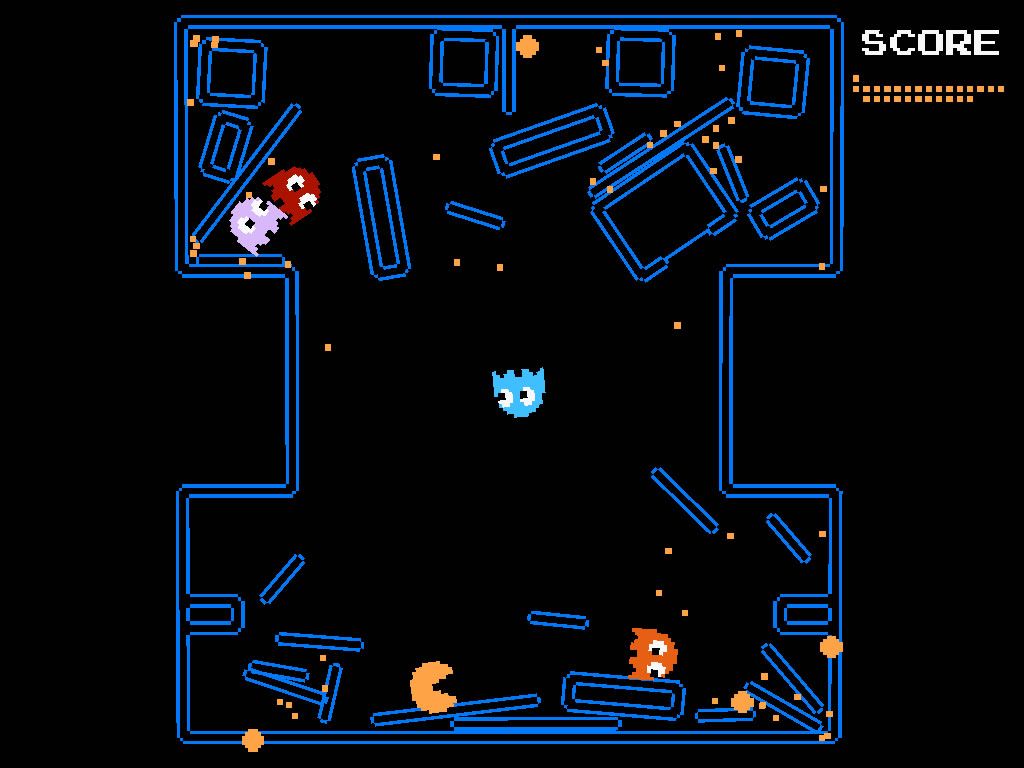
Pac-Man Physics reinvents the classic maze-chase formula by introducing a fully simulated physics engine into every facet of the game. Instead of following a fixed path etched into the maze, Pac-Man, ghosts, pellets, and even walls obey gravity, momentum, and collisions. This dynamic environment means that every playthrough feels unique—pellets can roll away, corners may collapse under impact, and ghosts will bounce unpredictably off both Pac-Man and the environment.
(HEY YOU!! We hope you enjoy! We try not to run ads. So basically, this is a very expensive hobby running this site. Please consider joining us for updates, forums, and more. Network w/ us to make some cash or friends while retro gaming, and you can win some free retro games for posting. Okay, carry on 👍)
The core objective remains the same: clear all the pellets while avoiding ghosts. However, traditional strategies quickly fall apart when a slight nudge sends pellets sprawling or sends walls tumbling. Each level becomes a puzzle in motion, forcing players to adapt on the fly. Timing and precision are still critical, but now so are spatial awareness and an understanding of basic physics principles.
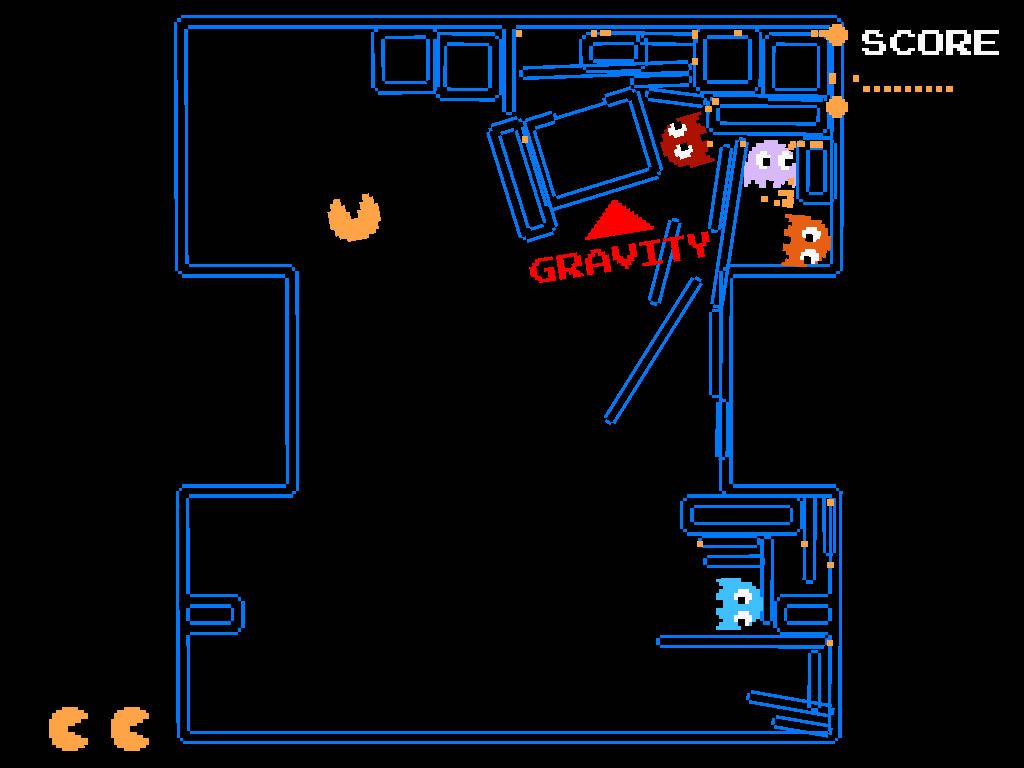
Power pellets add an extra layer of chaos. When consumed, they generate a strong gravity field that pulls every object toward a single point, often sending ghosts—and sometimes Pac-Man himself—hurtling through the maze. This mechanic can be a double-edged sword: a timely power pellet can trap multiple ghosts at once, but mistimed use might hurl Pac-Man straight into danger. Navigating these gravity wells requires quick thinking and a willingness to embrace controlled chaos.
Graphics
Visually, Pac-Man Physics retains the clean, minimalist charm of the original arcade classic while integrating subtle visual cues to highlight its physics-driven mechanics. The maze walls exhibit realistic cracking or shifting when struck with force, and pellets roll or bounce off surfaces rather than simply vanishing. These small touches reinforce the sensation of a world governed by physical laws.
Ghosts retain their iconic color palettes and expressions, but their animations now include elastic squash-and-stretch effects when they collide with obstacles or Pac-Man himself. These playful visuals enhance the sense of weight and momentum, making each encounter feel more impactful. The lighting remains bright and cheerful, ensuring the game’s experimental mechanics never feel too daunting or oppressive.
The user interface is thoughtfully designed to keep the action front and center. Physics indicators—such as small arrows showing gravitational pull directions during power pellet phases—appear only when necessary, ensuring the screen remains uncluttered. Overall, the graphical presentation strikes a fine balance between nostalgia and innovation.
Story
Pac-Man Physics does not attempt to weave an elaborate narrative; instead, the game’s “story” unfolds through emergent gameplay moments. As walls shift and pellets scatter, players craft their own dramatic sequences—narrow escapes, chain reactions of tumbling obstacles, and chaotic ghost pileups. Each session becomes a mini-story driven by chance and player ingenuity.
That said, subtle atmospheric details hint at a larger world. Background tiles occasionally crack or ripple to suggest an unstable environment, and ambient sound effects—rumbling walls, rattling pellets—help build tension. These flourishes imply that Pac-Man is not just eating dots but navigating a maze on the brink of collapse, giving context to the physics mayhem.
Power pellet activation also carries a narrative punch. The sudden gravitational pull often feels like a temporary cosmic shift or a magnetic disruption in the maze’s structure. These brief moments of narrative spectacle remind players that Pac-Man Physics is both a puzzle and a story about order versus chaos.
Overall Experience
Pac-Man Physics offers a refreshing twist on a timeless classic, blending nostalgia with inventive gameplay mechanics. Fans of the original will appreciate the familiar visuals and objectives, while newcomers can enjoy the clever physics-based puzzles. The unpredictable nature of each level ensures high replay value and countless “oh wow” moments.
The learning curve strikes a fair balance: beginners can still clear pellets by cautious exploration, but mastering the physics for high scores or speedruns presents a satisfying challenge. Multiplayer modes or time-attack leaderboards could further enhance this experience, and the foundation is solid enough that such features might be added in future updates.
Ultimately, Pac-Man Physics stands out as both a tribute to the arcade era and a bold experiment in game design. Its engaging blend of chaos, strategy, and emergent storytelling makes it a must-try for puzzle enthusiasts and Pac-Man devotees alike. Whether you’re chasing high scores or simply exploring the maze’s shifting corridors, this title delivers a uniquely memorable journey.



Reviews
There are no reviews yet.