 Retro Replay Retro Replay gaming reviews, news, emulation, geek stuff and more!
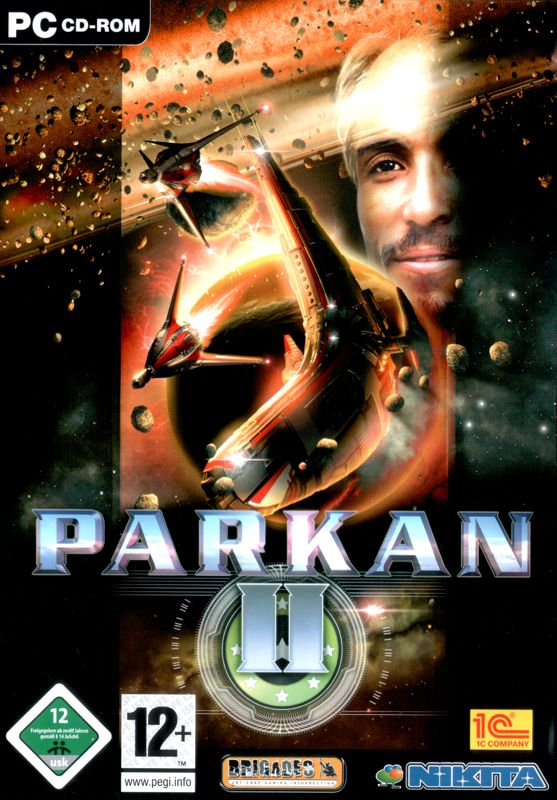


Retro Replay Review
Gameplay
Parkan II delivers a rich blend of space simulation, first-person shooter combat, and role-playing elements that keeps you constantly engaged. From the moment you strap into the cockpit of the Parkan, you’re given full control over navigation, weapons systems, and power management. Intercepting pirate convoys in open space transitions seamlessly into boarding actions and ground-based firefights once you don your battle suit, reinforcing the game’s promise of a “one-ship army” experience.
(HEY YOU!! We hope you enjoy! We try not to run ads. So basically, this is a very expensive hobby running this site. Please consider joining us for updates, forums, and more. Network w/ us to make some cash or friends while retro gaming, and you can win some free retro games for posting. Okay, carry on 👍)
The game world spans several hundreds of solar systems, each containing up to ten planets ripe for exploration. Depending on your standing with the ruling droid clans, you can dock for trade, pick up side missions, or declare full-scale assaults on bases in true FPS style. This non-linear approach means you’re never forced down a single narrative path—if one system proves too hostile, you can always chart a new course, gather resources elsewhere, then return stronger.
Character and ship progression are driven by salvaging loot, trading commodities, and upgrading both your cruiser and your battle suit. Weapons, shields, and propulsion systems can be swapped out for improved versions, while combat drones provide tactical support whether you’re strafing enemy fighters or clearing corridors on the ground. Although managing subsystems takes a bit of learning, the near-identical interface for ship and suit keeps the experience intuitive.
Despite its ambitious scope, Parkan II isn’t without its quirks. The flight model leans toward arcade-style responsiveness rather than hardcore simulation, which some players may find too forgiving or simplistic. Conversely, the first-person shooting can feel a tad floaty compared to dedicated FPS titles. Nevertheless, the hybrid system largely succeeds in delivering a cohesive, satisfying gameplay loop that rewards exploration and experimentation.
Graphics
Visually, Parkan II strikes a balance between expansive starfield vistas and detailed surface environments. Space is dotted with vibrant nebulae, asteroid belts, and distant suns, all rendered in crisp textures that belie the game’s age. When you land on a planet, the topography unfolds with surprising variety: barren deserts, icy plains, and industrial complexes each showcase distinct palettes and architectural styles.
Your ship and suit models are robust, with visible paneling, thrusters, and weapon mounts that reflect the upgrades you install. Explosions and laser volleys light up the darkness of space, while GPU-accelerated particle effects add depth to atmospheric storms and reactor malfunctions. On the ground, muzzle flashes and grenade blasts leave scorch marks on walls, enhancing the visceral feel of each firefight.
That said, the character animations can feel a bit stiff, and NPC facial expressions sometimes lack nuance. Pop-in can occur at longer draw distances, especially in densely populated stations. However, generous draw distances for planetside terrain help preserve immersion when you’re piloting overhead or strafing enemy outposts.
Overall, the graphics hold up well for a title of its era. The stylized art direction avoids photorealism in favor of a crisp, functional aesthetic that ensures you always know what’s happening, whether you’re evading plasma fire or plotting an interstellar jump.
Story
Parkan II’s narrative thrust is rooted in a classic time-travel premise. As the lone pilot of a retired anti-pirate cruiser, you’re thrust seventeen years into the past to investigate a looming catastrophe threatening the colonized reaches of your present. This sense of urgency permeates every sector you visit, whether you’re chasing down leads on a missing science ship or probing the source of a mysterious spatial anomaly.
The war-torn region is dominated by rival clans of autonomous droids, each with its own culture, politics, and hidden agendas. Gaining favor—or igniting full-scale conflict—affects how you access missions, trade goods, and crucial intelligence. Meeting a charismatic clan leader might unlock diplomatic avenues, while burning her supply depot to the ground can open up lucrative salvage runs. This fluid dynamic keeps the story feeling alive and reactive to your choices.
Mission briefings and in-game dialogue flesh out the lore, revealing hints of ancient experiments and corporate cover-ups that tie into the larger mystery. Although cutscenes are sparse, the fractured delivery of narrative through logs, intercepted transmissions, and NPC chatter gives you that satisfying detective-style unraveling. Some players may wish for more polished voice acting or cinematic set pieces, but the core storytelling remains compelling.
By the time you confront the true source of the catastrophe, you’ll have pieced together a web of conspiracies that feels earned. The climax unites your spacefaring and ground combat skills in a final showdown that tests every upgrade and ally you’ve accumulated along the way.
Overall Experience
Parkan II stands out as a niche gem for players who relish genre-blending adventures. It doesn’t shy away from its complexity—learning the ropes takes time, and you’ll need patience to juggle spaceship maintenance, ground combat, and interstellar politics. Yet for those willing to dive in, the payoff is a vast, living universe that reacts to your every action.
While some mechanics show their age, the core loop of exploration, combat, and progression remains as addictive now as it did at launch. The seamless switch between starship and suit keeps momentum high, and the open-ended mission structure encourages creative problem solving. You’ll find yourself charting new trade routes one session and orchestrating full-scale planetary invasions the next.
Minor technical hiccups—occasional frame dips or control quirks—never overshadow the game’s breadth and ambition. The art direction and sound design work in tandem to reinforce the atmosphere of a galaxy on the brink, whether you’re cruising past a black hole or storming the halls of a droid fortress.
In sum, Parkan II offers a uniquely rewarding ride for fans of space sims and FPS titles alike. Its sprawling universe, emergent storytelling, and hybrid gameplay mechanics coalesce into an experience that feels both nostalgic and forward-thinking, making it a worthy addition to any sci-fi gamer’s library.


Reviews
There are no reviews yet.