 Retro Replay Retro Replay gaming reviews, news, emulation, geek stuff and more!

Retro Replay Review
Gameplay
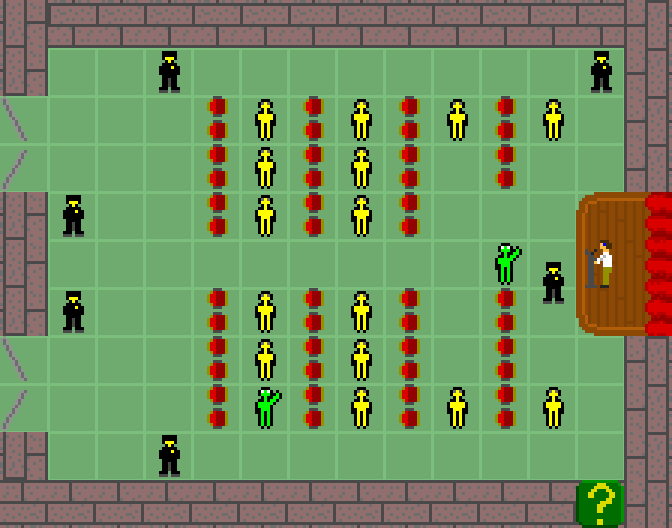
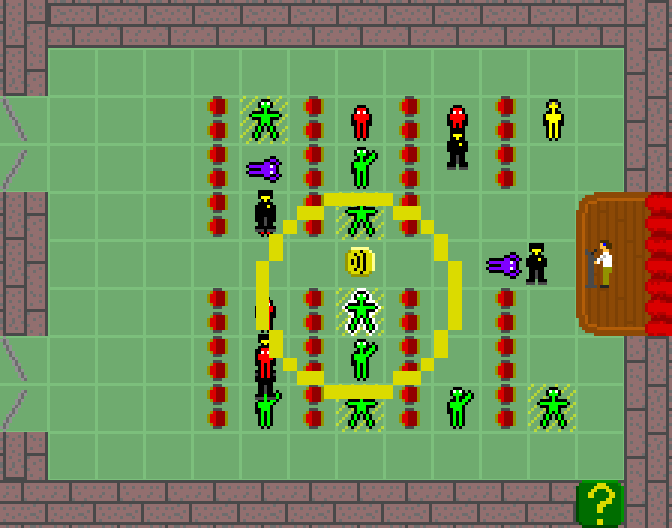
Police Brutality places you in control of a crowd caught in the tension of a real‐world incident. The game unfolds from a semi top‐down perspective at the exact moment a bystander is tased, and your goal is to keep the crowd organized and prevent the police from dragging victims away. Instead of direct combat or violence, Rohrer’s design focuses on crowd psychology and positioning, challenging you to balance fear and morale among your virtual spectators.
(HEY YOU!! We hope you enjoy! We try not to run ads. So basically, this is a very expensive hobby running this site. Please consider joining us for updates, forums, and more. Network w/ us to make some cash or friends while retro gaming, and you can win some free retro games for posting. Okay, carry on 👍)
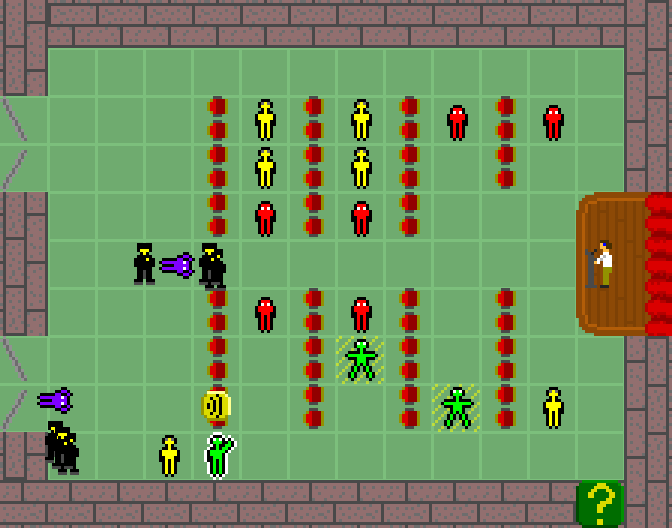
The core mechanic revolves around four emotional states—terrified (red), subdued (purple), alerted (yellow), and fully conscious (green). At the start, only one spectator remains conscious. Clicking the icon above this leader lets you shout and expand a radius that converts terrified onlookers into alerted or conscious state. As soon as you make yourself visible, however, the police target you, and if you fall to “subdued,” you lose the ability to inspire others forever.
Managing multiple potential leaders adds strategic depth. When one leader is taken out, you must quickly select another conscious spectator to rally the crowd again. This shifting of roles simulates the ebb and flow of real‐life protests, where leadership can be disrupted at any moment. The challenge lies in timing your shouts, positioning blockers to impede police movement, and preserving enough conscious individuals to maintain resistance.
Replayability comes from experimenting with shout radii, prioritizing which spectators to awaken first, and discovering optimal block formations. No two attempts play out exactly alike, as police patrol patterns and the initial placement of spectators introduce variability. The minimalistic rule set belies surprising complexity, making each session both a tense puzzle and a social simulation.
Graphics
Visually, Police Brutality adopts a clean, minimal aesthetic that echoes the abstract nature of a sketchbook design. Characters appear as simple colored circles, each hue corresponding to an emotional state, while officers are represented by uniform blue shapes. This reductionist approach keeps the focus on crowd dynamics rather than flashy assets, underscoring Rohrer’s experimental ethos.
The semi top‐down view offers clear sightlines, allowing players to survey the entire scene at once. Subtle animations—such as pulsing when a character is shouted into awareness or a brief stagger when subdued—provide immediate feedback on your actions. Although the graphics lack detailed textures or high‐fidelity models, they are intentionally crafted to convey information efficiently.
Color choices are more than stylistic; they serve as vital gameplay cues. Reds and purples stand out against the pale ground, signaling danger zones and subjugated individuals. Greens and yellows pop when your rally succeeds, offering a quick visual reward. These contrasts help maintain situational awareness, even as the scenario grows chaotic.
Sound design complements the minimalist visuals with restrained ambient noise and a few key sound effects. You’ll hear a distinct shout when rallying, a short electric zap when someone is tased, and muffled footsteps as officers advance. Background audio remains subdued, keeping the player’s attention firmly on the evolving crowd states.
Story
Rooted in the infamous “Don’t tase me, bro!” incident at the University of Florida in 2007, Police Brutality offers a sobering reinterpretation of a viral moment. Jason Rohrer draws upon this real‐life event to explore themes of collective action, authority, and the media’s role in amplifying individual voices. The game does not retell the incident beat by beat but instead uses its emotional resonance to drive emergent narratives.
Rather than focusing on a single protagonist, the story emerges from the conversion of bystanders into leaders. Each playthrough becomes a unique tale of resilience, fear, and unity. As you guide strangers to stand up and block officers, you witness how quickly hope can spread—and how fragile it remains under pressure. This branching narrative structure rewards experimentation and reflection over cinematic cutscenes.
Although there is no dialogue or character backstories, the game’s premise provokes questions about civil disobedience and the ethics of crowd control. The absence of explicit narrative beats invites players to project their own interpretations onto the scene, turning the simulation into a thought experiment about collective power versus institutional force.
By focusing on the crowd’s emotional states rather than individual protagonists, Police Brutality transforms a single news clip into a broader commentary on social dynamics. In doing so, it achieves a depth that belies its modest presentation, urging players to consider the real‐world implications of nonviolent resistance.
Overall Experience
Police Brutality is less about adrenaline‐fueled action and more about strategic empathy. Its inventive mechanics encourage players to think critically about how people respond to fear and authority. While it may not appeal to those seeking a conventional shooter or high‐octane spectacle, it offers a uniquely cerebral challenge for gamers interested in social simulation.
The game’s minimal graphics and straightforward interface serve its experimental aims perfectly, but the real highlight is the emergent drama that unfolds each time you press the rally button. Tension mounts as you juggle multiple leaders, defend choke points, and watch your organized resistance teeter on the brink of collapse. That quiet stakes‐raising is far more memorable than any explosive confrontation.
For players intrigued by video games as art or social commentary, Police Brutality stands out as a compelling case study. It demonstrates how simple rules can yield profound outcomes, and how interactive media can invite reflection on real events without resorting to graphic violence. It’s an experience that lingers long after you close the window.
Ultimately, Police Brutality is an invitation to explore the power of collective action in an abstract, controlled environment. It’s ideal for those who appreciate thoughtful design and narrative built from systems rather than linear storytelling. If you’re looking for a game that challenges your assumptions about protest, leadership, and crowd psychology, Jason Rohrer’s latest sketchbook experiment is well worth your time.



Reviews
There are no reviews yet.