 Retro Replay Retro Replay gaming reviews, news, emulation, geek stuff and more!
Retro Replay Review
Gameplay
Skispringen 2000 offers a deceptively simple control scheme that belies the precision required for top-tier ski jumping. The core mechanic revolves around timing your mouse click to initiate take-off and landing, demanding both patience and quick reflexes. Early attempts may feel forgiving, but as you progress to larger hills like Innsbruck or Garmisch, that window of opportunity narrows significantly. This keeps each jump engaging by requiring players to learn from mistakes and refine their timing.
(HEY YOU!! We hope you enjoy! We try not to run ads. So basically, this is a very expensive hobby running this site. Please consider joining us for updates, forums, and more. Network w/ us to make some cash or friends while retro gaming, and you can win some free retro games for posting. Okay, carry on 👍)
Beyond the basic click-to-launch system, fine-tuning in mid-air hinges on subtle mouse movements. Players must delicately adjust their posture to achieve the V-style position, which maximizes lift and distance. These micro-adjustments feel satisfying when executed correctly, rewarding careful observation of on-screen cues. The learning curve is gentle enough for newcomers, but steep enough to maintain depth for those seeking mastery.
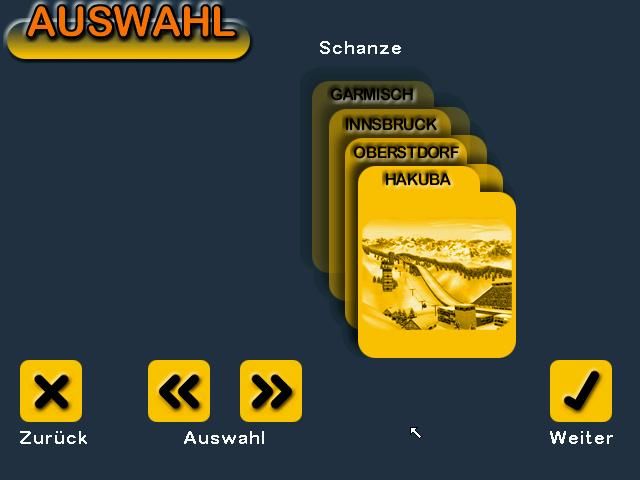
One notable omission is any form of campaign or ranking progression. You select a location—Garmisch, Oberstdorf, Innsbruck or Hakuba—and compete in standalone events. While this structure allows for quick pick-up-and-play sessions, it may leave players craving a persistent goal or global leaderboard. Still, the pure focus on nail-biting jumps makes each attempt feel like a personal best to beat.
Graphics
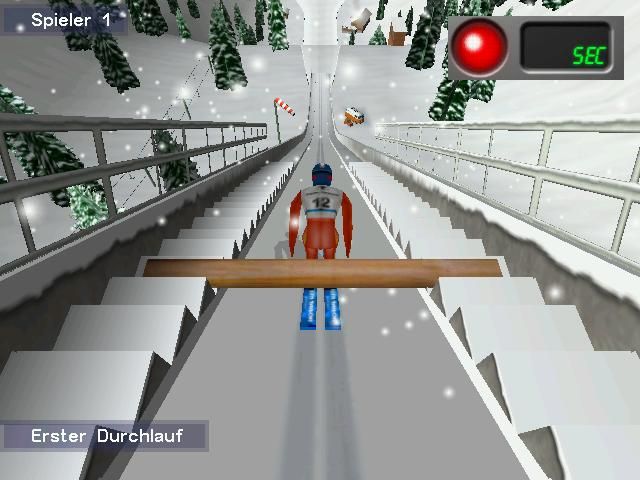
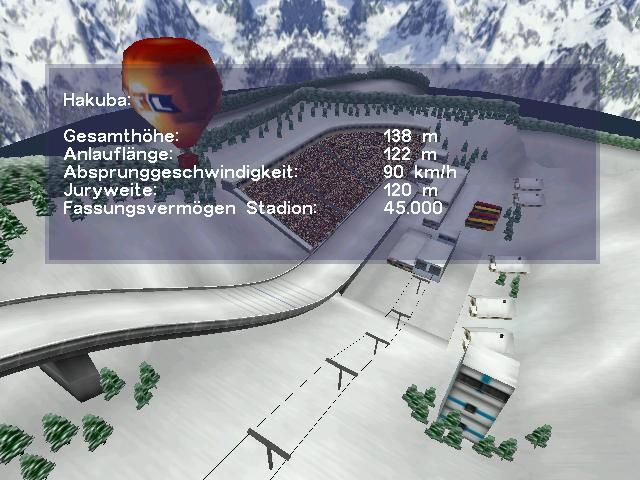
Visually, Skispringen 2000 leans toward functionality over flash. The four ski jump locations each sport a distinct palette—Garmisch’s snowy slopes, Oberstdorf’s winding runway and Hakuba’s mountainous backdrop are all rendered in clear, if somewhat dated, polygonal form. While not as detailed as later titles in the RTL Ski series, the environments remain easily readable, ensuring players aren’t distracted by extraneous details during critical moments.
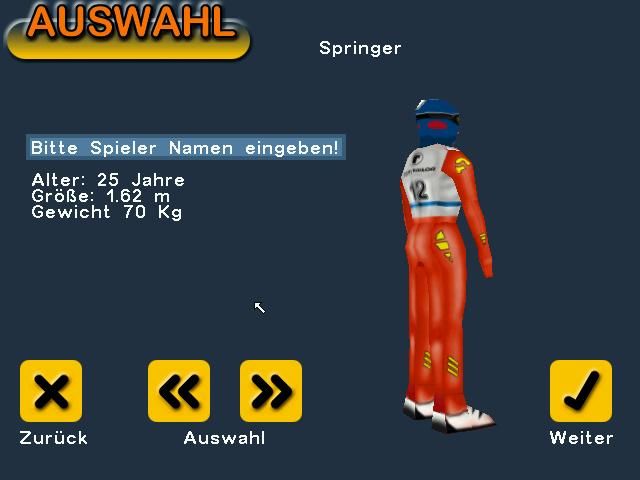
Athlete models are simple but effective, with eight distinct jumpers offering minor variations in build and attire. Animations focus on movement fluidity rather than facial detail, highlighting the take-off thrust and mid-air posture changes. Although textures are low-resolution by today’s standards, the lack of visual clutter enhances gameplay clarity—allowing you to spot wind flags, ramp angles and flight trajectory without confusion.
Replay options are a standout feature: successful jumps can be saved as video clips, giving players an opportunity to review their best performances in slow motion. This function not only showcases your personal highlights but also underscores how well the game captures the essence of ski jumping. The inclusion of full-screen replays gives a cinematic sheen that slightly offsets the otherwise utilitarian graphics engine.
Story
As a pure simulation, Skispringen 2000 doesn’t offer a narrative campaign or character-driven storyline. Instead, it focuses on recreating the atmosphere of professional ski jumping. The disc includes an exclusive video interview with Jens Weißflog, the legendary German jumper, which adds real-world context and a personal touch to the experience. His insights help bridge the gap between joystick control and snowy ramp dynamics.
Without official licensing, the game lacks real-world event branding, Olympic logos or official athlete names. However, this absence of license does not detract from the authenticity of the jumps themselves. Instead, it grants the developers freedom to emphasize simulation accuracy—prioritizing physics and wind behavior over marketing agreements. For purists who value mechanics over merchandising, Skispringen 2000 remains an honest representation of the sport.
The variety of locations—spanning Europe and Japan—provides a pseudo-world tour feel, even if there’s no running leaderboard tracking global performance. Each hill’s unique profile tells its own story, from the towering media-filled stands of Oberstdorf to the traditional wooden judges’ tower in Hakuba. These nuances help compensate for the lack of a structured narrative, allowing players to craft their own memorable ski jumping journey.
Overall Experience
For fans of winter sports simulations, Skispringen 2000 delivers a focused and challenging ski jumping experience. Its straightforward controls invite immediate experimentation, while the fine-tuning mechanic ensures that expertise is well-earned. The absence of a career mode or license may disappoint those seeking depth beyond standalone events, but this minimalist design also keeps the core gameplay loop razor-sharp.
The presentation balances functionality with occasional flair—replay videos and the Jens Weißflog interview add layers of authenticity that many contemporary titles overlooked. The four distinct hills and eight athletes supply enough variety for marathon sessions, yet the lack of online leaderboards or global rankings might limit long-term competitive appeal. Still, the game’s niche focus is precisely its selling point for simulation enthusiasts.
Whether you’re a newcomer intrigued by ski jumping mechanics or a seasoned veteran hungry for a pure simulation, Skispringen 2000 provides an engaging platform. It rewards repeated play with incremental skill improvements, immortalized via saved video replays. While not without its shortcomings—most notably the missing campaign structure—the title remains a compelling snapshot of ski jumping in the pre-license era.



Reviews
There are no reviews yet.