 Retro Replay Retro Replay gaming reviews, news, emulation, geek stuff and more!
Retro Replay Review
Gameplay
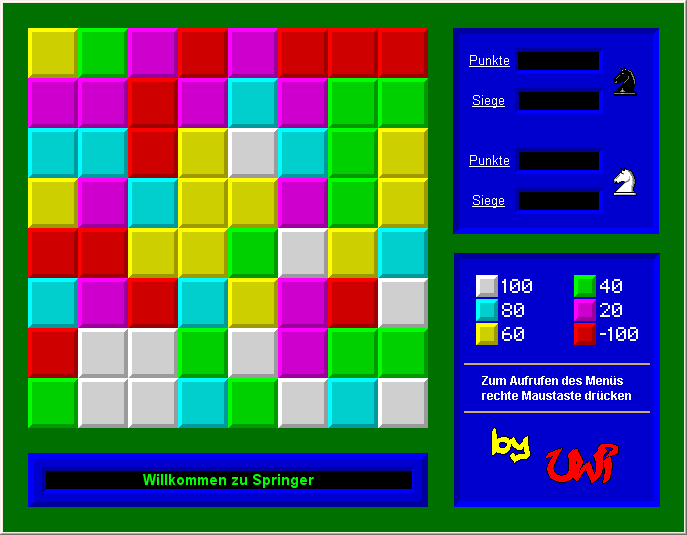
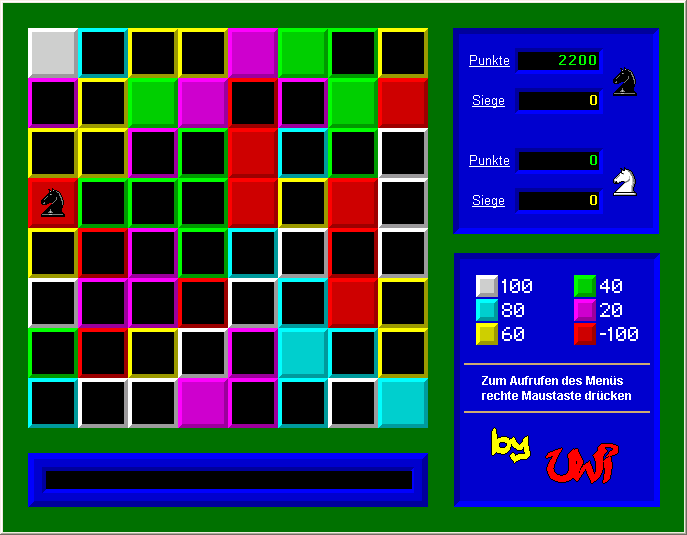
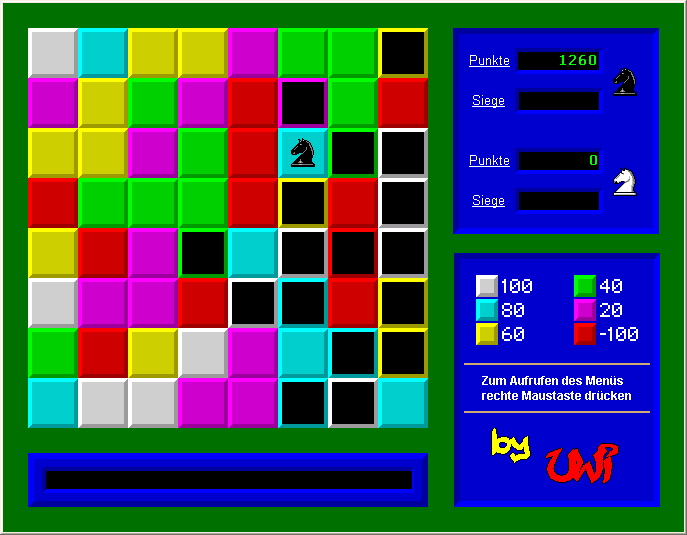
Springer distills chess down to its most iconic piece—the knight—and drops it into a vibrant, strategic puzzle on an 8×8 board. You control the Springer by making legal knight moves (two squares in one direction, one in the perpendicular direction), hopping across colored tiles to rack up points. Each color carries a distinct reward value: white, cyan, yellow, green, and magenta tiles boost your score, while landing on red tiles deducts points. Once a tile has been used, it turns black and becomes off-limits, narrowing your path and forcing you to think several moves ahead.
(HEY YOU!! We hope you enjoy! We try not to run ads. So basically, this is a very expensive hobby running this site. Please consider joining us for updates, forums, and more. Network w/ us to make some cash or friends while retro gaming, and you can win some free retro games for posting. Okay, carry on 👍)
Rather than racing to checkmate your opponent, you’re racing to maximize your score before all legal knight moves are exhausted. In single-player mode, the challenge is beating your own high score by uncovering long chains of valuable jumps; in two-player mode, you and a friend take turns or compete simultaneously to dominate the board without stranding your knight. The trade-off between visiting a high-value tile now versus preserving future routes injects a welcome tension into what might otherwise feel like a rote exercise in pattern recognition.
Springer’s controls are remarkably responsive, whether you’re clicking squares with a mouse or tapping them on a touch-enabled device. The game’s pacing can be leisurely or frenetic depending on your approach: you can deliberate every move for a methodical, almost meditative puzzle experience, or play against the clock and race your opponent for bragging rights. A built-in undo feature and move-history display help you experiment with risky maneuvers without punishing misclicks too harshly.
Graphics
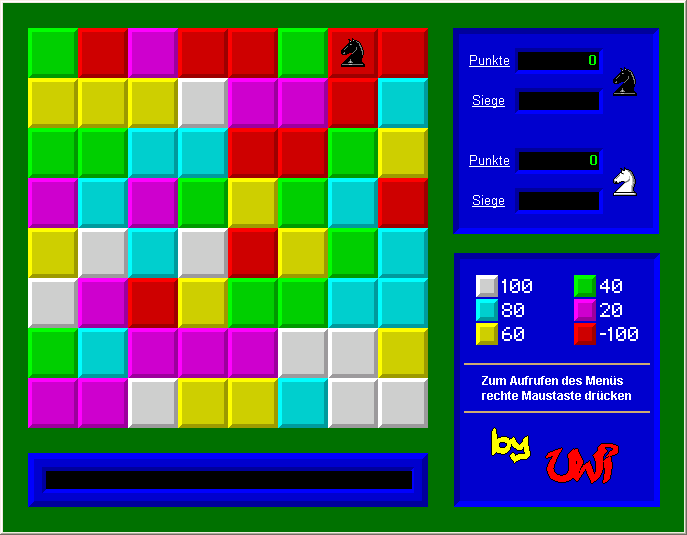
At first glance, Springer’s visuals are deceptively simple: a flat, top-down view of an 8×8 grid whose tiles cycle among six bold colors. Yet beneath that unassuming exterior lies a clean, user-friendly interface that never distracts from the core strategic gameplay. The color palette is bright and distinct—each hue pops against its neighbors—so you won’t need to squint or second-guess which cells offer the biggest point boost.
Subtle animations—such as the knight “jumping” with a small arc and a soft shadow—lend just enough polish to make each move feel satisfying. When a tile is used, it smoothly fades into an inky black, clearly signaling that it’s no longer part of the game. The score display and turn indicators remain unobtrusive, tucked neatly along the edges, ensuring your focus stays on plotting that next L-shaped leap.
While there’s no flashy 3D rendering or cinematic effects, the minimalist approach actually enhances playability, especially for a freeware title. Whether you’re playing on a desktop or a laptop, Springer loads instantly, and the crisp vector-style graphics keep the file size small. The result is a game that looks polished without hogging system resources—perfect for quick brain-teasers between more demanding gaming sessions.
Story
Springer doesn’t weave an elaborate narrative or erect a grand fantasy setting around its knightly hero. Instead, it lets the mechanics themselves craft a story of strategic conquest. Every new game is a fresh scenario in which you guide your lone knight to claim colored territories, racing against a gradual board lockdown as black squares proliferate. Your personal “journey” is told through the evolving pattern of your jumps and the faint regret of running out of moves.
In two-player mode, a silent rivalry takes shape: you and your opponent carve competing paths across the same board. Even without a scripted plot, these matches deliver emergent drama—one wrong turn can flip a commanding lead into a bitter last-ditch scramble. The absence of voice-overs or cutscenes keeps your brain firmly engaged in tactical planning rather than passive storytelling.
For gamers who crave a strong storyline, Springer’s minimalist approach may feel sparse. However, if you appreciate gameplay-driven narratives—the sort that arise naturally from the decisions you make—then the unfolding board patterns, the surges of colored tiles, and the drifting shadows of blacked-out squares offer their own kind of tale. You become both author and protagonist of a concise, self-contained puzzle saga every time you click “New Game.”
Overall Experience
Springer delivers a deceptively deep puzzle experience wrapped in a lightweight package. Its core mechanic—the knight’s L-shaped leap—feels instantly familiar to anyone who’s picked up a chess piece, yet the addition of colored, point-driven tiles creates a fresh layer of strategic complexity. Watching the board gradually shrink as squares turn black adds a satisfying crescendo to each session, whether you’re chasing a new personal best or outmaneuvering a friend.
As a freeware title, Springer punches well above its weight. There’s no cluttered UI, no intrusive ads, and no hefty download times—just pure, unadulterated puzzle action. The balance between risk and reward encourages experimentation, sharpening your foresight and planning skills with every move. And if you ever feel stuck, the undo history gives you breathing room to test daring gambits without penalty.
Whether you’re a chess enthusiast craving a novel way to flex your knight’s distinctive movement or a puzzle aficionado seeking quick mental workouts, Springer offers a compelling blend of simplicity and depth. Its straightforward presentation belies the strategic richness beneath, making it an ideal pick-up-and-play game for casual hours at home or for head-to-head battles over coffee. If you’re looking for a brain-teasing diversion that respects your time and challenges your wits, Springer is well worth downloading.


Reviews
There are no reviews yet.