 Retro Replay Retro Replay gaming reviews, news, emulation, geek stuff and more!


Retro Replay Review
Gameplay
The core of Tennis for Two Simulator lies in its precise recreation of the original 1958 mechanics: you adjust an angle dial, press the hit button, and watch a binary dot arc across a minimalistic court. There’s no HUD, no scorekeeper, and no fancy menus—just you, your opponent (real or AI), and a simulated oscilloscope screen. This bare-bones approach forces you to focus entirely on timing and trajectory, harkening back to a time when every pixel—every dot, really—mattered.
(HEY YOU!! We hope you enjoy! We try not to run ads. So basically, this is a very expensive hobby running this site. Please consider joining us for updates, forums, and more. Network w/ us to make some cash or friends while retro gaming, and you can win some free retro games for posting. Okay, carry on 👍)
When starting a match, you’ll choose between local two-player mode or an online rally against a friend or computerized opponent. The AI is rudimentary; it mimics human error rather than presenting a relentless challenge. This modest intelligence suits the game’s museum-piece credentials, though seasoned players may find matches short and repetitive after a while. The absence of scorekeeping means rallies end only when the ball fails to clear the net or comes to rest on the court, making each serve a mini-battle of patience and precision.
One of the simulator’s most faithful—and maddening—design choices is its refusal to reset the rally once the ball stops moving on the court floor. You’re left to power-cycle or manually restart if you misjudge a shot, which can be jarring by modern standards. Yet this quirk underscores the title’s historical fidelity: it isn’t striving to be an arcade blockbuster but a living artifact of early electronic gaming.
Sound effects, though simple “blip” and “click” samples, enhance the tactile feel of each hit. While these are modern additions rather than period-accurate reproductions, they help bridge the gap between an antique oscilloscope novelty and today’s expectations for audio feedback. If you crave tight, responsive controls and extended progression systems, Tennis for Two Simulator may feel limited—but for those eager to appreciate gaming’s humble beginnings, its spartan gameplay offers an unexpectedly absorbing challenge.
Graphics
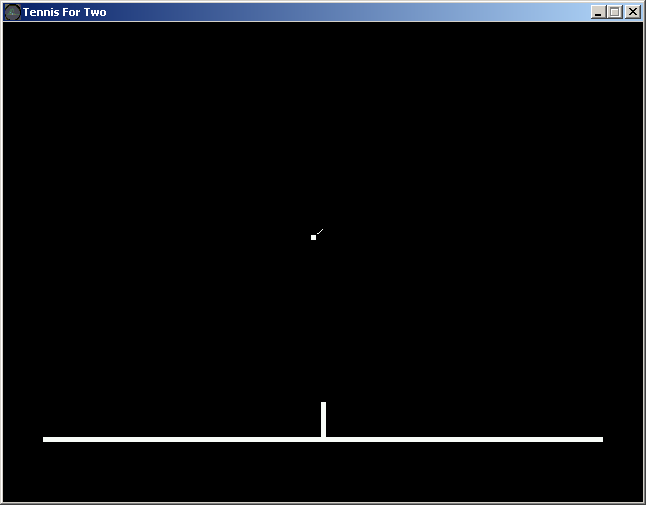
Tennis for Two Simulator presents its visuals in stark monochrome, faithfully emulating the glow of an old-school oscilloscope display. The court, divided by a simple horizontal line representing the net, sits against a black backdrop. The ball is a single white dot, and your racquet is implied rather than drawn—its presence felt through the trajectory lines that trace each shot’s arc under simulated gravity.
The simulator includes optional CRT filter effects to replicate the slight flicker and scan-line curvature of vintage hardware. Purists will appreciate the ability to toggle between pristine vector lines and the more nostalgic, slightly warped aesthetic. There’s no color shading, no textured courts, and no fancy particle effects—just authentic vector graphics that pay homage to gaming’s technical infancy.
Despite its deliberate minimalism, the visual clarity is superb. Every arc of the ball is crisply rendered, and the net’s silhouette remains distinct even when the dot barely clears it. The simplicity actually serves gameplay well: there are no distractions, and you can immediately judge your shot’s speed and angle at a glance.
For those used to high-definition courts and dynamic camera angles, the presentation may feel almost shockingly bare. However, this austere design choice underscores the simulator’s educational mission. It demonstrates how far gaming visuals have come without obscuring the sheer delight found in the earliest electronic interactions.
Story
Tennis for Two Simulator doesn’t offer a traditional narrative campaign; instead, its “story” is woven into the historical context it so lovingly preserves. In 1958, physicist William Higinbotham and his colleagues at Brookhaven National Laboratory crafted the original Tennis for Two to entertain visitors during laboratory open days. Their goal was simple: showcase the lab’s electronics expertise through an interactive display.
In lieu of cutscenes or character arcs, the simulator provides archival notes and short anecdotes about Higinbotham’s pioneering spirit. Pop-up text panels recount how the team programmed gravity into the game’s physics calculations, a concept lifted from contemporary artillery simulators. These informative snippets appear between matches, giving players a glimpse into the trial-and-error process that birthed one of gaming’s first interactive experiences.
Although there are no player avatars or fictional backstory, the game’s lack of narrative doesn’t feel like an omission. Instead, it highlights the novelty of the medium itself in 1958—long before storytelling tropes dominated game design. Here, the story is the simulation: a living museum exhibit that invites you to step into the shoes of both developer and player at a seminal moment in interactive entertainment history.
For history buffs and retro-enthusiasts, these contextual details enrich each rally, transforming what could be a dry tech demo into a meaningful exploration of gaming’s origins. If you approach Tennis for Two Simulator expecting a deep storyline, you’ll be disappointed. But if you seek to experience a tangible piece of gaming heritage, the minimal narrative framework is a feature, not a flaw.
Overall Experience
Tennis for Two Simulator is unapologetically niche. Its appeal hinges on a fascination with gaming history and an appreciation for the bare essentials of interactive design. It’s not a title you’ll lose hundreds of hours to, nor does it try to be. Instead, it offers brief but memorable sessions that foreground timing, physics, and sheer curiosity about the medium’s early experiments.
The simulator’s strengths lie in its dedication to authenticity: from the faithful vector graphics and dial-and-button controls to the quirks that modern developers would usually patch out. These choices underscore the project’s mission as a living exhibit rather than a commercial sports title. If you’re seeking cutting-edge visuals or deep multiplayer progression, you’ll find this offering sparse—but that’s precisely what makes it special.
Players with a casual interest in tennis games might find the lack of polish off-putting, but for educators, museum curators, and retro gaming aficionados, Tennis for Two Simulator is a delightful time capsule. It provides direct insight into how early engineers turned scientific equipment into interactive entertainment and paved the way for countless games to follow.
In the end, this simulator is a conversation piece, little more and little less. It invites you to reflect on the humble beginnings of an industry that now thrives on complexity and spectacle. If that proposition sounds intriguing, you’ll find each two-player match or solo practice rally both enlightening and oddly satisfying.



Reviews
There are no reviews yet.