 Retro Replay Retro Replay gaming reviews, news, emulation, geek stuff and more!


Retro Replay Review
Gameplay
Yu-Gi-Oh!: Power of Chaos – Kaiba the Revenge retains the core mechanics of its predecessor, delivering a faithful duel experience that veterans will immediately recognize. With the same intuitive interface and card interactions, players can summon monsters, set traps, and activate spells with ease. The pacing remains consistent, offering a balanced rhythm between drawing, planning, and executing your moves.
(HEY YOU!! We hope you enjoy! We try not to run ads. So basically, this is a very expensive hobby running this site. Please consider joining us for updates, forums, and more. Network w/ us to make some cash or friends while retro gaming, and you can win some free retro games for posting. Okay, carry on 👍)
What truly sets this expansion apart is the introduction of over 300 new cards, including powerful upgrade spells that can boost a monster’s attack well past the 10,000 mark. These additions significantly expand deck-building possibilities, allowing for creative strategies that were impossible in the original game. Whether you’re crafting a high-speed OTK (one-turn kill) deck or a defensive fortress of traps and spells, the new card pool keeps each duel fresh.
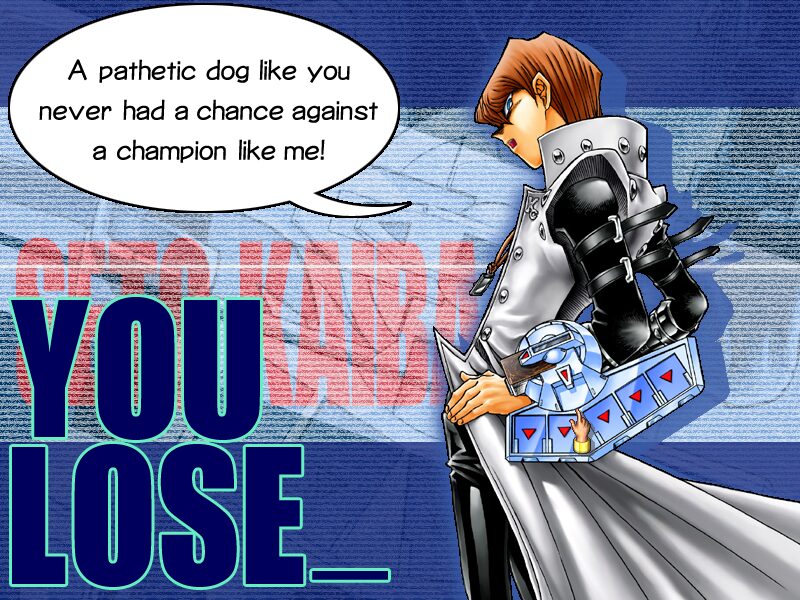
Arguably the most notable change in gameplay is Kaiba himself. His AI has been dramatically improved, employing advanced strategies and reading plays in ways that surprise even seasoned duelists. Kaiba will constantly adapt to your tactics, making full use of his powerful cards and counterplays. This heightened challenge makes every victory feel earned and encourages you to refine your deck with each loss.
The expansion also streamlines the experience for new and returning players. If you own Yugi the Destiny, your deck import is automatic—no manual setup required—and for newcomers, a balanced starter deck is provided. Deck construction remains flexible, allowing between 40 to 80 cards plus an optional side deck for match battles, giving you ample room to experiment and optimize.
Graphics
Graphically, Kaiba the Revenge maintains the series’ signature look with its crisp 2D card art and detailed animations. Each monster summon is accompanied by a unique full-screen illustration, and the attack/defense sequences are brought to life with dynamic effects. While not pushing modern hardware, the visuals hold up thanks to the nostalgic charm of the original anime-style artwork.
A welcome improvement over Yugi the Destiny is the refined user interface. Menus are clearer, card text is more legible, and the in-duel overlays occupy less screen real estate, keeping the focus squarely on the action. Background arenas, such as Duelist Kingdom’s colosseum or Kaiba’s high-tech tower, are richly textured and help immerse you in the atmosphere of each face-off.
Sound effects and music remain a highlight, pairing dramatic trumpet blasts with stateful ambient tracks that shift to underscore key moments. Kaiba’s iconic voice samples punctuate his AI duels, delivering taunts and reactions that add personality to each match. Though the audio quality mirrors early 2000s production values, it enhances the overall presentation without feeling dated.
Story
Unlike narrative-driven RPGs, Kaiba the Revenge focuses on the thrill of the duel as its main storyline engine. The game sets you against Seto Kaiba, who has orchestrated a grand tournament to prove his supremacy. Each victory brings you a step closer to his inner circle and hints at the high stakes behind his challenge, building tension through escalating matches rather than cutscenes.
While exposition is kept to a minimum, brief dialogue exchanges and victory quotes from Kaiba provide context and character motivation. His competitive edge comes through in every encounter: win or lose, Kaiba’s pride and unwavering confidence make him a compelling opponent. Fans of the original series will appreciate the familiar rivalry between Yugi and Kaiba playing out in reverse.
The simplicity of the narrative works in its favor, letting you concentrate on crafting decks and outplaying the opponent. Since duels themselves function as story beats, every duel win feels like narrative progress. This interactive storytelling model keeps you engaged even without an elaborate plot or multiple branching paths.
Overall Experience
Yu-Gi-Oh!: Power of Chaos – Kaiba the Revenge is a standout expansion that elevates an already solid dueling system to new heights. With its massive influx of new cards, sharpened AI, and seamless deck import feature, the game caters to both newcomers and veterans seeking a tougher challenge. It’s a duel-centric experience that rewards strategic thinking and careful deck-building.
The game’s standalone nature means you don’t need to own the original expansion to enjoy it, yet those who do will benefit from the deck import feature. Replay value is high thanks to the unpredictable AI and the incentive of earning cards from match battles. Completing Kaiba’s tournament multiple times with different deck archetypes keeps the experience fresh over the long term.
While the graphics and audio reflect early-2000s production values, they remain charming and functional, ensuring that the focus stays on the core dueling mechanics. The sparse narrative is purpose-built, driving you through successive gauntlets of increasingly cunning opponents led by Kaiba himself.
For any fan of the Yu-Gi-Oh! trading card game or digital duels in general, Kaiba the Revenge offers a robust challenge and a wealth of new strategies to explore. Its addictive deck-building, compelling AI battles, and streamlined interface make it a must-have title for those looking to test their skills against one of the franchise’s most legendary duelists.


Reviews
There are no reviews yet.