 Retro Replay Retro Replay gaming reviews, news, emulation, geek stuff and more!
Retro Replay Review
Gameplay
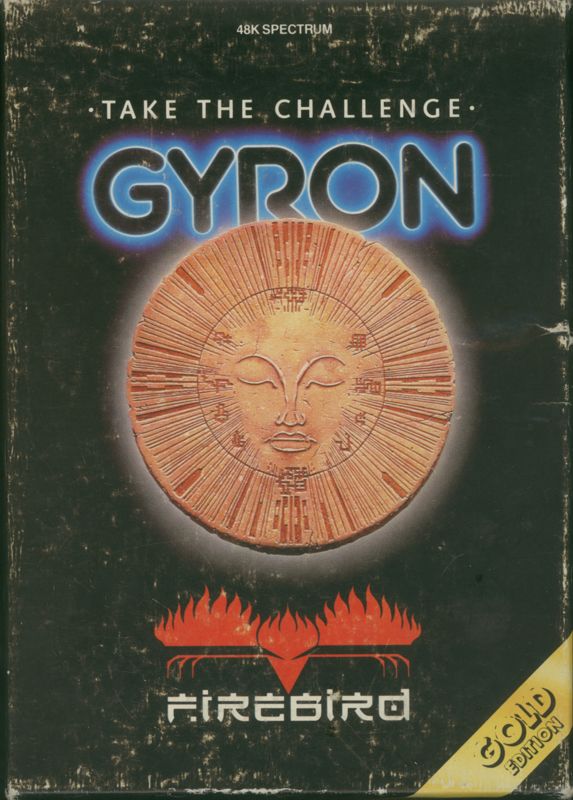
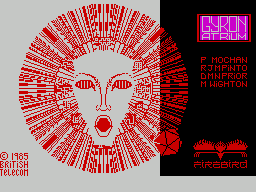
Gyron plunges players into two distinct labyrinthine environments: the Atrium and the Necropolis. The Atrium serves as a gentle introduction, offering a more linear layout that helps you master the Hedroid’s controls and the basic mechanics of towers, spheres, and the scanner. Once you feel confident, you progress to the Necropolis, a far more intricate maze where the objective is to locate the hidden “Place of Wisdom.” Every turn in Necropolis can spawn a new threat or opportunity, keeping the tension high as you navigate its depths.
(HEY YOU!! We hope you enjoy! We try not to run ads. So basically, this is a very expensive hobby running this site. Please consider joining us for updates, forums, and more. Network w/ us to make some cash or friends while retro gaming, and you can win some free retro games for posting. Okay, carry on 👍)
The core of Gyron’s gameplay revolves around precise navigation and tactical sabotage. The Hedroid’s vector-based movement lets you dash forward at high speeds or creep along walls for delicate maneuvers. Colliding with walls or towers at high velocity inflicts significant damage on your craft, forcing you to restart from the last checkpoint. This balance of risk and reward makes each run feel like a calculated gamble: push your speed to outrun danger or slow down to avoid costly repairs.
Towers perched on maze walls add a strategic layer—each one fires only in its facing direction, so sneaking around to attack from behind can alter their orientation or even make them vanish temporarily. Successfully shooting a tower ripples through the level, potentially unlocking new corridors or inadvertently exposing you to fresh lines of fire. Meanwhile, massive spheres patrol fixed routes; contact means instant death, so timing is everything. Learning their rhythms and using them as moving shields against tower fire becomes an essential tactic.
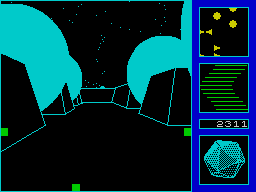
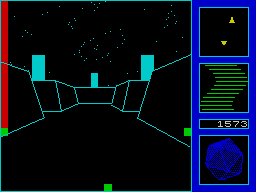
The in-game scanner is your lifeline, mapping local corridors, tower positions, orientations, and sphere trajectories. However, its range is limited, and altering towers in distant sections can reshape areas outside your scanner’s reach. This element of uncertainty ensures that no two playthroughs feel identical. Experimenting with different strategies—hugging trench walls, baiting towers into new alignments, or using spheres as mobile cover—keeps the gameplay dynamic from start to finish.
Graphics
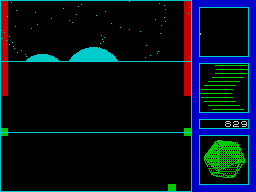
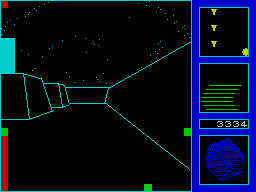
Gyron employs crisp vector graphics that emphasize clarity and speed. The stark lines of the mazes and the geometric forms of the Hedroid, towers, and spheres evoke a minimalist aesthetic reminiscent of classic arcade titles. This visual style not only looks sharp on modern displays but also ensures that gameplay-critical elements stand out against the backdrop, making it easy to track moving hazards and tunnel layouts even at high velocity.
The smooth acceleration and deceleration of the Hedroid are visually represented through dynamic line elongation and subtle color shifts, reinforcing the sensation of momentum. When you push the craft to top speed, walls and corridors blur slightly, heightening the adrenaline rush. Conversely, careful slow movement is depicted with crisp, stable lines that let you plan each move with surgical precision.
Each maze zone is distinguished by the hue of its spinning icosahedron, providing an intuitive waypoint system that complements the scanner readout. As you progress, color palettes shift to signal rising tension—cool blues in the Atrium give way to ominous reds and purples in the Necropolis. These transitions not only serve as visual cues for your advancement but also enhance the game’s atmospheric storytelling.
Though there are no detailed textures or complex shaders, the simplicity of the vector art ensures consistent performance on a wide range of hardware. Frame rates remain rock-solid even when multiple spheres and projectiles occupy the screen. In Gyron’s case, less truly is more: the minimalist visuals focus your attention squarely on the maze’s challenges rather than distracting embellishments.
Story
Gyron’s narrative is woven into its environment rather than delivered through cutscenes or dialogue. The two mazes—the welcoming Atrium and the forbidding Necropolis—represent an initiation and a trial. Your mission to unearth the “Place of Wisdom” deep within the Necropolis hints at a larger lore: a lost civilization whose knowledge was sealed behind labyrinthine defenses. This subtle storytelling invites players to imagine the world beyond the walls.
Although there are no characters to interact with, the game’s mechanical elements tell their own tale. The towers, static yet lethal, could be seen as remnants of an ancient security network. The moving spheres feel almost alive, patrolling sacred paths and asserting dominance over the corridors. Every time you disable or reorient a tower, you disrupt the Necropolis’s defenses, inching closer to the heart of its hidden truth.
The color-coded zones act as narrative markers, each hue suggesting a different aspect of the lost wisdom you seek. Cooler tones in early areas evoke calm rationality; deeper crimson and violet zones hint at arcane mysteries waiting to be deciphered. Though Gyron never hands you an explicit backstory, the interplay of environment, mechanics, and atmosphere conveys a compelling sense of purpose and discovery.
By focusing on environmental storytelling rather than text or voice, Gyron maintains a steady pace and keeps you immersed in the challenge. Every maze corner holds the possibility of revelation or ruin, reinforcing the theme that wisdom often lies hidden behind seemingly insurmountable obstacles.
Overall Experience
Gyron offers a tense, rewarding journey for players who appreciate skill-based challenges and minimalist design. The gradual ramp-up from the Atrium’s guided corridors to the Necropolis’s punishing puzzles feels well calibrated, ensuring newcomers aren’t immediately overwhelmed while still providing veterans with a genuine test of their reflexes and strategic thinking.
The satisfaction of outmaneuvering towers, timing sphere passages, and mapping uncharted zones is immense. Each victory—whether disabling a critical tower or slipping past a deadly sphere—reinforces your mastery of the Hedroid and the game’s mechanics. Conversely, frequent setbacks underscore the importance of precision and patience, making every subsequent attempt feel meaningful.
Replay value is high thanks to the dynamic interactions between towers, spheres, and your actions. No two playthroughs unfold exactly the same way, and experimenting with different tactics reveals hidden shortcuts and alternative routes. This unpredictability keeps the experience fresh even after multiple runs.
In all, Gyron stands out as a refined homage to classic vector-based titles, blending tight controls, strategic depth, and atmospheric presentation into a cohesive whole. If you’re searching for a brain-teasing maze romp that rewards careful planning and lightning-fast reactions, the Hedroid’s cockpit awaits.


Reviews
There are no reviews yet.