 Retro Replay Retro Replay gaming reviews, news, emulation, geek stuff and more!
Retro Replay Review
Gameplay
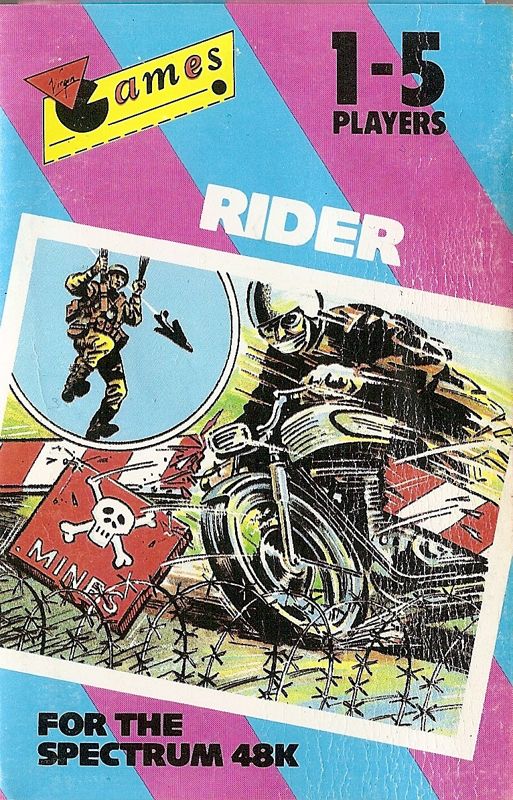
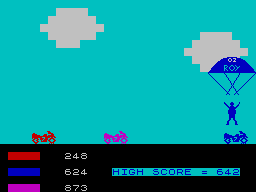
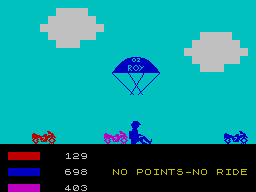
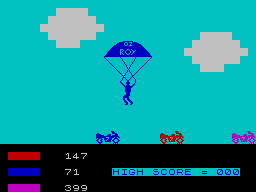
Rider delivers a two-stage challenge that keeps players engaged from drop to finish line. In the first phase, you assume the role of an MI5 agent parachuting into enemy territory. You must time your descent precisely to land on a passing motorcycle, balancing left and right movements to align with one of three color-coded bikes that scroll across the screen at unpredictable intervals. Each bike carries a distinct points value, and the randomized appearance of these bikes adds an element of tension and spontaneity to every attempt.
(HEY YOU!! We hope you enjoy! We try not to run ads. So basically, this is a very expensive hobby running this site. Please consider joining us for updates, forums, and more. Network w/ us to make some cash or friends while retro gaming, and you can win some free retro games for posting. Okay, carry on 👍)
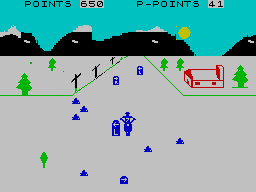
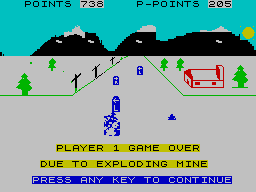
Once you successfully mount your bike, Rider shifts gears into its motorcycle-riding phase, where the action intensifies. You face a treacherous minefield filled with hidden explosives and scattered obstacles. Steering left or right and modulating your speed become crucial as you weave through this lethal gauntlet. The minefield stage rewards precision and anticipation, pushing players to learn obstacle patterns and react in real time.
The progression system in Rider keeps things fresh: clear the minefield and you earn a promotion to the next skill level, from 001 up to 007. With each promotion, the game’s scrolling speed increases and obstacle density grows, ensuring a steep difficulty curve for veterans while giving newcomers a chance to build their skills. Multiplayer support for up to five players—each taking turns—adds a competitive edge, letting friends vie for the highest score on a single cabinet or console setup.
Graphics
Rider’s visual presentation is rooted in classic arcade aesthetics, featuring bold, high-contrast sprites and a limited yet effective color palette. The parachute, the agent, and the motorcycles are all clearly defined, making it easy to distinguish between the three bike colors and gauge their point values at a glance. Background layers scroll smoothly, creating a sense of depth as you descend or race forward at increasing speeds.
While the graphics won’t rival modern high-definition titles, Rider’s pixel art is crisp and purposeful. The designers make smart use of color to highlight hazards in the minefield, with bright yellow warning signs and red mines that stand out against the darker ground textures. Animations—such as the parachute opening or the explosion of a mine—are both fluid and snappy, reinforcing the game’s fast-paced nature without overstaying their welcome.
Another strength lies in Rider’s clear user interface. Score indicators, skill-level markers, and remaining players are all displayed unobtrusively at the screen edges, ensuring you stay focused on the action. Overall, the graphics capture the arcade spirit: eye-catching enough to grab attention in a busy game room, yet simple enough to serve the core gameplay without distraction.
Story
Although Rider isn’t a narrative-driven epic, its premise provides just enough context to make your missions feel meaningful. You are an elite MI5 agent tasked with infiltrating enemy territory to scout ahead of your nation’s next war. This setup frames each parachute drop and minefield run as critical reconnaissance operations rather than mere high-score challenges, elevating the stakes with every failed landing or exploded bike.
The progression from skill level 001 to 007 simulates your ascent through the agency’s ranks, rewarding skill and persistence. Each successful mission brings you closer to full agent status, and the act of “promotion” adds a sense of tangible achievement. While there are no cutscenes or voiced dialogue, the minimalist storytelling relies on your imagination, making every victory feel earned.
Rider’s setting—enemy-held territory, covert resistance support, and looming wartime threat—injects a dash of Cold War-era intrigue. The color-coded bikes, supplied by the resistance movement, hint at an underground network rallying behind your efforts. Though brief and understated, this backstory lends purpose to your jumps and races, encouraging you to stay invested in your agent’s success.
Overall Experience
Rider offers a compact yet addictively challenging experience that excels in short bursts of play. The dual-phase structure keeps gameplay varied, as no two drops or minefield runs feel identical. Difficulty ramps up effectively, ensuring both newcomers and seasoned players find a suitable challenge. The random bike intervals and shifting obstacle layouts give Rider strong replay value, making each session unique.
Multiplayer turn-taking adds replayability and social fun, especially in arcade or party settings. Watching friends attempt the parachute drop or minefield challenge can be as entertaining as playing yourself, fostering friendly rivalry. Rider’s straightforward controls—move left, move right, and adjust speed—keep the learning curve gentle, yet the precision required at higher levels demands true mastery.
For fans of classic arcade action, Rider is a compelling throwback that blends simple mechanics with escalating tension. It may lack the narrative depth or graphical sheen of modern titles, but its core design shines through. Whether you’re chasing high scores alone or competing with up to four friends, Rider delivers a solid, pulse-pounding experience that stands the test of time.


Reviews
There are no reviews yet.