 Retro Replay Retro Gaming History, Reviews & Emulation
Retro Replay Review
Gameplay
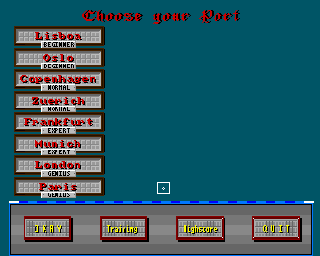
Airport starts with a wonderfully direct kind of pressure. You are looking down at an airport map, planes are arriving and leaving, and it is immediately your responsibility to keep their paths from colliding. There is no long runway before the real game begins: you issue orders, watch the traffic develop, and learn very quickly that a quiet airfield can become a problem the moment your timing slips.
The overhead view is a strong fit for the job. You can see the whole traffic picture rather than being trapped in a cockpit, and the ability to inspect information such as a plane’s route gives you something concrete to work with when planning ahead. Warnings about incoming flights help, but they do not remove the need to think several moves ahead. A safe landing is only half the task if an outgoing aircraft is about to complicate the same piece of airspace.
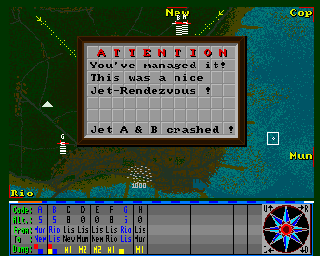
What keeps Airport from feeling like a simple scheduling exercise is the disruption. Bad weather and emergencies can force you to abandon a comfortable routine and react under pressure. That unpredictability is where frustration can set in, especially when you thought you had a clean sequence mapped out, but it is also where the simulation earns its tension. When you recover and traffic starts flowing again, the satisfaction is real.
The 15-minute scoring intervals are a smart source of momentum. Instead of waiting indefinitely to find out whether your work was good enough, you receive points and a rank change—or a demotion—on a regular basis. That makes each stretch feel like a compact shift, with clear consequences for sloppy decisions. Airport will suit you if you enjoy staying alert, organizing competing demands, and improving through repeated attempts rather than relying on reflexes alone.
Graphics
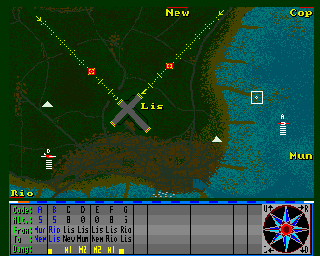
Airport is played entirely from an overhead map, putting runways, aircraft traffic, and airport layout in one practical view. The different airfields matter visually because their one-to-four-runway arrangements change how much space and complexity you have to manage.
Story
There is no character-driven story pulling you through Airport. Its drama comes from the job itself: incoming flights need attention, departures need room, and a normal shift can be interrupted by weather or an emergency.
That restrained approach works for a simulation about control and consequence. Each airport session creates its own small narrative of near-misses, recovered mistakes, and periods where your plan either holds together or falls apart.
The ranks give that emergent story a useful personal angle. Being rewarded for a strong 15-minute stretch feels like professional progress, while a demotion makes failure sting without requiring a scripted plot to tell you why it mattered.
Overall Experience
Airport is a focused air-traffic-control simulation built around the satisfying strain of keeping many moving parts orderly. Its strongest moments come when you stop reacting one plane at a time and begin treating the airport as a living schedule, anticipating what will be needed before the warning arrives.
The eight airports are important because they give the central idea room to grow. Starting with fewer runways lets you learn the basic rhythm; larger layouts ask you to manage more possibilities and more opportunities for trouble. The included editor is an especially welcome reason to keep experimenting once the built-in locations no longer feel unfamiliar.
This is not the kind of game to pick up for spectacle or a story campaign. Pick it up if the thought of reading routes, making calm decisions under mounting pressure, and being judged on operational efficiency sounds rewarding. For patient strategy-minded gamers, Airport’s stern little shifts can be far more absorbing than they first appear.


Reviews
There are no reviews yet.