 Retro Replay Retro Replay gaming reviews, news, emulation, geek stuff and more!




Retro Replay Review
Gameplay
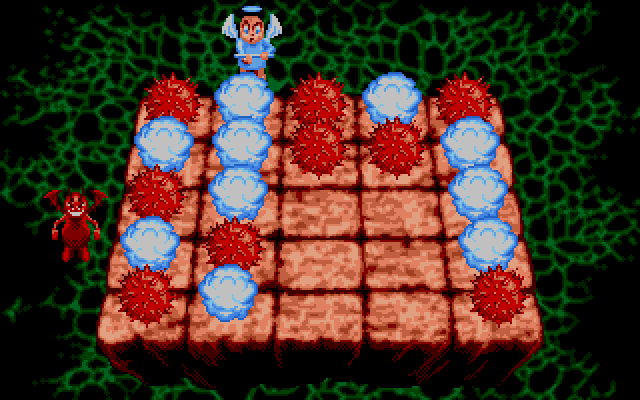
Antago delivers a deceptively simple puzzle experience on a compact 5×5 board, where two opponents—an angel and a devil—vie to align five balls in a row. Every turn revolves around pushing your character with the joystick, strategically positioning balls at the board’s edge, and attempting to thwart your rival’s lines. The core loop is easy to grasp: move, push, place a ball, and adapt as the board fills.
(HEY YOU!! We hope you enjoy! We try not to run ads. So basically, this is a very expensive hobby running this site. Please consider joining us for updates, forums, and more. Network w/ us to make some cash or friends while retro gaming, and you can win some free retro games for posting. Okay, carry on 👍)
The game offers flexible modes to suit different playstyles. You can challenge the computer across ten difficulty levels, face off against a friend in hot-seat play, or dive into a training session to hone your tactics. If you prefer a ready-made scenario, the “prepared” mode lays out balls in advance; for a blank slate, “plain” mode resets the field. A demo mode also exists, letting you watch two AI players duel—ideal for studying advanced strategies.
Strategic depth emerges from the simple mechanics. As your angel or devil slides along the grid, collisions send opponents skidding across squares, opening or blocking potential lines. Deciding when to push, when to place a ball, or when to forgo an opportunity entirely can swing the match in your favor. Over time, you’ll learn to read the board, anticipate your opponent’s moves, and orchestrate multi-step tactics to achieve that coveted five-in-a-row finish.
Graphics
Visually, Antago keeps things clean and focused. Each difficulty level features its own background art and board skin, ranging from ethereal clouds to fiery underworld scenes. While none of the graphics strive for realism, the colorful backdrops and contrasting ball hues clearly differentiate each side and enhance readability on the small grid.
The angel and devil avatars are charmingly stylized, with expressive poses that change when they push each other or secure a win. Ball pieces glitter briefly upon placement, offering a satisfying visual cue. Animations remain smooth even during rapid exchanges, and the minimalistic UI ensures there’s no clutter obstructing crucial board squares.
One notable omission is background music; during matches you’ll hear only simple sound effects—thuds for collisions, a ping when a ball drops, and a triumphant chime upon victory. This austere audio design might feel sparse to some, but it also removes distractions, letting you concentrate fully on your next move.
Story
Antago foregoes a traditional narrative in favor of a symbolic rivalry: the forces of good (an angel) versus evil (a devil). There’s no cutscene drama or unfolding plot; instead, the characters’ eternal contest is conveyed purely through gameplay. Each match becomes its own mini-battle in the heavens and hells of this abstract realm.
Though there’s no dialogue or lore text, the angel-versus-devil motif adds personality to what might otherwise be a stark strategy board. You feel a subtle thrill as your chosen champion slowly gains the upper hand, pushing their foe across the field and weaving a line of luminous balls.
If you’re looking for deep storytelling, Antago isn’t the game for you. Yet the minimal framing proves surprisingly effective: the thematic skin ties every move to a larger cosmic struggle, turning each five-ball alignment into a symbolic triumph of light or shadow.
Overall Experience
Antago shines as an intelligent, easy-to-learn puzzle duel that scales neatly from casual matches to fierce strategic battles. The ten AI levels offer a smooth difficulty curve, while human-versus-human play keeps competition fresh. Training and demo modes serve both newcomers and veterans, making the game accessible and replayable.
On the flip side, the absence of background music and a deeper storyline may leave some players wanting more sensory richness. The limited board size can feel repetitive after extended sessions, and sound effects are functional but unspectacular. However, these trade-offs reinforce the game’s focus on pure strategy rather than audiovisual spectacle.
For puzzle aficionados and fans of abstract board games, Antago is a compact gem. Its blend of simple rules, tactical pushing mechanics, and thematic flair ensures that each match feels tense and rewarding. Whether you’re honing your skills against the AI or out-witting a friend, Antago delivers a tight package of cerebral fun that’s easy to pick up and hard to put down.


Reviews
There are no reviews yet.