 Retro Replay Retro Replay gaming reviews, news, emulation, geek stuff and more!


Retro Replay Review
Gameplay
Biologica! centers on an educational journey through Earth’s earliest epochs, challenging players to understand how simple organic molecules coalesced into the first life forms. The core gameplay loop combines direct instruction—through text-based prompts and diagrams—with hands-on mini-puzzles that reinforce concepts such as cellular classification and evolutionary milestones. Each section tasks you with arranging building blocks of life in the correct order or matching organisms to their taxonomic groups, creating an active learning environment rather than passive reading.
(HEY YOU!! We hope you enjoy! We try not to run ads. So basically, this is a very expensive hobby running this site. Please consider joining us for updates, forums, and more. Network w/ us to make some cash or friends while retro gaming, and you can win some free retro games for posting. Okay, carry on 👍)
One of the standout features is the pair of 8-bit puzzle games that break up the didactic segments and inject a playful rhythm into the experience. In one mini-game, you must assemble strands of nucleotides to form viable DNA sequences; in another, you guide primitive cells through a nutrient maze, avoiding hazards that mimic the chaotic conditions of primordial Earth. Both puzzles are simple yet surprisingly addictive, offering just enough challenge to make each successful completion feel rewarding.
Arguably the most fascinating gameplay element is the primitive “Game of Life” simulation. Here, you input random seeds to spawn viruses, bacteria, or amoeboid organisms onto a grid. Watching your creations replicate, consume resources, and eventually perish provides a visceral illustration of natural selection and population dynamics. The emergent behavior—however rudimentary—captures the essence of life’s unpredictability and underscores the game’s educational mission.
Replay value stems from tweaking simulation parameters and experimenting with different microbial combinations. No two runs play out identically, so you’ll find yourself returning to observe new survival strategies or unexpected die-offs. While the controls and interface feel nostalgic—bordering on archaic by today’s standards—they fit the DOS-based, retro aesthetic and keep the focus on learning rather than flashy mechanics.
Graphics
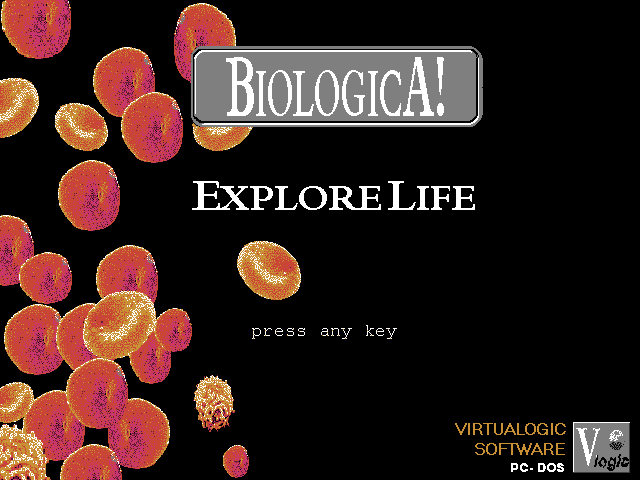
Biologica! employs an authentic 8-bit color palette that evokes the charm of early DOS-era software. Sprites are blocky yet distinct, with simple animations signaling replication events, cell movement, and environmental changes. While this style may strike modern gamers as rudimentary, it perfectly complements the game’s educational ambition by keeping visuals clear and free of extraneous detail.
The on-screen layout is compartmentalized into separate zones for text, puzzle grids, and simulation areas. This division ensures that players always know where to focus and minimizes visual clutter. Icons for nucleotides, cell membranes, and metabolic by-products are easily recognizable, which is crucial when you’re under pressure to solve a timed puzzle or track multiple organisms in the simulation grid.
Sound design sticks to basic beeps and boops, offering simple auditory feedback when you place a puzzle piece correctly or trigger a replication cycle. Though there’s no rich soundtrack, these minimal effects serve their purpose: they confirm actions without distracting from the educational content. Overall, the graphics and audio combine to deliver a cohesive retro vibe that reinforces the game’s DOS heritage.
Story
In place of a conventional narrative, Biologica! weaves an evolutionary storyline that unfolds as you progress. You begin in the Hadean era, where life is nothing but a chemical hypothesis, and advance through stages that illustrate the emergence of prokaryotes, the rise of eukaryotic complexity, and the dawn of multicellularity. Each chapter introduces new biological concepts, making the “story” as much a guided lecture as it is an interactive tale.
The gradual introduction of classification systems—kingdoms, phyla, and classes—serves as both gameplay mechanic and narrative device. By the time you reach the final levels, you’re no longer just building cells; you’re recognizing patterns and relationships that underpin modern taxonomy. This didactic progression feels organic, mirroring the very evolutionary processes you’re studying.
Although there are no characters in the traditional sense, the game assigns “profiles” to different organism types, describing their place in Earth’s history and their ecological roles. These snippets of lore enrich the simulation segments, supplying context for why some microbes thrive in acidic conditions while others prefer alkaline environments. The result is a cohesive educational storyline that never feels forced or disconnected from the gameplay.
Overall Experience
Biologica! strikes a rare balance between teaching and entertaining, making it an ideal title for students, educators, or anyone with a fascination for life’s origins. Its straightforward interface, coupled with varied puzzle mechanics and an emergent simulation, keeps you engaged throughout. The educational thrust never overwhelms the fun factor; in fact, mastering a puzzle or observing a successful replication cycle is genuinely satisfying.
That said, the game’s retro presentation may not appeal to everyone. The lack of high-definition graphics, orchestral music, or modern UI conveniences could deter players accustomed to contemporary production values. Yet for those willing to embrace its DOS-era aesthetic, Biologica! offers a rewarding throwback experience that doubles as a primer in biology and evolution.
In conclusion, Biologica! is more than an edutainment relic—it’s a thoughtfully designed tool for exploring the fundamental processes that shaped life on our planet. While it may feel quaint by today’s standards, its core mechanics remain relevant and engaging. If you’re seeking a unique blend of puzzles, simulations, and scientific discovery, this little DOS gem deserves a spot in your collection.


Reviews
There are no reviews yet.