 Retro Replay Retro Gaming History, Reviews & Emulation


Retro Replay Review
Gameplay
Chase gets you moving quickly. You are a hero in a spaceship pursuing the rescue of the abducted Princess Chardonnay, and the first challenge throws you into an asteroid field with enemy ships appearing along the way. It has the brisk, no-nonsense energy of an arcade game: steer cleanly, shoot when the target presents itself, and do not let the hazards crowd your attention.
The four levels are short on ceremony but sensibly varied. One asks you to guide a ship moving at a fixed linear speed through gates, making positioning the whole game. Another sends you through a tunnel where every checkpoint matters. The final tunnel combines obstacle avoidance with shooting enemies, asking you to divide your focus more aggressively than before. None of these ideas is elaborate on its own, but the sequence gives Chase more range than a single-screen blaster.
That fixed-speed gate stage is likely to be the point where the game either clicks or irritates you. You cannot solve a bad approach by slowing down; you have to anticipate the next gate and commit to your steering early. The tunnel stages similarly reward learning the course and staying composed when shooting and survival compete for your attention. Chase is more about clean execution than improvisation.
Once you clear all four levels, the game loops at a tougher difficulty. That structure gives the game a clear arcade purpose, but it also makes the rescue premise feel like a thin frame around an endurance test. If you enjoy replaying a compact challenge until your reactions sharpen, the escalating loop is the payoff. If you need fresh stages or a fuller sense of progression, Chase will wear out its welcome quickly.
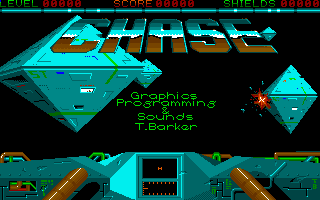
Graphics
Chase uses a first-person cockpit-style view for its space-flight challenges. Asteroids, gates, tunnel checkpoints, obstacles, and enemy ships all serve as immediate targets or threats in front of you, fitting a game that depends on rapid steering and shooting decisions.

Story
The story is stripped to a classic sci-fi rescue hook: Princess Chardonnay has been abducted, and you fly out to save her. It is a clear reason to jump into the ship, but Chase does not lean on narrative complexity. The plot exists to point you toward the next dangerous stretch of space.
That simplicity suits the arcade structure. You are not weighing choices or unraveling a mystery; you are pushing through four trials to complete the mission. The princess gives the action a destination, even if the real drama comes from threading a gate or surviving a tunnel at speed.
Do not come to Chase expecting the rescue tale to carry the experience. Its story is a tidy setup, not a major reward at the end of the road. The game lives or dies on whether its individual flight challenges make you want another attempt.
Overall Experience
Chase is a small, focused sci-fi action game that understands the value of changing the task before repetition becomes completely monotonous. Asteroid navigation, gate flying, checkpoint collection, and tunnel combat create a decent progression of pressures, with the later challenges asking for more concentration than the early ones.
Its limitations are inseparable from its appeal. The mission is brief, the plot is bare, and looping back at higher difficulty means you must enjoy the same core material becoming harsher. At its best, that feels like a proper arcade dare: you know the course, you know what went wrong, and you want to prove you can fly it better.
Give Chase a chance if you like uncomplicated first-person action games where precision matters more than exploration and replay value comes from mastering a set of stages. It is less convincing as a long adventure, but as a compact test of steering, timing, and nerves, it has enough variety to justify a few determined return trips.


Reviews
There are no reviews yet.