 Retro Replay Retro Replay gaming reviews, news, emulation, geek stuff and more!
Retro Replay Review
Gameplay
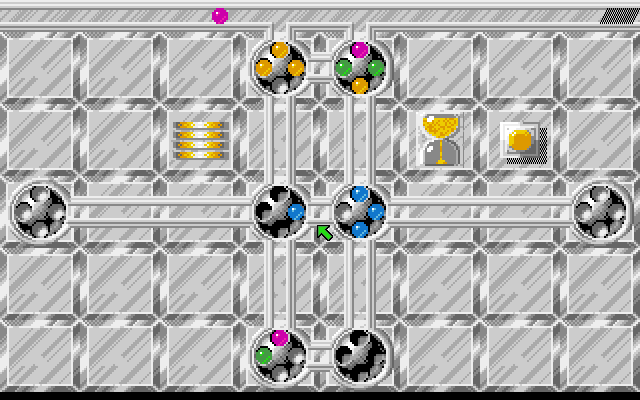
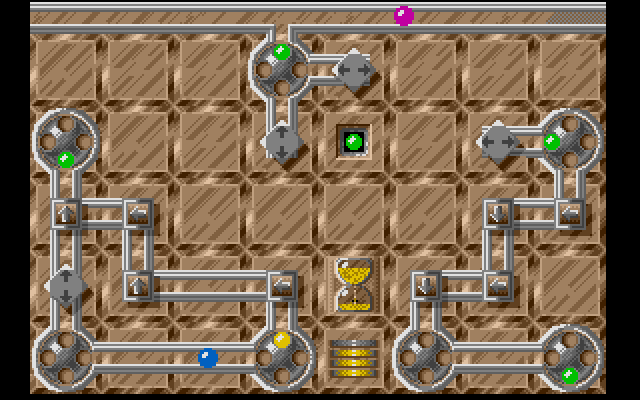
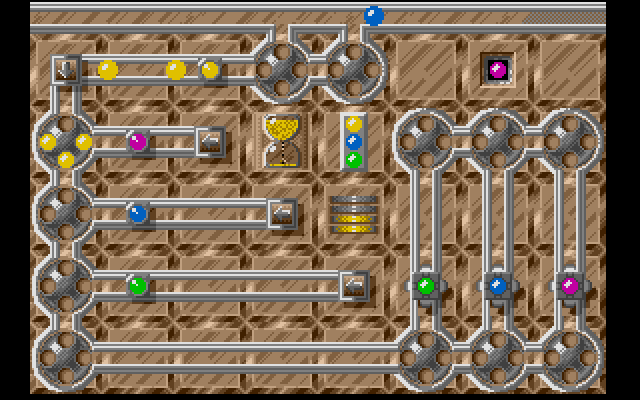
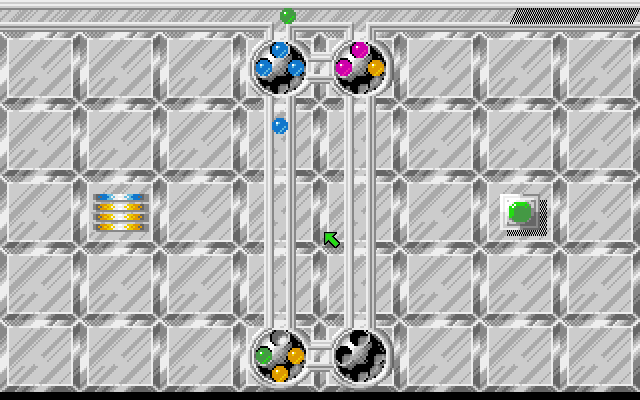
Log!cal’s core mechanic is deceptively simple: you must arrange clusters of four colored balls—green, purple, blue, or yellow—into quartets by manipulating a network of spinning orbs and connection paths. Each orb you encounter can be rotated at will, revealing new angles and linkages, and from there you pick a ball to send racing down the beam-like conduit that attaches it to the next hub. Successfully aligning four balls of the same hue clears them from the board, rewarding you with points and opening up fresh routes for more intricate combinations.
(HEY YOU!! We hope you enjoy! We try not to run ads. So basically, this is a very expensive hobby running this site. Please consider joining us for updates, forums, and more. Network w/ us to make some cash or friends while retro gaming, and you can win some free retro games for posting. Okay, carry on 👍)
As you advance through Log!cal’s myriad puzzles, the difficulty ramps up gracefully. Early levels introduce you to single-orb clusters and straightforward pathways, while later challenges present interlocking rings of spinning hubs and multi-segmented tunnels that demand careful foresight. The thrill of chaining quartets into cascading reactions keeps each stage feeling dynamic, as one well-timed move can trigger a chain that clears half the board in moments.
Controls are crisp and intuitive: clicking or tapping an orb rotates it, and a simple drag or directional input selects which ball to dispatch. This frictionless design allows you to focus entirely on puzzle-solving rather than wrestling with the interface. Though Log!cal’s learning curve is modest for puzzle veterans, newcomers may find themselves pausing frequently to plan the next spin-and-launch sequence—an indication of its capacity to engage both casual players and hardcore strategists alike.
Graphics
Visually, Log!cal opts for a sleek, minimalist aesthetic. The game board is rendered against a subdued backdrop, ensuring that each glossy sphere and neon-lit conduit stands out with perfect clarity. Orb surfaces reflect ambient light softly, imparting a tangible sense of weight and motion as they rotate in three-dimensional space. This restrained design choice keeps your attention firmly on the puzzle mechanics rather than forcing you to parse busy textures or distracting effects.
The color palette is purposefully vibrant: each hue is easily distinguishable, which is crucial when you’re racing against the clock to form quartets. Subtle glow effects highlight active pathways, guiding your eye to potential moves without resorting to obtrusive arrows or markers. Animations are smooth and responsive—balls glide through conduits with realistic momentum, and successful quartet clears are accompanied by a brief, satisfying flash that punctuates each victory.
Log!cal’s user interface follows the same design philosophy. Menus are cleanly laid out, with buttons and icons that respond instantly to your input. Tutorials are integrated seamlessly into early levels, utilizing concise pop-up text rather than pausing the action entirely. Whether you’re on a large monitor or a handheld device, the graphical elements scale gracefully, ensuring every spin and launch is rendered crisply with no loss of fidelity.
Story
Log!cal forgoes a traditional narrative in favor of an abstract, puzzle-first experience. There is no sprawling plot or character-driven arc—rather, the game invites you to interpret the mechanics as part of a larger, labyrinthine system. Each level feels like a chamber in a grand puzzle vault, and your goal is simply to unlock its secrets one quartet at a time. This sparse storytelling leaves room for personal interpretation and emphasizes pure cerebral engagement.
Though some players may miss cutscenes or voiced-over dialogue, Log!cal uses atmospheric sound design and ambient musical cues to create a subtle sense of place. Soft pulses and chimes mark each successful quartet, while a gentle electronic soundtrack underlies your journey. The lack of explicit narrative payoff translates into an almost meditative state: you’re not chasing plot twists so much as savoring the intellectual challenge.
For fans of narrative-light puzzles—or anyone who appreciates design that trusts players to find their own meaning—Log!cal’s abstract approach works beautifully. However, if you’re hoping for a story with defined characters or evolving lore, this game may feel too enigmatic. In that case, consider Log!cal an artful exercise in logic rather than an epic tale to be experienced.
Overall Experience
Putting all the pieces together, Log!cal delivers a polished, highly addictive puzzle package. Its blend of spinning orbs, colored quartets, and intricate connection pathways creates a distinctive challenge that stands out from typical match-three fare. The thoughtful progression of difficulty ensures that each new level introduces a twist or fresh constraint, keeping you engaged well beyond the initial handful of puzzles.
While the absence of a traditional story may deter those seeking narrative depth, the game’s atmospheric audio and minimalist visuals foster an immersive, almost hypnotic focus on problem-solving. Log!cal’s user-friendly controls, combined with its steady ramp in complexity, make it equally suitable for quick bite-sized sessions or marathon puzzle binges. Replay value is high—many early puzzles can be revisited to chase faster completion times or higher combo chains.
Ultimately, Log!cal is a must-play for puzzle enthusiasts craving a cerebral workout wrapped in sleek design. It’s approachable enough for newcomers yet offers enough depth and nuance to satisfy veterans. If you’re looking for a brain-teasing experience that balances clarity, challenge, and aesthetic refinement, this game will keep your synapses firing long after you’ve cleared the final quartet.


Reviews
There are no reviews yet.