 Retro Replay Retro Replay gaming reviews, news, emulation, geek stuff and more!


Retro Replay Review
Gameplay
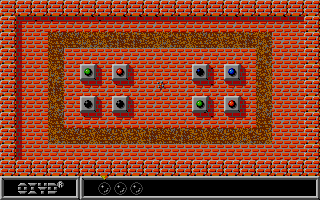
Oxyd’s core loop is deceptively simple: you guide a black orb through a series of intricate, maze-like “landscapes,” uncovering hidden oxydstones by rolling over them. Each stone reveals a colored symbol, and matching pairs of identical symbols keeps them permanently exposed. This memory-based mechanic turns every landscape into a tactile concentration exercise, challenging both your recall and your spatial awareness.
(HEY YOU!! We hope you enjoy! We try not to run ads. So basically, this is a very expensive hobby running this site. Please consider joining us for updates, forums, and more. Network w/ us to make some cash or friends while retro gaming, and you can win some free retro games for posting. Okay, carry on 👍)
Beyond the oxydstones, Oxyd layers on a wealth of environmental hazards and interactive elements. Pitfalls and quicksand force careful navigation, one-way walls demand forethought, and breakable tiles can shatter under your orb’s weight. Reflecting lasers introduce a Deflektor-style puzzle dimension, while movable blocks evoke Sokoban’s push-and-pull challenges. Doors, switches, and crumbling floor tiles further enrich each level’s puzzle tapestry.
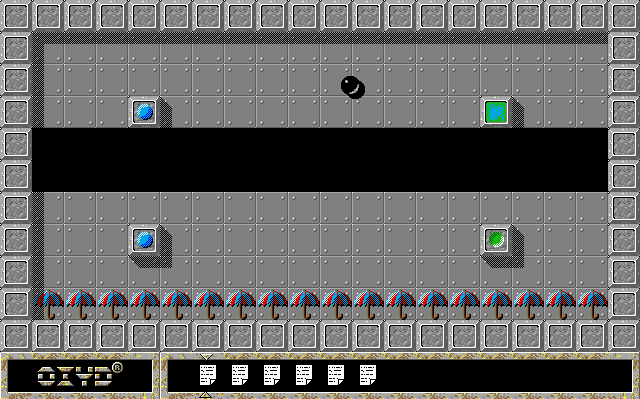
Scattered throughout many landscapes are handy items—notes that offer cryptic hints, umbrellas that grant temporary floating powers, bombs for blasting through sealed passages, and springs that launch you across yawning chasms. Each tool must be employed judiciously, as misusing an item can leave you stranded or force you to restart the landscape entirely.
Every tenth level shifts the paradigm with a “meditation landscape,” where you simultaneously juggle multiple green orbs, herding each one into its own pit to succeed. These multi-orb puzzles introduce a refreshing cooperative challenge with yourself, demanding split-second timing and spatial juggling that elevates Oxyd’s brain-teasing appeal.
Graphics
Oxyd opts for a clean, minimalist pixel aesthetic that prioritizes clarity over flash. Each landscape is color-coded to convey distinct themes—icy blues for frozen caverns, sandy tans for sunbaked dunes, and mossy greens for underground grottos—making it immediately obvious where hazards and oxydstones lie.
The black orb moves smoothly across tile-based floors, its rolling animation simple yet satisfying. Interactive elements like lasers and crumbling tiles come to life with crisp, high-contrast sprites that clearly signal danger. Though dated by modern standards, Oxyd’s visuals remain functional and charming, with just enough detail to keep you oriented in its complex mazes.
Item pickups and switches are represented by small icons that pop against the backdrop, ensuring you won’t miss important tools or turning points in a landscape. Even on low-resolution displays, Oxyd’s design preserves readability, preventing frustration that might arise from misjudging a jump or mistaking a safe tile for a pit.
Story
Oxyd does not burden you with an elaborate narrative; instead, the game’s “story” emerges from the act of puzzle-solving itself. The concept of a lone orb exploring a mysterious labyrinth hints at themes of discovery and introspection, inviting players to project their own motivations onto the black sphere as it unlocks hidden secrets.
Pieces of paper found in certain landscapes provide sparse, cryptic hints that double as the closest thing to a storyline. These notes stir curiosity—what is the labyrinth’s origin, and why are its oxydstones so carefully arranged? The answers remain deliberately opaque, preserving the focus on gameplay while sparking players’ imaginations.
The periodic meditation levels, in which you guide multiple orbs in concert, serve as a philosophical interlude. They emphasize harmony, coordination, and patience, reinforcing Oxyd’s central message: puzzling is as much about mental discipline and pattern recognition as it is about pushing blocks or dodging hazards.
Overall Experience
Oxyd is a masterclass in minimalist puzzle design, offering 200 distinct landscapes that range from relatively straightforward memory-matching to fiendishly complex, multi-layered challenges. The game’s learning curve is steep but rewarding; every new tile type or environmental mechanic feels like unlocking a fresh puzzle genre within the same world.
Replay value is built into the very fabric of Oxyd. Even landscapes you’ve cleared can be revisited under time pressure or with self-imposed constraints—no bombs, limited reveals, or speed runs—keeping the experience fresh. For puzzle aficionados, the game endures as a tranquil yet intellectually rigorous retreat.
Although Oxyd’s graphics and presentation are dated compared to modern titles, its timeless gameplay ensures wide appeal. Whether you’re a veteran of early ’90s shareware or a newcomer seeking a cerebral challenge, Oxyd provides a rich, hypnotic journey through a universe of memory tests, spatial puzzles, and quiet discoveries.


Reviews
There are no reviews yet.