 Retro Replay Retro Replay gaming reviews, news, emulation, geek stuff and more!


Retro Replay Review
Gameplay
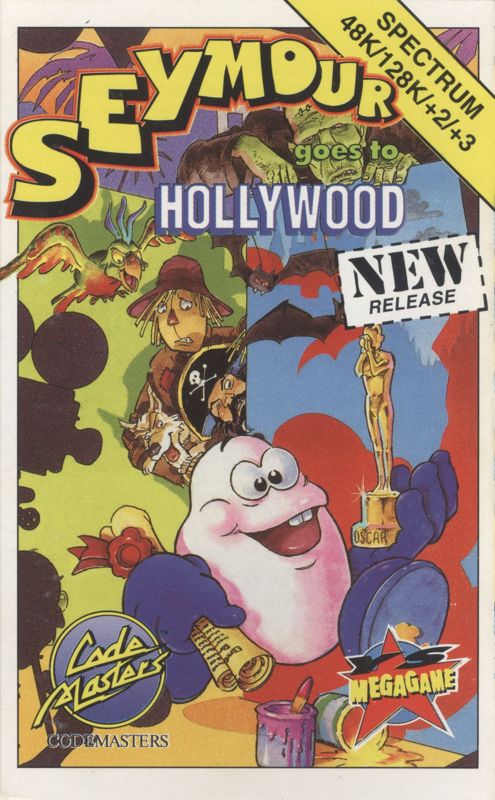
Seymour Goes to Hollywood delivers a classic platform-action experience that will feel instantly familiar to fans of the Dizzy series. You guide Seymour, an amorphous blob, across a sprawling studio backlot filled with props, sets, and hidden passageways. The core loop revolves around picking up every object you can find—using the fire button to grab items—and figuring out where each item belongs in order to progress.
(HEY YOU!! We hope you enjoy! We try not to run ads. So basically, this is a very expensive hobby running this site. Please consider joining us for updates, forums, and more. Network w/ us to make some cash or friends while retro gaming, and you can win some free retro games for posting. Okay, carry on 👍)
The game’s inventory system is refreshingly minimalist: you can only carry three items at a time, so you must constantly weigh the value of each object and backtrack when necessary. This restriction forces you to plan routes carefully and remember the locations of key props. Puzzles often hinge on using everyday studio items—like spotlights, director’s chairs, or film reels—in unexpected ways, turning the backlot into one big interactive playground.
Energy management adds an extra layer of challenge. Seymour’s energy bar ticks down whenever he collides with hazards—studio wreckage, booby-trapped sets, or fire effects left active. Lose all your energy and Seymour ends up as a pile of bones, costing you one of your three lives. With no way to save mid-adventure, you’ll need patience and persistence to master each area and avoid having to retrace your steps from the very beginning.
Graphics
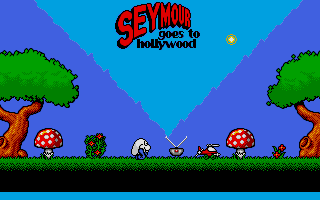
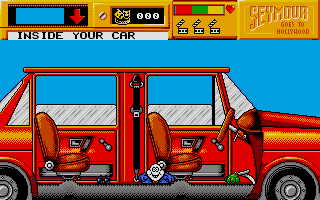
Visually, Seymour Goes to Hollywood embraces a colorful, cartoonish palette that captures the playful spirit of its Hollywood setting. Levels are rendered with bold outlines and distinct color blocks, making it easy to distinguish important objects from background scenery. Whether you’re navigating a glittering soundstage or slipping past flaming torches on a horror set, each area has its own visual identity.
The animations are surprisingly fluid for a game of this era. Seymour’s blob-like form stretches and squishes to match his movements, lending character to even routine actions like jumping or grabbing items. Environmental hazards—such as swinging studio lights or rolling camera dollies—also move with smooth, predictable patterns, allowing you to time your actions precisely.
Though the resolution and color depth are limited by 8-bit hardware, the game uses clever shading and repeated tile patterns to suggest depth and detail. Background elements like posters, cameras, and director’s clapboards help sell the Hollywood ambiance. For players who appreciate retro charm, the graphics strike a fine balance between simplicity and style.
Story
The premise of Seymour Goes to Hollywood is delightfully straightforward: Seymour is on his way to star in his first motion picture, only to learn that Dirk—the studio’s manager—has mysteriously vanished in Miami. With production hanging in the balance, Seymour takes it upon himself to assemble the sets and get filming underway. This lighthearted narrative provides just enough context to motivate your platforming exploits without bogging down the pace.
Storytelling is handled mostly through the layout of the studio itself and brief on-screen messages. You won’t find lengthy cutscenes or dialogue trees here; instead, the narrative unfolds as you collect items and restore order to the production. Finding a missing megaphone or replacing a burnt-out spotlight suddenly feels meaningful because each prop advances the film’s storyline, however minimally.
While the characters you meet are limited—mainly backstage mannequins and antagonistic hazards—the game’s whimsical tone shines through in its design. A runaway dolly becomes a comedic villain, and cobweb-filled corridors evoke the feel of an abandoned soundstage. In the absence of deep character development, Seymour’s cheerful resilience and the game’s playful environments keep the story engaging from start to finish.
Overall Experience
Seymour Goes to Hollywood offers a charming blend of platforming and puzzle-solving that will appeal to retro gamers and newcomers alike. The lack of a save feature adds old-school stakes to every leap and item swap, making victories feel genuinely hard-earned. Though the trial-and-error nature can be frustrating at times, perseverance is rewarded with satisfying “aha” moments when you finally crack a puzzle.
The game’s balance of challenge and accessibility is noteworthy. Controls are responsive, and the gradual introduction of new mechanics—inventory limits, energy management, complex hazards—helps you build confidence before tackling the toughest sections. Even seasoned platform veterans will appreciate the way Seymour Goes to Hollywood toys with expectations, hiding key items in plain sight and encouraging lateral thinking.
In short, Seymour Goes to Hollywood is a nostalgic trip through a pixelated movie studio filled with clever puzzles and vibrant scenery. Its minimal story and straightforward interface keep the focus squarely on gameplay, delivering an engaging experience that doesn’t overstay its welcome. For anyone seeking a platform adventure with a dash of Hollywood flair, Seymour’s debut is well worth the spotlight.


Reviews
There are no reviews yet.