 Retro Replay Retro Replay gaming reviews, news, emulation, geek stuff and more!
Retro Replay Review
Gameplay
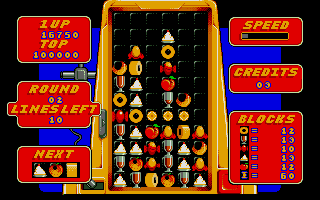
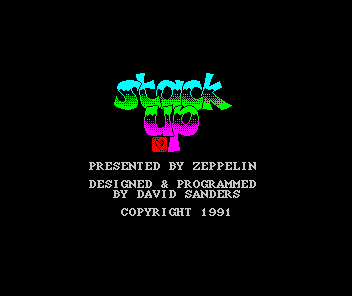
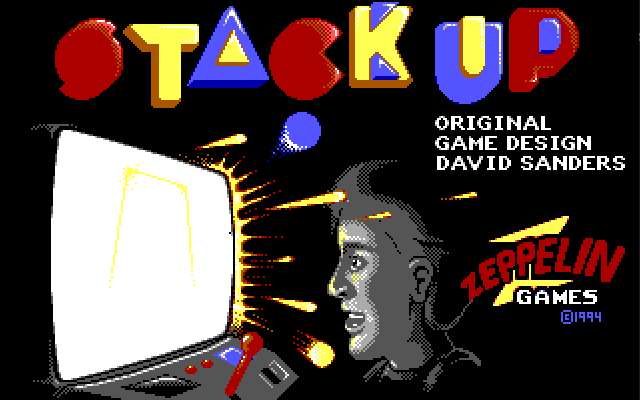
Stack Up expertly refines the classic “Columns” formula by shifting the focus from vertical arrangements to horizontal layouts. Each level challenges you to manipulate trios of colored blocks as they descend into a 6×18 grid, aiming to form lines of matching hues. This twist adds a fresh strategic layer: you must consider how each individual brick will drop independently, ensuring that the trio often splinters across multiple rows rather than landing as a single bar.
(HEY YOU!! We hope you enjoy! We try not to run ads. So basically, this is a very expensive hobby running this site. Please consider joining us for updates, forums, and more. Network w/ us to make some cash or friends while retro gaming, and you can win some free retro games for posting. Okay, carry on 👍)
The physics of block placement is a standout feature. When you commit a trio to the grid, gravity immediately takes over for each brick separately—no locked formations, no mid-air stops—so thinking several moves ahead becomes crucial. Once you clear a line, the remaining blocks above fill every gap automatically, guaranteeing a tightly packed grid with no floating pieces. This seamless “gapless” approach contrasts Tetris-style drop mechanics and keeps the action fast-paced.
Each stage presents a target number of lines to complete—combinations of four or five count as additional lines, reminiscent of Klax’s bonus structure. Horizontal clears yield the smallest point returns, vertical clears give a modest boost, and diagonals grant the highest multipliers. By incentivizing diagonal matches, Stack Up encourages creative stacking and rewards players who master complex drop patterns.
With steadily escalating difficulty, the game introduces new color variations and subtle grid modifiers as you advance. These tweaks maintain a comfortable learning curve while ensuring that veteran puzzle solvers will still feel tested. Whether you’re aiming for a casual high-score session or methodically grinding through each successive challenge, Stack Up’s core gameplay loop remains as addictive on minute fifteen as it does on minute one hundred.
Graphics
Stack Up’s visual presentation is a clean, vibrant homage to retro puzzle classics, yet it feels fully polished for modern screens. Each block is crisply rendered with bright primary colors that stand out clearly against the dark, minimalist grid background. The result is a color scheme that’s both eye-catching and functionally clear, even in the heat of a rapid cascade of falling pieces.
Subtle animations enhance the tactile sense of each drop: blocks exhibit a satisfying bounce on landing, and completed lines dissolve in a smooth, cascading fade. These visual flourishes keep the interface from feeling static without ever overwhelming the player or obscuring important gameplay information. The UI elements—score counter, next-piece preview, and line target indicators—are neatly arranged around the playfield, offering immediate readability.
Between stages, the backdrop shifts through a series of stylized gradient panels, providing visual variety without distracting from the core grid action. Ambient particle effects and a gentle glow on matched lines add depth, hinting at hidden mechanical sophistication behind the seemingly straightforward puzzle mechanics.
On high-resolution displays, Stack Up scales beautifully, retaining pixel-perfect clarity and vibrant contrast. Whether played in windowed mode on a desktop or full-screen on a large TV, the graphics engine delivers consistent performance, ensuring that the visual polish supports—and never compromises—the gameplay experience.
Story
While puzzle games seldom hinge on narrative, Stack Up weaves a light thematic layer into its progression. You are cast as a “Grid Architect,” summoned to restore balance to a fractured digital realm by realigning its corrupted data blocks. Each completed level represents a restoration of order, with brief lore snippets and stylized art breaching the fourth wall between challenges.
Between rounds, you encounter mystical glyphs and cryptic messages hinting at an ancient civilization that once harnessed the power of pure color. As you climb through the ranks of Grid Architect, these lore fragments gradually reveal a tale of hubris and redemption—though the game wisely keeps story beats short, ensuring they never interrupt the primary puzzle flow.
The minimalist storytelling approach is surprisingly effective: it provides just enough context to make each line clear feel purposeful, transforming abstract colored bricks into relics of a lost digital empire. For players seeking mere “tactical Tetris,” the narrative remains unobtrusive; for those craving a hint of world-building, the lore delivers a satisfying backdrop.
Ultimately, the story of Stack Up serves as a graceful narrative thread rather than a fully fleshed-out saga. It invites you to interpret the meaning behind the grid without overshadowing the core puzzle mechanics. In that sense, it strikes an ideal balance for both lore enthusiasts and pure gameplay purists.
Overall Experience
Stack Up strikes a harmonious balance between approachability and depth. Newcomers can dive in immediately, guided by simple controls and intuitive goals, while veteran puzzlers will find ample room to develop advanced drop strategies. The cleverly designed scoring system—rewarding diagonal and vertical lines—pushes you to experiment with unconventional stacking methods, invigorating the classic block-matching formula.
Replayability is a key strength. With multiple modes—campaign stages, endless endurance challenges, and time-attack runs—there’s always another personal best to chase. Coupled with local leaderboards and in-game achievements, Stack Up fosters a friendly competitive spirit, encouraging you to refine your technique and stack smarter, not just faster.
The audio package complements the visuals perfectly: upbeat electronic tunes and crisp sound effects heighten the sense of momentum, reinforcing each block’s satisfying thud. In the absence of a sprawling narrative, this audiovisual synergy grounds the experience, making every match feel both urgent and rewarding.
In sum, Stack Up is a polished, engaging puzzle title that revitalizes a proven concept with thoughtful innovations. Its tight gameplay mechanics, vibrant presentation, and subtle narrative touches combine into an experience that’s easy to learn yet challenging to master—an ideal pick for casual players, puzzle aficionados, and anyone looking for a smart, addictive way to spend a few minutes or a few hours.


Reviews
There are no reviews yet.