 Retro Replay Retro Replay gaming reviews, news, emulation, geek stuff and more!
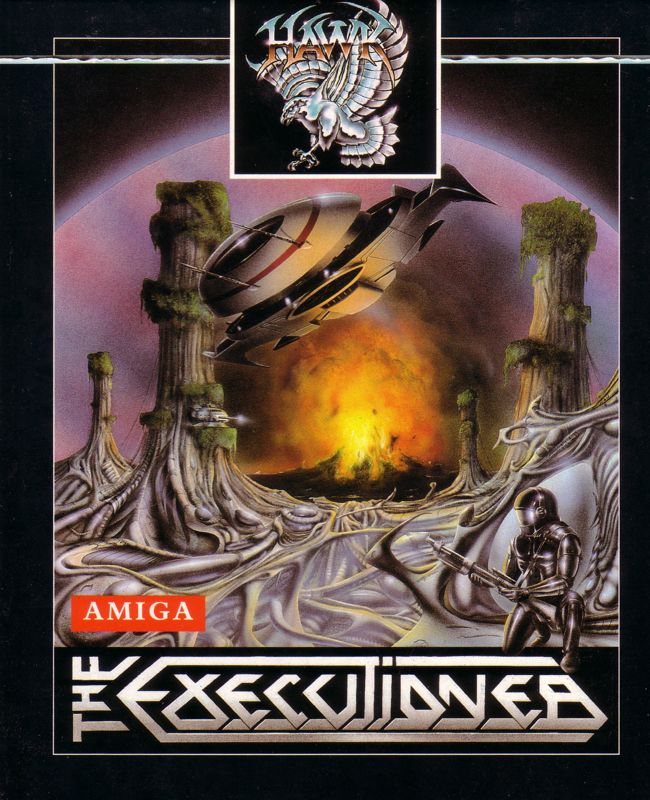
Retro Replay Review
Gameplay
The Executioner builds its challenge around a faithful recreation of classic Newtonian physics, offering a side-scrolling experience that demands precision control. You pilot a small craft through cavernous levels, balancing thrust and gravity to avoid catastrophic collisions. Unlike simpler arcade shooters, every adjustment to your engine’s power has real momentum implications, which makes strafing enemies or navigating tight tunnels a thrilling exercise in skill and timing.
(HEY YOU!! We hope you enjoy! We try not to run ads. So basically, this is a very expensive hobby running this site. Please consider joining us for updates, forums, and more. Network w/ us to make some cash or friends while retro gaming, and you can win some free retro games for posting. Okay, carry on 👍)
Beyond shooting foes, the game introduces a resource‐gathering mechanic by scattering fragments of a master key throughout the stages. Each piece is cleverly hidden behind obstacles or enclosed within pockets of hazardous terrain, encouraging methodical exploration. You’ll find yourself scouting out cavern walls and floating platforms, hunting out every nook and cranny before you attempt to tackle the end‐of‐level boss.
Perhaps most controversially, the Executioner lets you capture prisoners and extract information via torture, unlocking clues to remaining key fragments. This adds a tense risk‐and‐reward loop: do you risk further interrogation to speed up your progress, or do you sell prisoners as slaves in the in‐game marketplace for much‐needed ship upgrades? The mechanic pushes you to weigh immediate gains against longer‐term objectives, turning each kidnapping into a strategic decision rather than a mere trophy count.
Combat itself remains simple but satisfying. Your ship is armed with a basic energy cannon, and enemies often attack in predictable patterns, allowing you to learn and adapt through repetition. Boss encounters, by contrast, demand mastery of both your firing arc and your thrust controls: misjudge a shot or misfire your thrusters, and you’ll find yourself scrubbing across walls in a blaze of wreckage.
On the upgrade front, the in‐game shop offers a surprisingly deep set of options. Selling prisoners funds enhancements to your engines, shields, and weapons. Balancing the ethical cost of slavery—albeit in a fictional context—against power spikes adds a darker narrative undercurrent to what might otherwise be a straightforward shoot‐’em‐up loop.
Graphics
Visually, The Executioner embraces retro charm with a palette of sharp, contrasting colors that immediately evoke classic 8‐ and 16‐bit titles. Cavern walls are rendered in pixelated detail, each surface subtly variegated to hint at depth without overloading the screen. Despite its low‐res appearance, the game uses color coding smartly: key fragments, prisoners, and upgrade pickups all pop against the muted backgrounds.
Sprite animation is minimal yet effective. Enemies zip into view with brief, well‐timed frames that communicate motion despite their small size. Your ship’s thrust plume flickers in a handful of frames, but this simplicity works in the game’s favor, keeping the focus on your maneuvering rather than flashy effects.
Particle effects for explosions and projectile impacts are modest but serviceable, adding just enough flair without compromising the game’s performance or clarity. Even on busier screens—where multiple projectiles, sparks, and debris compete for attention—the frame rate remains rock solid, which is vital when split‐second decisions can mean the difference between success and obliteration.
The user interface stays true to old‐school sensibilities, featuring a minimalist HUD that displays key fragment count, prisoner numbers, and currency for the shop. No intrusive health bars or flashy damage indicators clutter the screen—your survival is literally the pulse in your control stick, not a numerical readout.
While you won’t find cutting‐edge shaders or high‐poly models, the cohesive aesthetic and responsive animations serve the gameplay perfectly. The Executioner’s graphics may feel simple by modern standards, but they’re precisely tuned to the game’s core physics‐based design.
Story
On the surface, The Executioner presents a utilitarian premise: assemble a fragmented key, infiltrate the enemy lair, and eliminate the final boss. But woven beneath this straightforward objective is a darker moral tapestry. Your willingness to subjugate and sell prisoners for profit speaks to a world where ethics are traded for tactical advantage, framing your pilot as an antihero rather than a white‐hat savior.
Little narrative exposition appears in text or cutscenes; instead, story emerges organically through gameplay mechanics. The presence of a torture system, a slave market, and a final showdown implies a larger conflict in which lawlessness reigns supreme. You’re not just an adventurer—you’re a product of a jagged universe where power is harvested from the weak.
Despite its minimalistic storytelling approach, small touches—like overheard radio chatter or the brief profile displayed for each prisoner—lend weight to the proceedings. Each captive has a snippet of backstory, making the act of selling or torturing them feel more than a mechanical step toward upgrades; it’s a moment of ethical discomfort that few action‐shooters explore.
The final confrontation, once you’ve reassembled the key, serves as a thematic culmination of your previous choices. You’ve exploited gravity and physics, manipulated lives for gain, and now face the architect of this system. The boss fight doubles as a narrative reckoning: everything you’ve learned—and every questionable decision—boils down to this ultimate test.
While there’s no lengthy script to dissect, The Executioner uses its mechanics to tell a story about moral compromise in high‐stakes environments. The result is a narrative experience that stays with you long after the credits roll, precisely because it’s atypical for the genre.
Overall Experience
The Executioner is a lean, relentless action title that thrives on its fusion of classic physics‐based gameplay and morally complex mechanics. Its steep learning curve—stemming from authentic Newtonian thrust controls—will both frustrate and exhilarate players seeking a hardcore challenge. Success is earned through iterative skill, making each cleared level deeply satisfying.
Graphics and audio fall squarely in the retro camp, but they harmonize perfectly with the design goals. There are no visual distractions or performance hitches, only clean sprites and crisp particle effects that reinforce the game’s high‐stakes atmosphere. The absence of modern graphical bells and whistles feels intentional, ensuring that your focus stays trained on momentum and targeting.
Perhaps most memorable is the ethical dimension introduced by prisoner management. Whether you decide to use torture for intel or profit from the slave market, each choice carries narrative weight. This layer of consequence elevates the experience beyond simple run‐and‐gun mechanics, encouraging repeated plays to explore different moral permutations.
In terms of longevity, the Executioner offers multiple difficulty tiers and a scoreboard that invites mastery. Speedrunners will appreciate the tight physics, while completionists can track down every key fragment and experiment with every upgrade path. With its blend of old‐school challenge and thought‐provoking systems, the game stands out in a crowded indie shooter landscape.
If you’re drawn to precision‐based flight controls, retro aesthetics, and a dose of moral ambiguity, The Executioner delivers an engaging package. It’s a succinct, potent experience that rewards patience and punishes recklessness—just as any great “reworked classic” should.



Reviews
There are no reviews yet.