 Retro Replay Retro Replay gaming reviews, news, emulation, geek stuff and more!




Retro Replay Review
Gameplay
A View to a Kill: The Computer Game puts you directly in the sleek shoes of James Bond, Tasked with foiling Max Zorin’s twisted plan to dominate the global microchip market by triggering a catastrophic earthquake in Silicon Valley. From the opening moments, you’ll find a mix of high-speed vehicular pursuit, precision platforming and nerve-racking puzzle-solving. The mission structure alternates between adrenaline-pumping chases in Paris and tense bomb-disarmament puzzles in the bowels of a San Francisco mine, ensuring the pace rarely lets you catch your breath.
(HEY YOU!! We hope you enjoy! We try not to run ads. So basically, this is a very expensive hobby running this site. Please consider joining us for updates, forums, and more. Network w/ us to make some cash or friends while retro gaming, and you can win some free retro games for posting. Okay, carry on 👍)
In Paris, you’re behind the wheel of the iconic Bond vehicle, barreling along winding city streets in hot pursuit of Zorin’s lethal henchwoman Mayday. The chase sequence tasks you with maintaining speed, dodging traffic and reacting to Mayday’s unpredictable parachute maneuvers. It’s an inventive level that captures the cinematic feel of the movie—and it demands keen timing and quick reflexes to stay close enough to neutralize the threat without crashing.
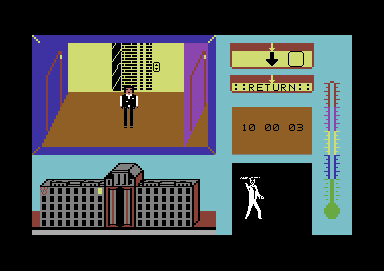
Once you touch down on U.S. soil, the game shifts gears to a stealth-and-puzzle affair. A visit to City Hall tests your observational skills, prompting you to scour offices for intel, hack rudimentary security systems and subtly avoid guard patrols. But the true climax unfolds deep in an abandoned mine, where disarming the ticking doomsday bomb hinges on deciphering circuit diagrams and manipulating rudimentary tools under time pressure. Fail, and you’ll watch Silicon Valley sink beneath the waves in a dramatic, if somewhat pixelated, sequence.
Graphics
Visually, A View to a Kill: The Computer Game embraces the pixel art aesthetic of late-’80s home computers, delivering environments that brim with nostalgic charm. Parisian rooftops and narrow boulevards are rendered in muted earth tones, while the San Francisco sequences showcase a foggy skyline and detailed mine shafts. Animations are fairly fluid for the era, though modern eyes may spot occasional sprite flicker or simplistic backgrounds during cutscenes.
Character sprites capture Bond and key villains with surprising personality. Bond’s tuxedo-clad frame and Mayday’s distinctive silhouette are immediately recognizable, even in low resolution. Simple but effective color palettes help each locale feel unique: Paris glows with artful streetlights at dusk, while City Hall’s marbled halls are steeped in muted grays and cold blues. The mine’s interior is darker still, with eerie lantern-lit corridors that heighten the sense of danger.
Effects for weapon fire, small explosions and the ultimate quake sequence are basic but serviceable, lending each action moment some visual punch. Though the game relies on abstraction rather than photorealism, its crisp sprite work and clear level layouts ensure you always know where you stand—and where the next threat might spring from.
Story
The overarching narrative takes direct inspiration from the A View to a Kill film, weaving a plot centered on corporate sabotage, global intrigue and classic Bond one-liners. You learn early that Max Zorin aims to ‘redefine’ the microchip industry by flooding Silicon Valley—literally—through a man-made earthquake. This high-concept premise provides a tangible ticking clock that drives every mission.
Dialogues and in-game text snippets between levels flesh out motivations for secondary characters, from the ruthless Mayday to Zorin’s cadre of mercenaries. While expository sequences are brief, they establish enough detail to make your few lines of coded text feel like part of a broader spy thriller. Bond’s characteristic dry wit surfaces in mission briefings, delivering flavor even if the writing occasionally dips into cliché.
Although the story doesn’t deviate significantly from the film’s outline, the game’s creative license in staging new challenges—such as extra puzzle rooms in City Hall or bonus collectible items in Paris—adds incentive for exploration. Fans of the movie will appreciate these nods, and newcomers will find a compelling spy saga that remains coherent even without prior knowledge of the Bond canon.
Overall Experience
A View to a Kill: The Computer Game stands as a solid representation of early action-adventure design. Its blend of vehicular chases, stealth segments and puzzle-based bomb defusal offers enough variety to keep most players engaged across multiple sessions. Difficulty is moderate, with some trial-and-error demanded by precision jumps or circuit puzzle mechanics, but save points are reasonably placed to avoid frustration.
Audio support—chiptune adaptations of classic Bond themes and sparse sound effects—imbues the game with atmosphere, though it may feel simplistic by today’s standards. Yet, the nostalgic crackle and bleeps will resonate with retro enthusiasts and complement the on-screen action without overwhelming it.
For prospective buyers, A View to a Kill: The Computer Game represents a time capsule of licensed Bond adventures. If you’re drawn to vintage graphics, varied level design and the chance to thwart a microchip tycoon’s apocalyptic scheme, it’s worth exploring. While modern action games may outshine it in polish and scope, this title delivers a rewarding, old-school spy thriller experience that still holds a certain playable charm.


Reviews
There are no reviews yet.