 Retro Replay Retro Replay gaming reviews, news, emulation, geek stuff and more!


Retro Replay Review
Gameplay
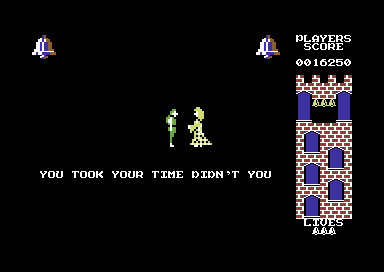
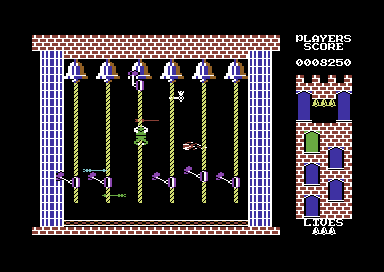
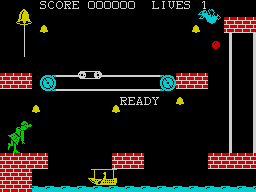
The archetype of the Hunchback of Notre Dame really isn’t terribly nuanced: he jumps around towers, ringing bells, rescuing Esmeralda and being generally physically unattractive. Here he does all of these things, in a more platform-oriented take than the original, clambering up dangling ropes as they rise and fall, avoiding environmental threats such as rabid bats, thrown hatchets and enormous grinding clockwork gears all in the pursuit of small bells strewn across each screen’s platforms. Gathering all the bells permits you to advance higher up the tower, at the top of which the damsel in distress awaits your homely visage.
(HEY YOU!! We hope you enjoy! We try not to run ads. So basically, this is a very expensive hobby running this site. Please consider joining us for updates, forums, and more. Network w/ us to make some cash or friends while retro gaming, and you can win some free retro games for posting. Okay, carry on 👍)
Controls feel responsive, with Quasimodo able to leap between platforms, grab moving ropes, and briefly hang in midair to line up his next move. Each level is designed around vertical progression, demanding precision timing to avoid hazards that can send him plummeting back down. While early stages ease you in with slower-moving obstacles, later encounters lock you into tight corridors of gears and swinging axes, rewarding memorization as much as raw reflexes.
Level design shows a steady ramp in difficulty: later towers introduce shifting platforms that break away after contact, walls of flame that spread across ledges, and timed sequences where missing a single jump forces a restart. Though the challenge can feel punishing, checkpoints are placed frequently enough to limit frustration. Completionists will appreciate hidden alcoves with bonus bells, offering additional replay value for score chasers.
Despite its simplicity, the core loop of climbing, bell collection, and bat avoidance remains engaging through all ten stages. There are no power-ups beyond extra lives, but cleverly designed set-pieces keep each tower distinct. Whether you’re a hardcore platform veteran or a newcomer seeking a retro challenge, Hunchback II’s straightforward mechanics deliver a satisfying test of skill.
Graphics
Visually, Hunchback II embraces a colorful, cartoonish aesthetic that captures the medieval tower setting without veering into grim realism. Quasimodo’s sprite is surprisingly detailed, complete with a flowing robe and expressive face, and each enemy—be it a snarling bat or a spinning gear blade—is easily identifiable against the backgrounds.
Animation is smooth for its era: ropes sway naturally, gears spin convincingly, and Esmeralda’s outline at the top of the tower shimmers to signal player progress. Backgrounds feature stained-glass windows, mossy brickwork, and distant cityscapes, contributing to an immersive sense of place that feels richer than many contemporaries.
While the color palette occasionally leans toward muddy browns in the lower tower sections, the game compensates with vibrant flashes whenever a bell is collected or a special event triggers. The combination of dynamic sprites and parallax scrolling in some segments gives Hunchback II a visual polish that belies its modest hardware requirements.
Story
Hunchback II: Quasimodo’s Revenge doesn’t reinvent Victor Hugo’s classic tale, but it provides just enough narrative framework to justify the endless climb. The premise is simple: Esmeralda has once again been taken captive, and our hunchback hero must ascend the tower’s treacherous heights to free her.
Story beats are delivered through minimal interstitial screens—typically a short title card before each level boasting a bit of flavor text. There are no voiced cutscenes or branching dialogue, yet the sense of urgency is palpable, driven by in-game hazards that feel directly tied to a gauntlet set by the antagonist.
While purists might bemoan the absence of deeper character development, the game’s focus on vertical platforming action keeps the narrative moving at a brisk clip. By the time you reach the final summit, you’ve invested enough hours overcoming traps and collecting bells to make the final rescue feel earned.
Overall Experience
Hunchback II: Quasimodo’s Revenge strikes a satisfying balance between retro platformer simplicity and escalating difficulty. Its precise controls and varied hazards keep each level fresh, while clever visual cues guide you through complex sequences without hand-holding.
The challenge is unapologetically old-school, demanding pattern recognition and split-second timing. Yet the generous use of checkpoints and occasional bonus areas ensures that perseverance, rather than luck, determines success.
For fans of classic arcade-style platformers, Hunchback II offers a tight, rewarding climb filled with memorable set-pieces—swooping bats, deadly hatchets, and massive clockwork gears all stand between Quasimodo and his prize. Modern players seeking a brisk, skill-focused romp will find plenty to enjoy here.
Overall, Hunchback II captures the charm of its predecessor while introducing enough new mechanics to feel like a worthy sequel. If you’re in the market for a challenging vertical platformer with character and flair, Quasimodo’s Revenge is well worth the ascent.



Reviews
There are no reviews yet.