 Retro Replay Retro Replay gaming reviews, news, emulation, geek stuff and more!

Retro Replay Review
Gameplay
Knight Lore’s gameplay is built around a series of self-contained rooms, each functioning as a mini-puzzle that combines platforming, object interaction, and careful timing. As our hero races against the clock to reach Melkhior the wizard, players must collect keys, activate switches, and avoid lethal traps on every screen. The blend of exploration and trial-and-error encourages meticulous planning: one wrong move can force you to restart a room or even cost precious in-game time.
(HEY YOU!! We hope you enjoy! We try not to run ads. So basically, this is a very expensive hobby running this site. Please consider joining us for updates, forums, and more. Network w/ us to make some cash or friends while retro gaming, and you can win some free retro games for posting. Okay, carry on 👍)
Each of the game’s 128 rooms presents a unique challenge. Some screens demand precise jumps across moving platforms or thin ledges, while others hinge on manipulating objects—pushing blocks into slots or dropping barrels to bridge gaps. The real test, however, comes from the day/night cycle: as daylight fades, the protagonist transforms into a werewolf, altering his jump height and movement speed and adding a new layer of complexity to your strategy.
This dynamic transformation ensures that no two play sessions feel identical. The first few days allow you to learn the castle’s layout in human form, but as nights draw in, you must adapt to the werewolf’s abilities and limitations. This mechanic not only raises the stakes but also injects a palpable tension into each decision, making every leap and puzzle solution all the more satisfying when you succeed.
Graphics
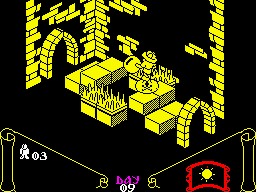
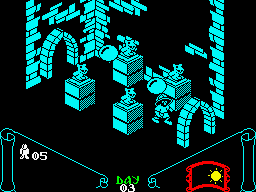
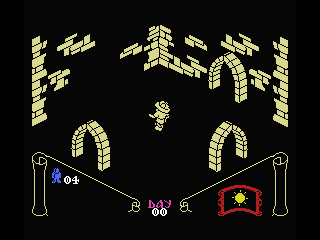
Knight Lore was groundbreaking in its use of an isometric viewpoint on 8-bit hardware. Though rendered in monochrome, the detailed sprite work and cleverly shaded walls create a convincing 3D illusion. Ultimate Play the Game’s engineers employed techniques to minimize flicker, ensuring that moving objects and the player character remain distinctly visible even amidst complex screen transitions.
Despite the ZX Spectrum’s color constraints, the game’s environments feel rich and varied. Ornate archways, decorative pillars, and patterned floors are all carefully drawn to distinguish different rooms and aid navigation. The absence of color is offset by strong contrasts and well-defined lines, which not only look sharp but also help you identify hazards at a glance.
Every visual element serves both an aesthetic and functional purpose. Interactive objects like chandeliers and spinning blades are animated smoothly, giving life to the castle’s perils. The subtle flicker-avoidance tricks mean that you’re never guessing where a moving platform might be—you always have clear visual feedback, which is crucial when timing your jumps to the frame.
Story
At its heart, Knight Lore tells a simple yet evocative tale: our hero has been cursed with lycanthropy and must reach Melkhior, the only wizard capable of lifting the affliction. Unlike modern games that spoon-feed their plots, Knight Lore unfolds its narrative through an atmospheric rhyming poem. This succinct verse sets the scene, introducing a sense of mystery and urgency that permeates every hour you spend in the castle.
Ultimate Play the Game’s penchant for riddles and minimal hand-holding heightens the adventure. Rather than lengthy cutscenes, the game relies on visual storytelling and cryptic clues scattered throughout the rooms. Solving each puzzle brings you one step closer to Melkhior’s chamber, and the sparse but effective lore construction leaves room for your imagination to fill in the gaps.
The day/night transformation underpins the narrative’s emotional core. By day, you’re a determined hero navigating intricate pathways; by night, you’re a powerful but uncontrollable creature struggling against time itself. This duality not only reinforces the curse’s thematic weight but also makes the ultimate confrontation with Melkhior feel like a well-deserved culmination of both puzzle-solving prowess and narrative tension.
Overall Experience
Knight Lore remains a shining example of elegant design overcoming hardware limitations. Its tightly crafted puzzles, memorable isometric visuals, and atmospheric storytelling combine into a cohesive experience that still holds up decades after its release. While the difficulty curve can be steep—particularly once the werewolf form comes into play—each triumph feels genuinely earned.
For fans of classic platformers and puzzle adventures, Knight Lore offers a masterclass in level design. The absence of explicit maps or walkthroughs encourages exploration and experimentation, rewarding careful observation and creative thinking. Even today, there’s a special charm in discovering a hidden shortcut or mastering a tricky jump that makes you feel like you’ve cracked the game’s secret code.
Ultimately, Knight Lore is more than a relic of gaming history; it’s a timeless adventure that challenges and delights in equal measure. If you’re seeking a game that demands both strategic planning and nimble reflexes, with a touch of old-school mystique, this gothic isle of puzzles may very well be your next obsession.


Reviews
There are no reviews yet.