 Retro Replay Retro Replay gaming reviews, news, emulation, geek stuff and more!



Retro Replay Review
Gameplay
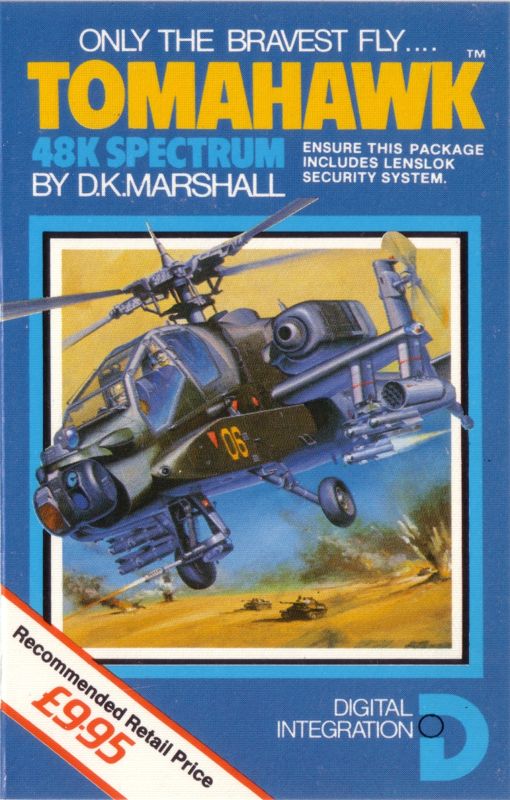
Tomahawk’s hallmark lies in its authentic flight simulation mechanics, delivering an impressively realistic representation of piloting an AH-64 Apache helicopter. From the moment you take off, altitude directly affects airspeed, and you’ll find yourself fine-tuning collective and cyclic controls to maintain a steady hover or execute a rapid climb. The game’s support for dual-joystick setups through the Sinclair interface means you can assign pitch and roll to one stick while dedicating the other to yaw adjustments—just as in a true Apache cockpit.
(HEY YOU!! We hope you enjoy! We try not to run ads. So basically, this is a very expensive hobby running this site. Please consider joining us for updates, forums, and more. Network w/ us to make some cash or friends while retro gaming, and you can win some free retro games for posting. Okay, carry on 👍)
The armament system further deepens the gameplay, offering a selection of cannons, rockets, and anti-tank missiles. Each weapon type has its own targeting process, and although only one can be loaded at a time, the decision of which ordnance to carry adds a strategic layer before every sortie. You’ll balance the need for rapid-fire cannon bursts against the destructive power of rockets and the precision of guided missiles, adapting your loadout to the mission’s objectives.
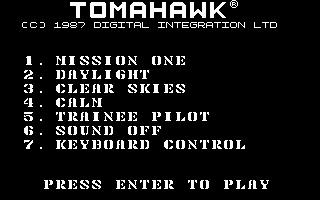
Flexibility in environmental conditions allows both newcomers and seasoned virtual aviators to find their comfort zone. You can choose between day or night operations, toggle cloud cover, and introduce air turbulence to simulate challenging conditions. Enemy presence ranges from patrol helicopters to ground-based turrets and heavily armored tanks, ensuring that each mission tests your situational awareness and weapons management in a dynamic battlefield.
Graphics
Considering its era, Tomahawk’s graphical presentation strikes a impressive balance between performance and visual fidelity. Landscapes are populated by block-style trees, rolling hills, and geometric mountain ranges that create a convincing battlefield environment. While textures may appear simplistic by modern standards, the distinct silhouettes of pylons, bridges, and enemy emplacements make target identification swift and decisive.
Instrument panels in the cockpit are rendered with clear readouts and responsive gauges, allowing you to monitor airspeed, altitude, and weapon status at a glance. The heads-up display integrates seamlessly with the virtual cockpit, overlaying critical information without obstructing your view of the terrain below. This combination of external and internal visuals helps maintain immersion during both low-level strafing runs and high-altitude reconnaissance loops.
Weather effects, though limited, convey meaningful variation. Transitioning from clear skies to a heavy cloud deck reduces visibility and forces reliance on your instruments. Night missions introduce stark contrasts between dimly lit gauges and the dark horizon, while the occasional lightning flash during turbulent settings adds a dramatic flair to the nighttime skies.
Story
Tomahawk’s narrative framework is chaptered into a series of standalone missions rather than a continuous campaign, each introduced by mission briefings that establish objectives and threat assessments. You take on assignments ranging from close air support of friendly convoys to covert reconnaissance sweeps behind enemy lines. Though the storyline is sparse, the briefings are concise and functional, giving just enough context to encourage tactical planning before takeoff.
The game’s scenarios are loosely set within a generalized modern-theater conflict, focusing on the Apache’s role in neutralizing armored columns and hostile air assets. Mission goals evolve from simple target-destruction tasks to complex multi-stage operations requiring coordination between ground forces and allied helicopters. The absence of a rich narrative arc is offset by the variability of objectives, which keeps each mission fresh even without a sprawling plotline.
Dialogue is minimal, relying instead on mission parameters to drive engagement. Radio chatter and status updates from briefings help maintain a sense of urgency, though you’ll mainly be motivated by the challenge of mastering the helicopter’s systems. If you’re seeking an intricate storyline with deep character development, Tomahawk may feel light on narrative—but its mission diversity compensates by offering a breadth of combat scenarios.
Overall Experience
Tomahawk delivers a robust helicopter simulation experience that prioritizes authenticity and depth of control. Its learning curve can be steep—managing lift, yaw, and bank all at once requires patience and practice—but the satisfaction of perfecting a low-altitude rocket run or a precise missile lock on a distant tank is wholly rewarding. For simulation enthusiasts, this title captures the essence of Apache operations in a compelling package.
Replay value is enhanced by the adjustable difficulty settings: novices can disable turbulence and enjoy clear weather flights, while veterans can crank up all the environmental challenges for a true test of their piloting prowess. The mission variety, from open desert battlegrounds to forested valleys, keeps the gameplay loop engaging, and the option to customize flight conditions makes each session feel unique.
While modern gamers might find the graphics rudimentary and the story bare-bones, Tomahawk remains a significant title for those interested in vintage flight sims or military aviation history. Its dedication to realistic control mechanics, comprehensive instrument feedback, and scenario flexibility cements its status as a classic among rotary-wing aficionados. If you’re in the market for a pure helicopter sim that emphasizes technical fidelity over cinematic spectacle, Tomahawk is well worth your attention.


Reviews
There are no reviews yet.