 Retro Replay Retro Replay gaming reviews, news, emulation, geek stuff and more!


Retro Replay Review
Gameplay
Aevum Obscurum places you at the helm of a burgeoning medieval empire in 1300 Europe, tasking you with forging alliances, waging wars, and managing your realm’s economy and population. The core loop revolves around a turn-based system that simulates a play-by-mail environment—each turn offers a window to issue orders on military campaigns, allocate resources for population growth, and adjust tax rates to fuel your expansion. For strategy enthusiasts, every decision carries weight, as mismanaging your economy can leave you vulnerable on the battlefield and stall your diplomatic ambitions.
(HEY YOU!! We hope you enjoy! We try not to run ads. So basically, this is a very expensive hobby running this site. Please consider joining us for updates, forums, and more. Network w/ us to make some cash or friends while retro gaming, and you can win some free retro games for posting. Okay, carry on 👍)
One of the game’s defining features is its robust multiplayer mode, accommodating more than fifty players in a single session. Interaction happens organically through an in-game messaging interface and a dedicated diplomacy panel. You can propose alliances, negotiate non-aggression pacts, or even broker cease-fires when war drains your coffers. These human-driven dynamics introduce a layer of unpredictability and excitement that no AI opponent can replicate.
For those who prefer a solitary experience, Aevum Obscurum offers a single-player mode with AI-controlled rivals. While the AI can emulate strategic decision-making, veteran players may find it less crafty than human opponents. Nevertheless, the solo mode is an excellent way to learn the mechanics, explore different economic strategies, and practice military tactics before diving into the competitive multiplayer arena.
Graphics
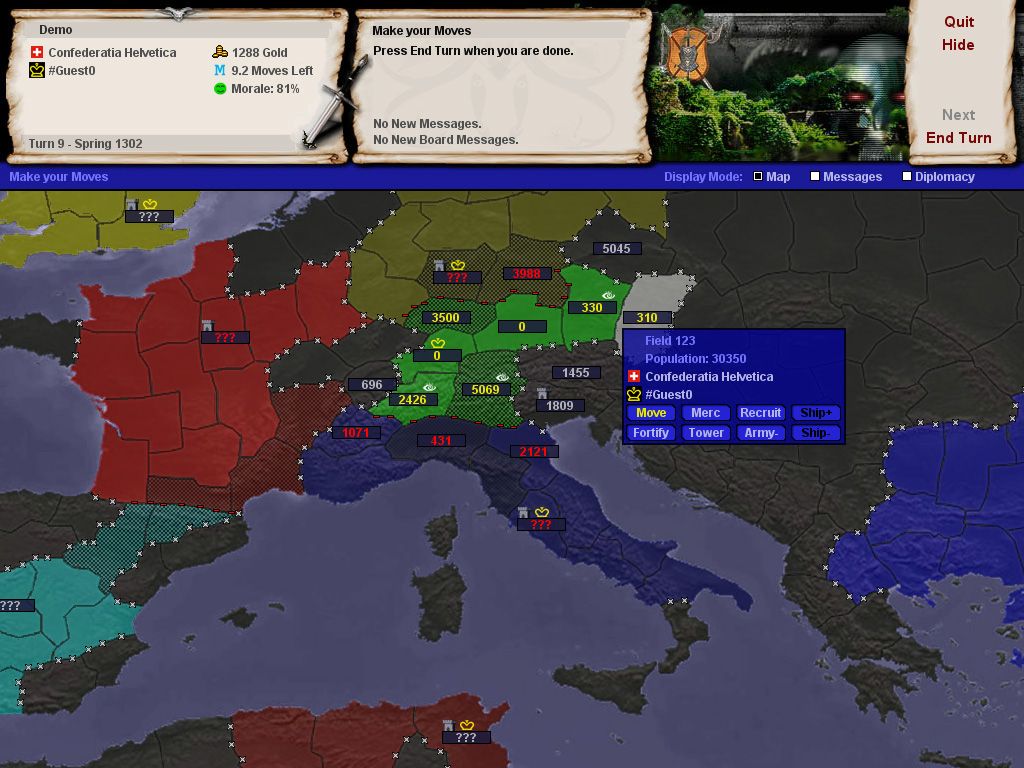
Visually, Aevum Obscurum opts for a functional, map-centric interface rather than flashy, real-time 3D models. The game board is rendered in crisp 2D, with each province delineated by clear borders and color-coded according to political allegiance. Icons representing armies, fleets, and resources are immediately recognizable, making it easy to assess the state of your empire at a glance.
Animations are modest but purposeful: troop movements and battle resolves unfold with simple yet satisfying transitions, while diplomatic actions trigger informative pop-up windows. Though the graphics won’t win awards for realism, they serve the game’s strategic emphasis exceptionally well, ensuring that clarity and usability take precedence over visual spectacle.
Customization options allow you to adjust the UI scale, toggle map overlays for things like trade routes and population density, and choose between various colorblind-friendly palettes. These accessibility features demonstrate the developers’ commitment to accommodating a wide range of players, ensuring that everyone can navigate the map and interpret data with ease.
Story
Unlike narrative-driven titles, Aevum Obscurum forgoes a scripted storyline in favor of emergent historical drama. The “story” unfolds through your interactions: forging betrayals, sealing marriages for political gain, or rallying vassals to repel invaders. Each multiplayer session weaves its own tapestry of alliances and rivalries, meaning your campaign’s highlights are dictated by diplomatic intrigue as much as by battlefield heroics.
In single-player mode, brief historical flavor text sets the stage for each game, providing context about the feudal landscape and notable families vying for power. While these vignettes are concise, they enhance immersion by reminding you of the era’s complex social hierarchies and the stakes of territorial conquest.
The emergent narrative extends to economic and demographic developments, too. Watching a once-neglected province flourish under your stewardship or witnessing a famine triggered by poor harvest management adds another layer of story to your reign. These systemic events reinforce the idea that every decision you make reverberates through the world, shaping the unique saga of your empire.
Overall Experience
Aevum Obscurum excels as a deep, turn-based strategy platform that balances economic micromanagement, military conquest, and diplomatic nuance. The learning curve can feel steep at first, but a thoughtful tutorial and well-documented help files ease new players into the complex systems. Those willing to invest the time will be rewarded with a highly replayable experience that evolves with each campaign.
The multiplayer environment is the game’s beating heart: forging alliances or backstabbing fellow rulers in real time creates memorable moments you won’t find in single-player skirmishes. However, if you’re mainly interested in rapid, action-packed gameplay, the deliberate pace of the turn-based system may test your patience. This is a title for strategy purists who revel in plotting their next move rather than twitch-based combat.
Ultimately, Aevum Obscurum offers a compelling package for fans of historical strategy. Its accessible interface, deep diplomatic tools, and emergent storytelling ensure that every session feels fresh. Whether you’re carving out a continental empire solo or jockeying for position among dozens of real players, this medieval conquest simulator provides a rich, engrossing sandbox that can keep you strategizing for months on end.


Reviews
There are no reviews yet.