 Retro Replay Retro Replay gaming reviews, news, emulation, geek stuff and more!


Retro Replay Review
Gameplay
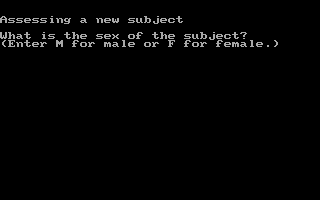
Mind Prober centers on an interactive questionnaire that guides players through 23 carefully chosen adjectives—everything from talkative and pleasure-seeking to disciplined and curious. Each adjective forms the basis of a short, targeted prompt, asking you to rate yourself or someone else on a clear scale. The pacing is thoughtful, letting you deliberate on each trait without feeling rushed, and the branching logic changes subtly based on your gender and age category, ensuring a personalized experience.
(HEY YOU!! We hope you enjoy! We try not to run ads. So basically, this is a very expensive hobby running this site. Please consider joining us for updates, forums, and more. Network w/ us to make some cash or friends while retro gaming, and you can win some free retro games for posting. Okay, carry on 👍)
The decision to tailor questions by gender (male or female) and age (under 18 or 18 and older) adds depth to the gameplay. It avoids a one-size-fits-all approach and acknowledges that personality assessments can vary greatly across different demographics. This design choice makes the process feel more inclusive and relevant, though it may raise questions about binary classifications for some players.
Beyond mere question-and-answer mechanics, Mind Prober rewards careful consideration with its built-in progress tracker and instant feedback system. You can see how far you’ve come and what remains, which helps maintain focus during longer sessions. It isn’t a fast-paced action title, but for a self-reflective tool, it strikes the right balance between guidance and autonomy.
For those who appreciate a structured, introspective challenge, the gameplay loop of reading, reflecting, and rating feels surprisingly engaging. There’s an almost meditative quality to working through the list of adjectives, making it easy to lose track of time in pursuit of self-knowledge. And if you choose to rate someone else—friend, partner, or colleague—those insights can lead to lively discussions once the results appear.
Graphics
Mind Prober’s visual presentation leans heavily on simplicity, favoring clean text interfaces and minimalistic iconography over flashy 3D models or dynamic cutscenes. Each question is displayed in crisp, legible typography against a soft background, minimizing distractions so you can focus entirely on your responses. The color palette is muted but professional, creating a welcoming environment rather than an adrenaline-fueled spectacle.
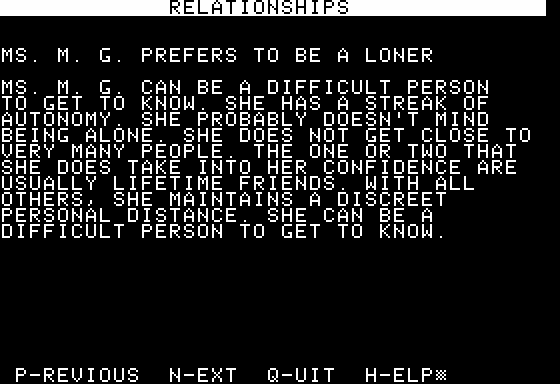
While those seeking high-end visual effects may find the graphics underwhelming, the design excels at clarity. Buttons are large and clearly labeled, navigation arrows unobtrusive, and the layout of the three-page report is neatly divided into sections, charts, and narrative blocks. This text-focused approach underscores the game’s core purpose: thoughtful analysis rather than visual dazzle.
The manual-plus-book that ships with the program introduces a welcome tactile element. Its thick, well-illustrated chapters include diagrams, sample reports, and personality maps that complement the on-screen experience. This blend of physical and digital assets elevates the overall presentation, reminding players that this isn’t just software but a comprehensive personality toolkit.
Transitions between questions and results are smooth, with subtle fade effects that maintain immersion. There are no jarring cuts or loading screens to speak of—only a steady flow from one adjective to the next, and finally, to the detailed report. Overall, the graphics serve the game’s introspective nature perfectly, prioritizing readability and comfort over spectacle.
Story
Though Mind Prober doesn’t follow a conventional narrative with characters and plot twists, it weaves a story of self-discovery through carefully structured prompts. Each adjective acts as a chapter in your personal journey, revealing facets of your temperament and behavioral tendencies as you progress. The sense of unfolding discovery builds naturally, keeping you invested in uncovering the “you” hidden beneath surface impressions.
The tone of the narration—found both in on-screen text and the accompanying manual—is warm, encouraging, and at times gently probing. You get the sense that an expert psychologist is guiding you through the process, offering insights without judgment. This narrative voice reinforces the idea that the exercise is both scientific and empathetic, encouraging honest self-assessment.
Gender and age differentiation also add a narrative layer, as the questions subtly reference life experiences common to different stages and identities. For a teenager, prompts might focus on socializing and academic motivations, whereas for an adult, they could explore career ambitions or relationship dynamics. This dynamic storytelling element makes each playthrough feel like a bespoke experience.
Once you complete the questionnaire, the three-page report reads like the final act of a play—tying together themes, strengths, and areas for growth. Charts visualize your scores, anecdotes illustrate typical behaviors, and the manual’s chapters provide deeper context. The overall effect is a satisfying narrative arc from self-questioning to self-awareness.
Overall Experience
Mind Prober stands out as a thoughtful, user-friendly personality assessment tool wrapped in the guise of a “game.” It’s perfect for individuals seeking deeper self-knowledge, professionals in education or counseling, and friends curious about each other’s traits. The straightforward questionnaire, combined with demographic tailoring, ensures results feel relevant rather than generic.
The inclusion of a comprehensive manual-plus-book is a major value-add, providing background theory, case studies, and practical tips for interpreting the report. You’re not left with cryptic scores and graphs; instead, you receive actionable advice on how to leverage your personality profile in everyday life. This makes it more than just an amusement—it’s a genuine learning resource.
However, those expecting fast-paced gameplay or vibrant visual spectacles may find Mind Prober’s minimalist style too subdued. The lack of audiovisual flourishes is intentional, but it does mean the “game” feels more like a productivity app. If you enjoy interactive fiction or rich, story-driven adventures, this might not scratch the same itch.
In the end, Mind Prober delivers on its promise of insightful, personalized feedback. Its strengths lie in clarity of design, thoughtful question curation, and robust supporting materials. For anyone interested in understanding themselves or others more deeply, this program offers a compelling, engaging journey into the mind.



Reviews
There are no reviews yet.