 Retro Replay Retro Replay gaming reviews, news, emulation, geek stuff and more!
Retro Replay Review
Gameplay
The Sands of Egypt delivers a classic interactive fiction experience enriched by rudimentary graphics and an old-school parser. As Sir Percy, you navigate the vast Sahara using simple single-letter directions (N, S, E, W) and verb-noun commands such as “Go Pool” or “Take Gem.” The parser handles basic input reliably, though more complex sentences often lead to “I don’t understand that” prompts. The pace of exploration feels deliberate, encouraging careful mapping of each dune, oasis, and cavern you encounter.
(HEY YOU!! We hope you enjoy! We try not to run ads. So basically, this is a very expensive hobby running this site. Please consider joining us for updates, forums, and more. Network w/ us to make some cash or friends while retro gaming, and you can win some free retro games for posting. Okay, carry on 👍)
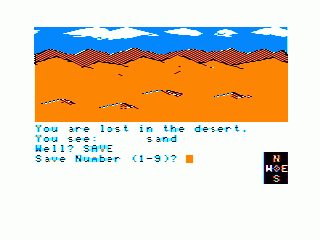
Resource management plays a central role. Without a water supply, Sir Percy’s survival is at constant risk, and the need to locate oases or hidden wells adds genuine tension. Additionally, encountering venomous snakes or precipitous cliff edges forces you to think twice before forging ahead. If you neglect to save often on the disk-only save/load system, one misstep can send you back hours, reinforcing the requirement to plan carefully and tread lightly.
The game’s HELP feature, though limited, provides occasional nudges when you’re hopelessly stuck. It will remind you of basic commands or your current objectives, but it stops short of handing you the solution. This encourages exploration and puzzle-solving the way early ’90s adventures intended, rewarding patience more than trial-and-error. Overall, the gameplay loop is challenging but fair for those who appreciate the old interactive fiction style with a graphical twist.
Graphics
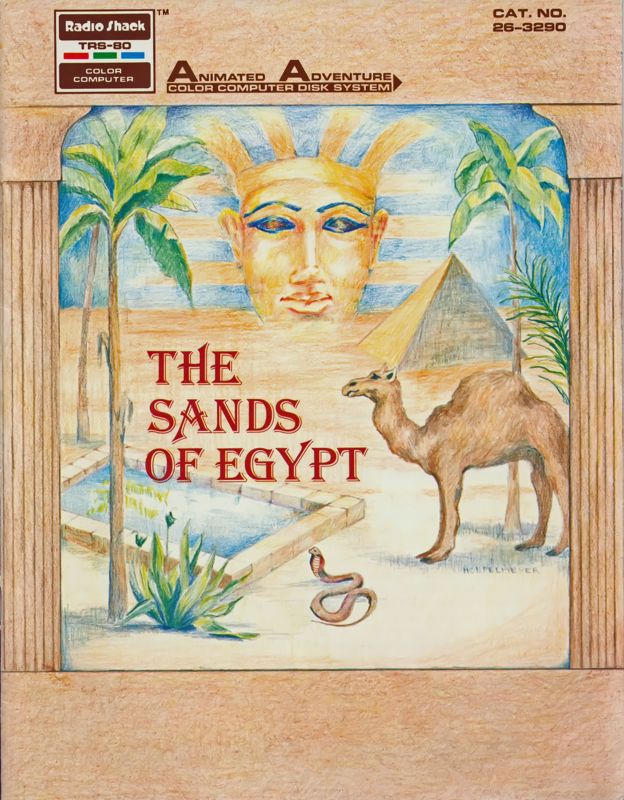
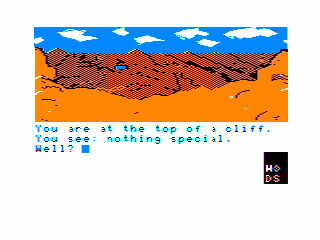
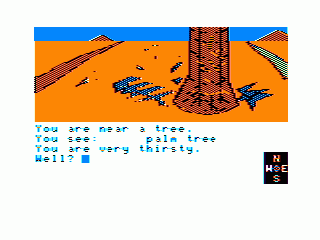
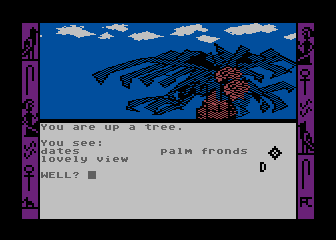
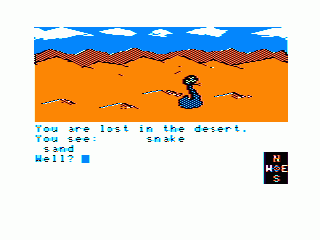
Sands of Egypt pairs the text-driven mechanics of a parser adventure with simple line-based graphics that render key locations. Each screen features a small, static illustration—perhaps a palm-shaded oasis, the gaping entrance to a tomb, or the silhouette of a cobra. These images are monochrome or limited-palette, evoking the feel of a late-’80s DOS title. While not technically impressive by modern standards, they complement the story rather than distract from it.
The minimalistic art style reinforces the sense of isolation in the desert. Sparse, pixelated dunes stretch across the screen; jagged cliffs loom at the edge of your character’s vision. Occasional color accents—emerald green palms, rust-colored sandstone—help important landmarks stand out. Despite the low resolution, these touches guide players visually, reducing the chance of wandering aimlessly off-screen.
Animation is virtually non-existent beyond simple flicker or screen transitions, but the game’s static imagery is enough to spark the imagination. When the text describes a hidden trap door or a venomous snake, your mind fills in the rest. In this way, Sands of Egypt demonstrates how basic graphics can amplify the narrative, leaving the heavy lifting to the player’s imagination.
Story
Set in 1893, The Sands of Egypt casts you as Sir Percy, a British aristocrat turned explorer in search of the legendary Tomb of Ra. The premise is rich with period detail—colonial diaries, cryptic hieroglyphs, and rumblings of ancient curses. From the outset, the narrative paints the desert as both a treasure trove and a deadly adversary, establishing a classic “man vs. nature” scenario.
Dialogue and descriptive text are evocative, transporting you to the scorching sands and echoing temple corridors. Encounters with Bedouin guides, rival archaeologists, and nomadic traders fill in the backstory. Though the game’s focus remains on survival and puzzle-solving rather than deep character development, enough intrigue festers to keep you invested in Sir Percy’s quest and well-being.
Pacing is deliberate: brief interludes of exposition are balanced by tense sequences of resource gathering and trap avoidance. Key narrative beats—discovering hieroglyphic clues, unlocking hidden passageways, and unearthing priceless artifacts—unfold organically as you explore. The writing occasionally drifts into period-piece verbosity, but it mainly enhances immersion, reminding you of the late Victorian zeal for discovery.
Overall Experience
The Sands of Egypt offers a niche but rewarding adventure for fans of retro interactive fiction. Its blend of text and simple graphics evokes nostalgia while delivering a satisfying survival puzzle. Expect deliberate pacing, methodical mapping, and occasional frustration when you stray too far without water or neglect to save. Yet overcoming these challenges brings genuine triumph.
This disk-only release may feel archaic to modern gamers, but its old-fashioned charm endures. The SAVE and LOAD commands directly to disk capture the era’s technical constraints, motivating you to think ahead and respect the desert’s perils. Meanwhile, the limited HELP system keeps you from completely floundering, striking a balance between hand-holding and blind guesswork.
For those intrigued by 19th-century exploration tales and willing to embrace an unhurried gameplay loop, The Sands of Egypt is a worthwhile journey. It may not compete with high-end graphics or complex interfaces, but it excels in atmosphere, tension, and a sense of discovery. Grab your map, pack extra water, and prepare to chart the unknown dunes in search of ancient glory.



Reviews
There are no reviews yet.