 Retro Replay Retro Replay gaming reviews, news, emulation, geek stuff and more!
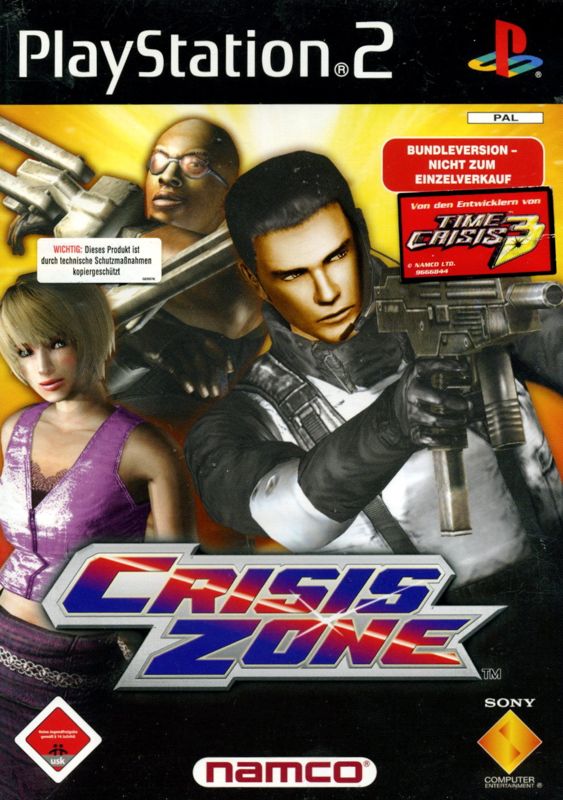
Retro Replay Review
Gameplay
Time Crisis: Crisis Zone retains the classic on-rails shooter mechanics that made the original arcade release a hit. Players assume the role of an elite Special Tactical Force operative, moving automatically through the environment while terrorists from the U.R.D.A. ambush you from every corner. The hallmark cover system returns in full force: press the pedal to duck behind your shield, reload your weapon, or avoid incoming fire, then pop up to take out enemies before the timer runs out. The tension created by the ever-ticking clock keeps each stage brisk and exciting.
(HEY YOU!! We hope you enjoy! We try not to run ads. So basically, this is a very expensive hobby running this site. Please consider joining us for updates, forums, and more. Network w/ us to make some cash or friends while retro gaming, and you can win some free retro games for posting. Okay, carry on 👍)
The PS2 port supports both the G-Con 45 and G-Con 2 light guns, bringing the arcade experience into your living room. Using the G-Con peripherals elevates immersion, as you physically aim and shoot at on-screen targets. For players without a light gun, the standard controller remains a viable option, using the analog stick to aim and face buttons to fire. This flexibility ensures that Crisis Zone is accessible, whether you own the bundled G-Con 2 or prefer a more traditional setup.
Beyond the core arcade stages, the PS2 version introduces an exclusive mission set in the Grassmarket District, unfolding six months after the Garland Square incident. This bonus stage extends gameplay by adding new environments, enemy placements, and timed objectives. Additionally, a handful of light-gun mini-games—ranging from target practice to quick-draw challenges—offer a fun diversion and help players hone their skills between main missions.
Graphics
For a PlayStation 2 title based on an early-2000s arcade game, Crisis Zone delivers surprisingly crisp visuals. Character models are well-detailed for the hardware generation, with distinct uniforms and facial features for both your STF allies and UR.D.A. terrorists. The lighting engine casts convincing glare off office windows and harsh shadows in abandoned corridors, reinforcing the feeling of a high-stakes counterterrorism operation.
Environments strike a fine balance between realistic office interiors and stylized destruction. The complex’s lobbies, hallways, and server rooms showcase different textures, from glossy tile floors to flickering neon signs. Explosions, muzzle flashes, and bullet impacts are all rendered smoothly, maintaining a consistent frame rate even during the most chaotic firefights. While not as polished as modern HD shooters, Crisis Zone’s graphics hold up well and effectively convey the urgency of each mission.
The extra Grassmarket District stage highlights the engine’s versatility, taking players outside the office complex and into a dimly lit urban neighborhood. Cracked pavement, graffiti-covered walls, and abandoned vehicles create a convincingly distressed cityscape. Subtle weather effects—like the occasional rain drop on the screen—add atmosphere and remind players that this release is a step above most generic rail shooters of its era.
Story
At its core, Crisis Zone tells a straightforward, adrenaline-fueled tale of counterterrorism. You play as a member of the Special Tactical Force, racing against time to thwart the UR.D.A. group after they seize control of an office center. The plot’s stakes are high: terrorists threaten to activate a buried nuclear reactor, creating a scenario that demands precision shooting and lightning-fast reflexes rather than lengthy cutscenes or branched dialogue trees.
Characterization is minimal but effective. The game’s terse briefings set the stage before each level, outlining objectives such as hostages to rescue or key terrorists to neutralize. Commander Kessler’s grave voice-overs underscore the seriousness of the mission, while terse radio chatter during firefights adds an authentic, military-style ambiance. Although the narrative does not delve deep into personal backstories, it maintains momentum and keeps players focused on the goal.
The PS2-exclusive Grassmarket District mission extends the story by revealing the aftermath of Garland Square. Here, players learn that Commander Kessler’s daughter has been kidnapped, raising the emotional stakes. This additional chapter—complete with a rescue subplot—provides a fresh angle and motivation to see the operation through to the end. It also offers a satisfying sense of continuity for fans familiar with the Time Crisis universe.
Overall Experience
Time Crisis: Crisis Zone on PlayStation 2 succeeds in capturing the arcade spirit, delivering a lean, no-nonsense shooter experience. Its on-rails design and cover mechanics come straight from the source, while the PS2 port’s extras—namely the Grassmarket District and mini-games—add welcome replay value. Whether you’re dusting off your G-Con or picking up the DualShock for the first time, the controls feel responsive and intuitive.
Replayability is strong thanks to the branching paths and hidden hostages scattered throughout each level. Speedrunners will enjoy pushing for faster completion times, while completionists can hunt down all the bonus objectives. The local high-score table encourages friendly competition, making Crisis Zone a great party title if you own the light-gun peripherals. Even without online leaderboards, the drive to beat your personal best remains compelling.
Overall, Crisis Zone stands as one of the strongest rail shooters on the PS2. Its blend of crisp graphics, tight mechanics, and arcade-style pacing create a pick-up-and-play sensation that still thrills two decades after release. For fans of light-gun games or anyone seeking a straightforward action experience, Time Crisis: Crisis Zone is well worth adding to your collection.


Reviews
There are no reviews yet.