 Retro Replay Retro Replay gaming reviews, news, emulation, geek stuff and more!


Retro Replay Review
Gameplay
Flash Gordon delivers a classic fixed-shooter experience that tasks you with navigating perilous tunnels while fending off relentless spider warriors. The core objective is twofold: rescue trapped spacemen and eliminate the alien hatching pods that churn out enemies. Each successful rescue and pod destruction edges you closer to purging Spider City of its insectoid invaders, creating a pulse-pounding loop of danger and reward.
(HEY YOU!! We hope you enjoy! We try not to run ads. So basically, this is a very expensive hobby running this site. Please consider joining us for updates, forums, and more. Network w/ us to make some cash or friends while retro gaming, and you can win some free retro games for posting. Okay, carry on 👍)
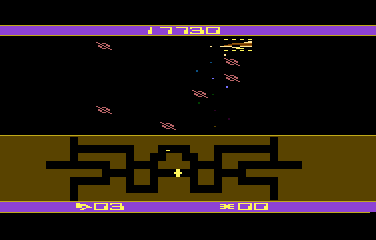
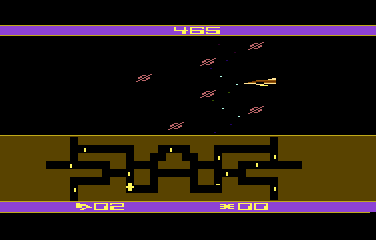
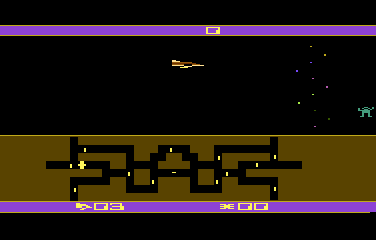
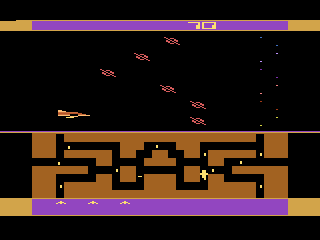
The game employs a dual-screen interface that enhances situational awareness. The upper half offers a close-up view of Flash’s ship in narrow corridors, where precision piloting and quick reflexes are paramount. Below, a tactical map displays the entire city layout, complete with hatching pods marked by vertical lines and deadly Disrupters shown as crosses. This split perspective forces you to balance immediate threats with long-term navigation strategy.
Rescuing spacemen is as simple as brushing them with your ship, but doing so under fire keeps the tension high. Combat revolves around blasting waves of spider warriors and avoiding environmental hazards like debris and patrol ships. Destroying generators temporarily halts the Disrupter, granting a brief respite, yet the never-ending flotsam keeps you on your toes. Mastering these intertwined mechanics rewards patience and precision.
Scoring is a driving incentive: debris nets 10 points, patrol ships 25, rescued spacemen 70, and generators 100. Chain-kills at a single pod yield escalating bonuses, and achieving five or more kills—or losing a life near a pod—grants a shield that guards you for a few heartbeats. An audio cue of two beeps warns when the shield is about to expire, adding an extra layer of auditory strategy to the frenetic action.
Graphics
On the Atari 2600 hardware, Flash Gordon’s visuals are a triumph of clarity over complexity. The tunnels are rendered with simple lines and blocks, yet each corridor feels distinct, helping you track pod locations and hazards at a glance. The spider warriors themselves are small sprites, but their characteristic movement patterns make them immediately identifiable.
The dual-screen presentation maximizes the limited resolution. The top action window uses bold colors to differentiate between your ship, enemies, and obstacles, while the bottom map opts for contrasting hues to clearly mark pods, Disrupters, and your position. This clean visual hierarchy ensures that crucial information never gets lost in the chaos.
Despite its age, the game’s animation is surprisingly fluid. Ship movements, enemy spawns, and destruction effects convey a tangible sense of weight and momentum. Though pixelated by modern standards, the tight sprite work captures the essence of a sci-fi rescue mission, demonstrating how smart design can overcome hardware constraints.
The color palette, dominated by stark blacks, yellows, and reds, reinforces the alien atmosphere. Each city level shifts subtly in tint, giving you a sense of progression as you cleanse the tunnels. For retro gaming enthusiasts, these graphical touches evoke the charm of early ’80s arcade cabinets, complete with flickering CRT authenticity.
Story
Flash Gordon’s narrative is straightforward but compelling: Spider City has claimed countless lives, and only one hero stands between the alien menace and total galactic conquest. Your mission to rescue fellow spacemen underscores the game’s stakes, transforming every close call into a personal triumph or tragedy.
The backstory of scattered captives and hatching pods creates a palpable sense of urgency. As Flash, you’re not just another pilot—you’re humanity’s last hope against an insectoid uprising. Each tunnel cleared represents another foothold regained in the battle to restore peace across the stars.
While the plot unfolds largely through the game’s manual and intro screens, in-game events reinforce the narrative. You see new pods spring to life, hear the beeps of your dwindling shield, and watch enemy waves surge in response to delays. These dynamic moments give the story a rhythm that grows more intense with each passing level.
Originally released under the Flash Gordon license in 1983 (and retitled Spider City or Space Adventure in some regions), the game preserves the pulp-hero spirit of the source material. Fans of the comic serial and its cinematic adaptations will appreciate the rapid-fire pacing and high-stakes heroism that defined Flash Gordon’s legacy.
Overall Experience
Flash Gordon stands as a testament to the enduring appeal of fixed-shooter gameplay. Its blend of rescue missions, strategic navigation, and nonstop enemy engagements creates an addictive loop that rewards both reflexes and tactical thinking. Each playthrough offers new challenges as enemy patterns shift and pods multiply.
Audio cues and minimalist sound design heighten the tension without overwhelming the senses. The iconic double-beep warning, explosion blips, and background hum immerse you in Spider City’s depths, keeping you alert to every turn. These elements combine to forge an experience that feels larger than the Atari 2600 itself.
While the graphics and mechanics reflect early-’80s limitations, they also exude retro charm. Modern players seeking a historical snapshot of classic home-console shooters will find Flash Gordon both accessible and rewarding. The balance between map-based planning and corridor-level execution remains engaging decades after its debut.
Overall, Flash Gordon offers a concise yet satisfying excursion into sci-fi heroism. Whether you’re chasing high scores, reliving childhood memories, or discovering fixed-shooter history for the first time, this title delivers an experience that feels just as urgent and exciting today as it did in 1983.



Reviews
There are no reviews yet.