 Retro Replay Retro Replay gaming reviews, news, emulation, geek stuff and more!
Retro Replay Review
Gameplay
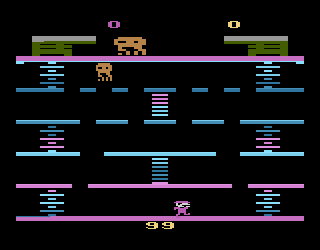
Pac-Kong delivers a familiar yet engaging arcade challenge that closely mirrors the classic Donkey Kong formula. You take control of a plucky adventurer—sometimes even called Kong—whose sole mission is to scale a series of platforms and ladders in pursuit of treasure chests hidden by an evil octopus. Movement is straightforward: left, right, climb, and press fire to initiate a jump. This simplicity belies the precise timing and coordination required to clear gaps and ascend to higher levels.
(HEY YOU!! We hope you enjoy! We try not to run ads. So basically, this is a very expensive hobby running this site. Please consider joining us for updates, forums, and more. Network w/ us to make some cash or friends while retro gaming, and you can win some free retro games for posting. Okay, carry on 👍)
The primary mechanic is the jump, which must be used strategically to cross broken sections of the platforms. You’ll quickly learn that a mistimed leap can send your hero plummeting back to the start of the level or into the path of a wandering hazard. Between jumps, you’ll navigate ladders that connect the tiers of each stage, often requiring you to backtrack to evade danger or set up the perfect opportunity to dash forward.
Obstacle variety keeps each run tense and rewarding. Smaller octopi patrol the platforms in predictable yet relentless patterns, while errant clouds of poisonous gas drift unpredictably across the screen. The gas forms a moving barrier that may force you to pause your ascent or retreat temporarily, injecting a welcome dose of unpredictability into the otherwise methodical climb.
For those who enjoy a dash of friendly rivalry, Pac-Kong supports two-player alternating play. Each contestant takes turns guiding the hero through identical levels, vying for high scores and the fastest completion times. This mode not only adds replay value but also transforms each session into a test of endurance and skill as players push each other to refine their timing and route choices.
Graphics
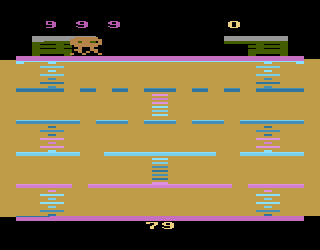
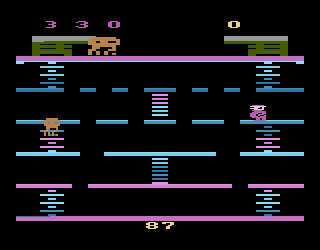
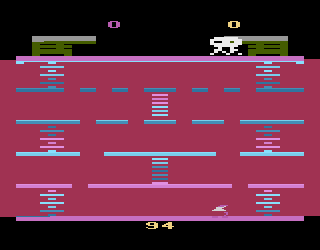
On the graphical front, Pac-Kong leans into its arcade roots with bold, blocky sprites and a straightforward color palette. Each version of the game introduces subtle sprite swaps, meaning your antagonist, the hero, and environmental elements can vary in appearance depending on the release. While these changes don’t affect gameplay, they give collectors and fans a reason to hunt down multiple editions.
The animation is crisp, if minimal. Jumping, climbing, and enemy patrol routines are rendered in a handful of frames, but the result remains clear and readable even during hectic moments. The solid color backgrounds keep visual clutter to a minimum, allowing the key details—ladders, platforms, and hazards—to stand out prominently.
Despite the rudimentary visuals by modern standards, Pac-Kong’s aesthetic exudes charm. The bright reds, blues, and greens harken back to the golden age of arcades, and the character designs—particularly the mischievous octopus—offer a quirky personality that few contemporary clones manage to replicate.
Overall, the graphics serve the game’s fast-paced demands perfectly. There’s no wasted detail, and every pixel contributes directly to gameplay clarity. If you appreciate retro authenticity over photorealism, Pac-Kong’s visuals will feel right at home on your screen.
Story
While Pac-Kong’s narrative is minimal, it provides just enough context to drive the action. An evil octopus has stashed away priceless treasures across a series of perilous platforms, daring any brave soul to claim them. Your hero—named Kong in some versions—takes on the challenge, determined to outwit the cephalopod and recover the booty.
The tale unfolds level by level, with each new stage raising the stakes. Rather than weaving a complex plot, the game relies on environmental storytelling: the increasing density of gas clouds and the speed of the smaller octopi subtly hints at your adversary’s growing desperation. It’s a classic arcade approach, where gameplay mechanics and level design do the heavy lifting of narrative immersion.
Though there are no cutscenes or dialogue, the urgency is palpable. With every misstep costing a life and every successful climb bringing you closer to the treasure, Pac-Kong transforms what could have been a barebones premise into a pulse-pounding race against time and hazards.
In short, the story acts as a lightweight framework that enhances your motivation rather than overshadowing the arcade action. If you’re looking for a deep, branched narrative, you might find it lacking—but if you crave straightforward hero-versus-villain stakes, Pac-Kong delivers.
Overall Experience
Pac-Kong stands out as a highly replayable arcade platformer that marries simplicity with challenge. Its pared-down control scheme ensures that players of all skill levels can jump in quickly, yet mastering the timing and memorizing gas cloud patterns offers a satisfying learning curve for veterans. Whether you’re squeezing in a quick session or setting up a competitive two-player showdown, the gameplay loop remains addictive.
The game’s audio-visual presentation contributes to its retro charm. Chippy sound effects and bouncy background tunes evoke the era of coin-op machines, even if the soundtrack itself isn’t particularly elaborate. The clean pixel art and clear level layouts ensure that every jump and ladder climb feels intentional, minimizing frustration and highlighting player skill.
While Pac-Kong lacks some of the polish and variety of modern platformers, it shines in its purity of design. No power-ups, no upgrades—just you, a joystick, and the relentless march of octopi. This focus creates an unfiltered arcade experience that can be both brutally difficult and deeply rewarding.
For collectors and retro aficionados, Pac-Kong represents a niche gem, offering multiple regional variants and sprite swaps that encourage exploration. Casual players seeking a quick blast of nostalgic fun will appreciate its straightforward, pick-up-and-play appeal. In either case, Pac-Kong proves that great gameplay doesn’t require bells and whistles—just well-crafted levels and a dash of infectious challenge.


Reviews
There are no reviews yet.