 Retro Replay Retro Replay gaming reviews, news, emulation, geek stuff and more!


Retro Replay Review
Gameplay
Video Chess on the Atari 2600 offers a faithful digital adaptation of the classic board game, relying on the standard U.S. chess rules. Moving a piece is a two-step process: first you place the on-screen “X” cursor over the piece you wish to relocate and press the red button, then you move the cursor to your target square and press again. If the move is illegal—whether it violates piece movement patterns or leaves your king in check—the console emits a warning beep and rejects the action. This simple interface makes the game accessible while still demanding precision and planning.
(HEY YOU!! We hope you enjoy! We try not to run ads. So basically, this is a very expensive hobby running this site. Please consider joining us for updates, forums, and more. Network w/ us to make some cash or friends while retro gaming, and you can win some free retro games for posting. Okay, carry on 👍)
The implementation of special moves such as castling and en passant adds depth and authenticity to the gameplay. For castling, neither your king nor the chosen rook may have moved previously; once you’ve moved your king two squares toward the rook, the Atari automatically repositions the rook to complete the maneuver. En passant is handled smoothly as well: if an opposing pawn advances two squares past your pawn on its initial move, you can capture it by moving diagonally into the square it passed over, just as in formal play.
One of the most compelling features is the range of eight skill levels, which determine how long the computer will think before making its move. Ranging from Level 1 (approximately 15 seconds of thinking time) up to Level 7 (around 10 hours of deliberation), these settings allow players to tailor the challenge to their experience. Interestingly, Level 8 clocks in at a brisk 10 seconds and is explicitly labeled as a beginner mode, giving novices a chance to learn tactics without being overwhelmed.
The progressive difficulty curve ensures that both newcomers and seasoned players find an engaging match. Beginners can start at the lowest level to learn basic strategies, while experts can test their mettle against the longest computation times. Overall, the gameplay loop is clean, focused, and emphasizes chess fundamentals without any distracting extras.
Graphics
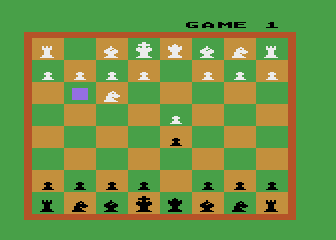
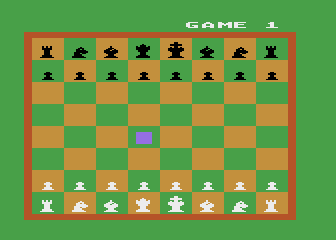
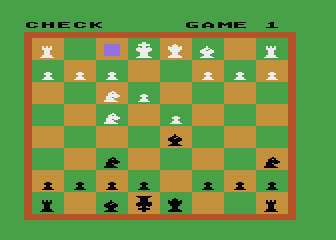
Graphically, Video Chess embraces the Atari 2600’s limitations to deliver a clear, functional board layout. The checkered board is rendered in simple, contrasting blocks that make it easy to distinguish squares, and each piece—pawn, knight, bishop, rook, queen, and king—has its own distinct, minimalist icon. While the visuals lack shading or advanced detail, they prioritize clarity over flair, ensuring that every piece is immediately recognizable.
The color palette is limited but effective: light and dark squares are easy on the eyes, and the cursors and highlights stand out in bright hues. This straightforward design choice means you’re never in doubt about whose turn it is or which piece is selected. There are no animated flourishes or background scenes, but that absence of superfluous graphics keeps the focus squarely on strategy.
On older CRT displays, the board retains its crispness and the cursor’s “X” marker blinks just enough to guide the player’s attention. While modern gamers accustomed to font anti-aliasing and high-resolution textures might find the presentation rudimentary, fans of retro aesthetics will appreciate the nostalgic charm. In its era, Video Chess represented one of the cleanest, most legible chess displays available for home consoles.
Story
As a pure chess simulation, Video Chess does not feature a narrative campaign or character-driven storyline. Instead, it offers the timeless, open-ended story of chess itself: a battle of wits between two opponents. Each match unfolds as a unique drama of tactical exchanges, positional warfare, and endgame duels. This lack of scripted plot is intentional, leaving the creativity and drama in the hands of the players.
For many, the “story” emerges from the board—pawn structures collapsing into forks, knights dancing through open files, and queens orchestrating decisive blows. Every game writes its own narrative, whether it’s a surprising underdog victory at low skill levels or a tense endgame clash when playing against the highest difficulty. In this way, Video Chess invites you to be the author of your own chess saga.
While there are no cutscenes, voiceovers, or branching quests, the satisfaction comes from mastering classical motifs like the Fried Liver Attack or executing a textbook en passant. The coherence of these in-game moves creates a subtle, emergent storyline, driven by strategy rather than scripted events. For purists, this open framework is precisely the point: chess needs no embellishment.
Overall Experience
Video Chess is a prime example of early home-console gaming’s focus on core gameplay over bells and whistles. The intuitive two-step move input, faithful rule enforcement, and automatic handling of special moves ensure that the technical side of the game never distracts from deep strategic play. Whether you’re new to chess or looking to hone your tactics against a calculating opponent, the variety of skill levels provides an appropriate challenge.
The graphical presentation is unassuming but purposeful: crisp board squares, clear piece icons, and a visible cursor make every move unambiguous. While it doesn’t offer modern niceties like hover-over move hints or animated piece captures, its minimalist approach means there’s nothing standing between you and the battle of minds unfolding on the board.
Though there is no storyline in the traditional sense, the true narrative emerges from each confrontation. Chess aficionados will appreciate the purity of the experience, and casual players can still discover the joy of classic chess tactics. For those seeking a straightforward, reliable chess simulation on vintage hardware, Video Chess stands out as an enduring, no-frills choice that captures the essence of the world’s oldest strategy game.


Reviews
There are no reviews yet.