 Retro Replay Retro Replay gaming reviews, news, emulation, geek stuff and more!


Retro Replay Review
Gameplay
Journey to the Planets strikes a satisfying balance between pulse-pounding action and brain-teasing puzzles. Players assume the role of a determined spacefarer, hopping from one exotic world to the next in search of precious treasures needed to power the return journey. Each planet presents a fresh challenge: sometimes enemies swarm your path and demand quick reflexes and precise shooting, while other times intricate environmental puzzles stand between you and your goal.
(HEY YOU!! We hope you enjoy! We try not to run ads. So basically, this is a very expensive hobby running this site. Please consider joining us for updates, forums, and more. Network w/ us to make some cash or friends while retro gaming, and you can win some free retro games for posting. Okay, carry on 👍)
The game’s mechanics are straightforward yet deep enough to keep experienced players engaged. Your starship’s limited fuel supply adds a strategic layer, forcing you to plan routes carefully between worlds. Collecting treasures isn’t merely about reaching the end of a level; it’s about optimizing every jump, conserving ammunition, and strategizing which puzzles to tackle in what order.
On the original 1983 cartridge release, the developers chose to tone down some of the more fiendish early puzzles. This adjustment eases newcomers into the game’s intricacies without sacrificing the overall challenge curve. Veteran players will still find late-game puzzles satisfyingly complex, and the occasional shoot-‘em-up segments provide an adrenaline rush that keeps the pacing dynamic.
Control responsiveness is commendable for a title of its era. Whether you’re lining up a precise shot or guiding your astronaut through narrow corridors, the inputs feel tight. The learning curve is gentle yet rewarding, making Journey to the Planets accessible to casual gamers while still offering depth for completionists and speedrunners.
Graphics
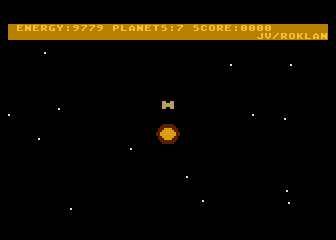
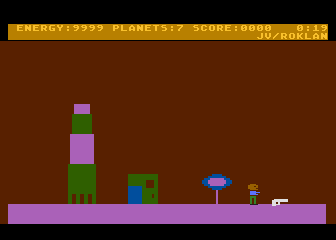
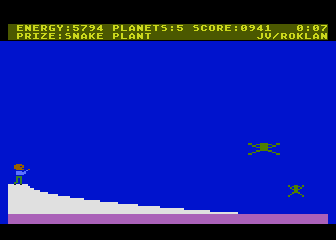
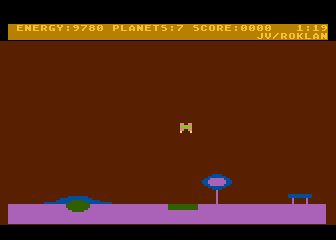
Visually, Journey to the Planets embraces a classic 8-bit aesthetic that holds nostalgic charm without feeling too dated. Each planet features a distinct color palette—from icy blues and whites of frost-covered worlds to warm oranges and reds of volcanic landscapes. These varied environments ensure that exploration never feels monotonous.
Sprite work is crisp and functional. Your spacefarer character is easily distinguishable from background elements, even during hectic combat scenes. Enemy designs range from robotic drones to alien wildlife, each with unique attack patterns that are clearly telegraphed thanks to well-animated sprites.
Attention to detail extends to environmental hazards and interactive elements. Flickering lights in abandoned ruins, shifting platforms in ancient temples, and subtle parallax scrolling all contribute to a sense of depth and immersion. While the hardware imposes clear limitations, the game’s artistic direction maximizes the system’s capabilities.
The cartridge release features an updated soundtrack that complements the visuals with more upbeat tones and streamlined tunes. The music may not be orchestral, but its catchy melodies enhance exploration and pair perfectly with the pixel-perfect backdrops.
Story
At its core, Journey to the Planets tells a straightforward yet compelling tale: a lone explorer stranded far from home, driven by the hope of returning to familiar skies. This simple premise serves as a strong hook, motivating players to uncover each planet’s secrets and reclaim the artifacts essential for revival of their starship.
Story snippets are delivered through brief mission briefings and environmental cues. Scrawled alien glyphs on temple walls, scraps of crashed ship logs, and conversations with mysterious automated systems all hint at a larger interstellar lore. Though not overly verbose, these elements provide a sense of discovery that goes beyond mere treasure hunting.
Character development may be sparse by modern standards, but the sense of solitude and determination is made palpable through the game’s pacing and atmosphere. You grow attached to your quest, celebrating each recovered relic and feeling tension whenever fuel levels dip too low.
While there are no branching narratives or dialog trees, the structure of multiple worlds and varied objectives gives the illusion of a sprawling saga. Players piece together the backstory in small increments, making every new planet a chapter in the larger tale of homeward longing.
Overall Experience
Journey to the Planets delivers an engaging retro adventure that blends action, puzzle-solving, and resource management into one cohesive package. The mixture of shooting segments and logic puzzles keeps gameplay fresh, while the ticking-clock element of limited fuel adds a layer of strategic urgency.
The refurbished 1983 cartridge edition shines with its revised soundtrack and slightly softened puzzle difficulties, offering a smoother entry point for newcomers without dulling the challenge for seasoned players. Its pick-up-and-play accessibility makes it a great choice for retro enthusiasts and casual gamers alike.
Though some may find the narrative minimal by today’s standards, the journey itself—hopping between vividly realized worlds, outmaneuvering foes, and cracking intricate puzzles—provides a strong enough drive to keep you invested until the final fuel tank runs dry. The sense of accomplishment when you finally pilot your starship back towards home is genuinely rewarding.
If you’re in search of a classic-style space adventure that tests both reflexes and wits, Journey to the Planets stands out as a must-play. Its blend of polished gameplay, charming graphics, and atmospheric storytelling make it a title that continues to resonate with players decades after its initial release.


Reviews
There are no reviews yet.