 Retro Replay Retro Replay gaming reviews, news, emulation, geek stuff and more!



Retro Replay Review
Gameplay
Goldrush takes the classic Lode Runner formula and injects it with a futuristic twist. Each level is presented on a single screen, challenging you to collect every piece of stolen PosiGold before the exit appears. You navigate platforms, ladders and glass panels while laying bombs strategically to carve new pathways or trap the pursuing droids. Unlike traditional platformers, bombs only affect solid floor tiles, leaving ladders, glass and the droids themselves untouched. This limitation forces you to think several moves ahead and adapt on the fly as the ship’s computer periodically repairs any damage you’ve inflicted.
(HEY YOU!! We hope you enjoy! We try not to run ads. So basically, this is a very expensive hobby running this site. Please consider joining us for updates, forums, and more. Network w/ us to make some cash or friends while retro gaming, and you can win some free retro games for posting. Okay, carry on 👍)
The inclusion of two distinct droid types—heat-seeking or motion-seeking—adds a layer of tactical choice before each run. Heat-seeking droids relentlessly home in on your last position, making safe zones fleeting. Motion-seeking droids, by contrast, patrol or chase only when you move, allowing for momentary respite if you can stand still long enough. This variety lets you tailor the challenge: choose a more forgiving mode to learn the levels’ intricacies, or opt for relentless pursuit if you crave high-octane tension.
Progression in Goldrush is all about mastering timing and tile control. After you plant a bomb, you must dash away before it detonates, clear the PosiGold, and slip through the newly opened passage before the computer’s automatic repairs seal it shut again. With each deck guarded by a tougher class II droid, the puzzle elements escalate organically. As you advance, levels introduce more complex platform arrangements, moving hazards and segmented glass floors that shatter underfoot, keeping the core loop fresh across dozens of stages.
Graphics
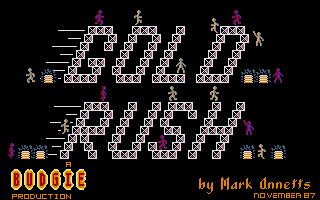
Goldrush embraces a vibrant, pixel-art aesthetic that feels both nostalgic and crisp on modern displays. Each level’s palette is dominated by metallic grays and neon accents that evoke the claustrophobic corridors of a starship. The PosiGold pieces glow with a rich amber hue, making them immediately distinguishable against the darker backgrounds. Even on a single-screen layout, the environments never feel monotonous thanks to subtle variations in tile patterns and background details.
Character sprites are compact but convey clear movement and intent. The class II droids sport blinking sensors and smoothly animated treads, while your runner’s jumps, climbs and bomb-planting motions are snappy and responsive. Bomb explosions are brief but impactful, with a quick flash and tile-crumbling animation that telegraphs exactly which squares will vanish. The animation hierarchy ensures you always know where the danger zones are, even when multiple bombs and droids are on screen.
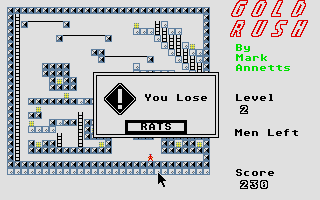
The user interface is minimal by design: a simple counter tracks remaining PosiGold and bombs, and a level indicator shows your current deck. This uncluttered HUD keeps your focus on the playfield. Occasional HUD pop-ups reinforce mission objectives or warn of impending auto-repairs, but they never overstay their welcome. Overall, Goldrush’s visual presentation strikes a fine balance between retro charm and modern clarity.
Story
Set in the year 3081, Goldrush casts you as a newly minted class III runner on your first assignment: retrieve the PosiGold stolen from the Galactic Government on planet Supre-60. The backstory unfolds through a brief text introduction and sparse mission briefings between levels. While the narrative delivery is minimal, it serves as a compelling hook: you aren’t simply collecting gold for fun—you’re restoring crucial resources to a futuristic civilization.
Each ship deck you infiltrate is vaguely characterized by unique tile layouts and rising droid difficulty, suggesting different zones of the stolen-ship fortress. Although there are no voiced cutscenes or elaborate dialogues, the looming threat of class II droids and the knowledge that the PosiGold funds galactic stability add weight to every bomb drop. You’re not just looping through puzzles; you’re on a covert operation where every misstep could let valuable resources slip through your fingers.
The sparse storytelling actually works in Goldrush’s favor by keeping the action front and center. Rather than pausing gameplay for lengthy exposition, the game lets you inject your own heroics into the mission. The thrill of narrowly escaping a heat-seeking droid or racing against the ship’s automatic floor repairs is amplified by the knowledge that you’re fighting for a grander cause—even if that cause is conveyed through just a few lines of text.
Overall Experience
Goldrush delivers an addictive blend of puzzle-platforming and high-stakes action. The simple premise—collect gold, avoid droids, use bombs wisely—unfolds into a deeply strategic game where every step, every bomb placement, and every pause to outwit the computer’s repairs matters. Its single-screen design ensures that each level feels like a compact brain-teaser with just enough space to experiment, fail spectacularly, and try again.
Difficulty ramps up at a satisfying pace, making early levels approachable for newcomers while offering veteran puzzle-platformers plenty of late-game deviousness. The choice between two droid‐AI modes lets players dial in their preferred challenge, and resource management of your seemingly endless bombs becomes an unexpected art form when you learn to chain blasts and plan multi‐step escapes.
Ultimately, Goldrush is tailor-made for fans of retro classics like Lode Runner as well as newcomers seeking a quick-to-learn, hard-to-master experience. Its engaging premise, crisp pixel art, and thoughtful level design combine to create a memorable sci-fi adventure that rewards careful planning and split-second decision-making. Whether you’re chasing that final PosiGold piece or outrunning a relentless droid, Goldrush keeps the tension—and the fun—levels skyhigh.



Reviews
There are no reviews yet.