 Retro Replay Retro Replay gaming reviews, news, emulation, geek stuff and more!
Retro Replay Review
Gameplay
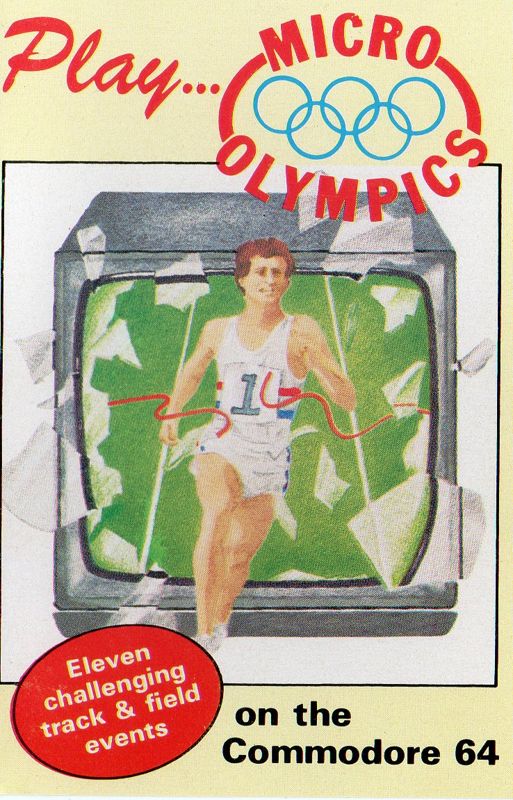
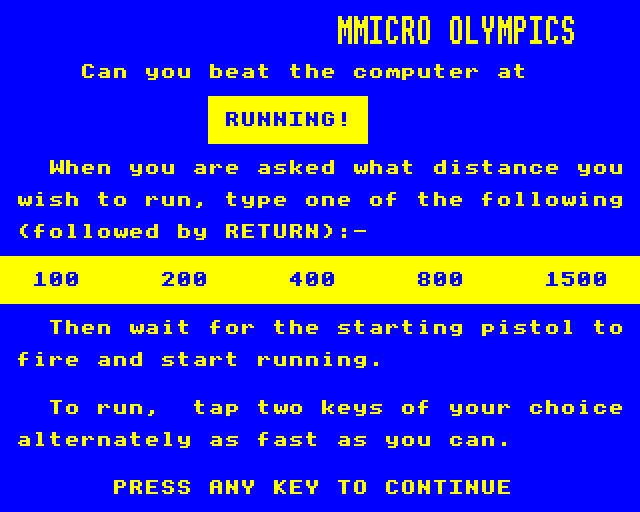
Micro Olympics delivers a straightforward yet addictive collection of eleven Track ’N’ Field–style events, all hinging on one core mechanic: frantic joystick waggling. From the blistering sprint of the 100 meters to the endurance test of the 1500 meters, the game challenges players to maintain a rapid, rhythmic input to maximize speed. This simplicity makes the controls instantly accessible, letting newcomers pick up the joystick and dive right into the competition without wading through complex button combinations.
(HEY YOU!! We hope you enjoy! We try not to run ads. So basically, this is a very expensive hobby running this site. Please consider joining us for updates, forums, and more. Network w/ us to make some cash or friends while retro gaming, and you can win some free retro games for posting. Okay, carry on 👍)
Where the five running events shine in their quick bursts of excitement, the 1500m can feel like a slog. Unlike Daley Thompson’s Decathlon, which offers varied techniques and performance metrics across longer disciplines, Micro Olympics relies on the same rapid-tap routine for every distance. As a result, the longer races become a test of physical endurance (and hand stamina) more than a test of strategy or timing.
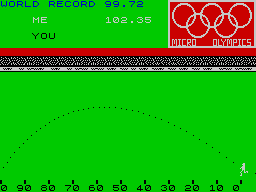
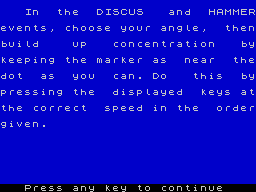
The throwing events—Javelin, Discus, and Hammer—add a welcome change of pace. Here, timing and release angle play a more pronounced role, encouraging players to study the flight arc and adjust their launch accordingly. The High Jump, Long Jump, and Triple Jump each introduce unique button-timing windows and approach speeds, rewarding precision over raw speed. Chasing each pre-defined world record fosters a satisfying loop of practice and incremental improvement.
Overall, the event variety keeps Micro Olympics from growing stale too quickly, but the core reliance on joystick waggling can become repetitive over extended play sessions. Fans of pick-up-and-play sports mini-games will appreciate its arcade roots, while those seeking deeper simulation elements may find the gameplay lacking nuanced depth.
Graphics
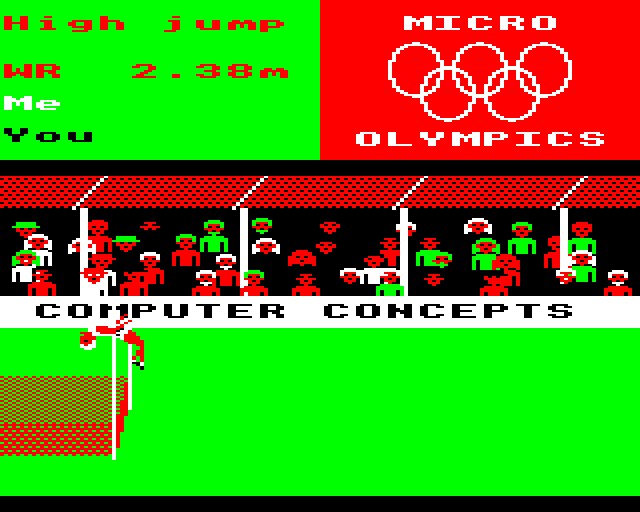
Visually, Micro Olympics embraces a colorful, chunky-pixel aesthetic typical of its era. Athlete sprites are bold and easily distinguishable from the track or arena backgrounds, ensuring that the focus stays firmly on your avatar’s explosive starts and jumps. While details are minimal compared to modern standards, the retro charm is undeniable.
The stadium backdrops feature looping crowds and brightly colored banners, creating an energetic atmosphere that amplifies the competitive spirit. Animations—whether it’s the hammer throw spinning toward its apex or the athlete launching into the triple jump—are smooth enough to convey a sense of speed and impact without taxing the hardware.
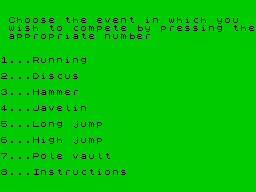
Menus and HUD elements are clear and functional, displaying current times, distances, and remaining attempts without clutter. Simple sound effects—crowd cheers, the ringing of a starting pistol, the thud of a discus landing—complement the visuals and give players immediate feedback on their performance.
While Micro Olympics doesn’t push graphical boundaries, its consistent art style and lively color palette serve the gameplay well. The visuals support quick decision-making and maintain an upbeat tone throughout each event.
Story
As with many arcade-style sports titles, Micro Olympics doesn’t weave a complex narrative. There’s no elaborate backstory or character progression—no rising-from-the-ranks drama, no rival athletes to outwit. Instead, the story is entirely player-driven: you are the sole contender chasing eleven world records, driven by your own ambition and hand-eye coordination.
This minimalist approach places the emphasis on performance. Each event’s predefined world record becomes a personal milestone, and the lack of NPC dialogue or cutscenes reinforces the game’s pick-up-and-play ethos. You create your own “story” through repeated attempts and moment-to-moment triumphs.
For some, this bare-bones presentation may feel underwhelming compared to sports games that offer career modes, unlockable personalities, or narrative arcs. However, the absence of narrative fluff can be an advantage for players who simply want to compete in a streamlined Olympic sampler without distractions.
Overall Experience
Micro Olympics offers a tightly focused arcade sports compilation that excels in short bursts of competitive fun. The event variety ensures there’s always something fresh to tackle, and each world record chase provides a clear goal to keep players coming back. The pick-up-and-play design is perfect for casual sessions, while high-score chasers will relish the relentless pursuit of perfection.
That said, the reliance on constant joystick waggling—especially during the 1500-meter race—can lead to hand fatigue and a sense of repetitiveness. Players looking for deeper strategy or technique-based challenges may find themselves wishing for more varied controls or event-specific mechanics.
Graphically and sonically, Micro Olympics delivers a bright, energetic presentation that captures the spirit of track and field. While there’s little in the way of narrative, the absence of story elements keeps the focus laser-sharp on raw competition. For buyers seeking an old-school, arcade-style sports experience, Micro Olympics is an engaging pick—just be prepared for your thumbs to get a workout.
Ultimately, Micro Olympics stands as a testament to simple, competitive design. Its straightforward events and retro charm may not satisfy those craving simulation depth or storyline, but for classic joystick-driven athletic challenges, it remains a solid and enjoyable choice.


Reviews
There are no reviews yet.