 Retro Replay Retro Replay gaming reviews, news, emulation, geek stuff and more!



Retro Replay Review
Gameplay
“A Story as You Like It” offers a remarkably early take on interactivity, predating the term “hypertext” by decades. The game unfolds through a simple binary selection mechanic: at each juncture, you choose between two options that steer the narrative in different directions. Despite its apparent simplicity, this branching structure provides a surprisingly rich sense of agency for only 21 sections of content.
(HEY YOU!! We hope you enjoy! We try not to run ads. So basically, this is a very expensive hobby running this site. Please consider joining us for updates, forums, and more. Network w/ us to make some cash or friends while retro gaming, and you can win some free retro games for posting. Okay, carry on 👍)
One of the most engaging aspects is the ability to backtrack or override previous decisions. If you take a plot thread down one road and find it unappealing, you can jump back and try an alternate path—just as the Oulipo authors intended. This freedom empowers readers to tinker with the narrative loops and uncover connections between sapient vegetable characters that might otherwise remain hidden.
While modern adventure gamers may find the lack of traditional puzzles or combat mechanics jarring, the true “gameplay” here lies in exploration. Each choice feels weighty, since you never know if it will circle back on itself or launch entirely unrelated storylines. For players interested in narrative experimentation, the decision trees evoke a sense of playful discovery rarely matched in contemporary titles.
Graphics
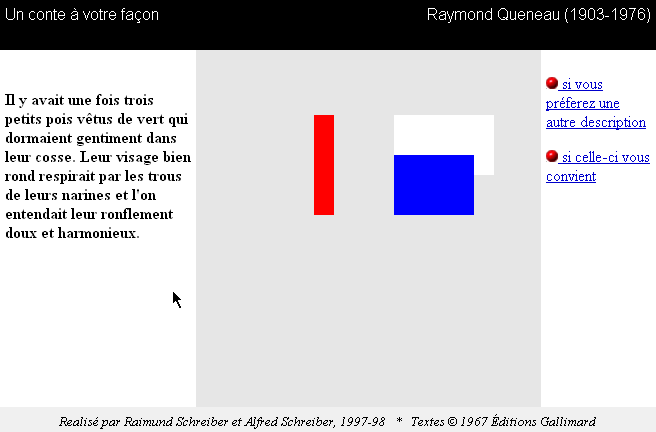
As a 1967 proof-of-concept, “A Story as You Like It” is fundamentally text-based and makes no pretense at visual spectacle. In its original form, the game would have resembled early mainframe printouts—plain text punctuated by cryptic GOTO-style instructions. However, modern implementations wrap the text in crisp HTML, complete with clickable hyperlinks that evoke the feeling of clicking through a retro-era terminal.
The minimalist presentation ultimately serves the work’s experimental nature. There are no high-resolution textures or animated sprites; instead, emphasis is placed on typography, spacing, and the tactile pleasure of selecting colored links. On mobile or desktop browsers, the clean layout ensures maximum readability and quick navigation between sections.
For players expecting cinematic cutscenes or dynamic UI panels, the graphical restraint might be a letdown. Yet this stark aesthetic choice reinforces the concept’s roots in Oulipo literature and early computing. The absence of visual clutter directs all attention to the twisting plotlines—an approach that, in many ways, feels refreshingly pure.
Story
At its heart, the narrative revolves around a small ensemble of sapient vegetables—peas with personalities, carrots with quirks, and more. The framing is whimsical, yet there’s an undercurrent of playful absurdity that keeps each twist surprising. Because the story splinters into multiple threads, you’ll witness the same character under wildly different circumstances, from daring escapes to existential musings on salad bowls.
The proof-of-concept nature of the work limits each storyline to a handful of passages, but within those 21 sections, there’s an admirable range of tone. Some paths read like lighthearted fables, while others delve into surprisingly philosophical territory. The Oulipo origins are evident in the text’s self-awareness: you often catch the narrative “thinking” about its own branching structure.
Despite the brevity of each branch, the overall effect is oddly cohesive. Recurring motifs—shared jokes, mirrored events—create a tapestry that rewards multiple playthroughs. As you shuffle between options, you begin to sense the author’s design, discovering how even “wrong” choices contribute to the game’s thematic resonance.
Overall Experience
“A Story as You Like It” is less a video game in the modern sense and more a historical artifact brought to digital life. Its compact size means you can finish a round of choices in under half an hour, making it perfect for quick, reflective sessions. Players with patience for textual play and curiosity about narrative form will find themselves enchanted by its clever architecture.
That said, audiences seeking rich graphics, deep mechanics, or extended playtime may feel shortchanged. The game’s charm resides in its minimalist ambition: a spark of interactivity born from an era when computers were novelties and branching stories were groundbreaking. Embracing its limitations is key to appreciating what it achieves.
Ultimately, “A Story as You Like It” stands as a fascinating milestone in interactive literature. It may not satisfy every gamer’s wishlist, but for those intrigued by hypertext history and experimental storytelling, it offers an engaging, thought-provoking journey through a world where even a vegetable can tell a story on its own terms.


Reviews
There are no reviews yet.