 Retro Replay Retro Replay gaming reviews, news, emulation, geek stuff and more!



Retro Replay Review
Gameplay
Bailey’s Book House employs a simple point-and-click interface that makes it immediately accessible for young children. Upon starting the game, players arrive in Bailey’s cozy reading room, and every object in the scene—bookshelves, chairs, a picture frame—serves as a gateway to a different learning activity. Verbal instructions guide the player through each section and can be replayed at any time, allowing children to work at their own pace without feeling rushed or confused.
(HEY YOU!! We hope you enjoy! We try not to run ads. So basically, this is a very expensive hobby running this site. Please consider joining us for updates, forums, and more. Network w/ us to make some cash or friends while retro gaming, and you can win some free retro games for posting. Okay, carry on 👍)
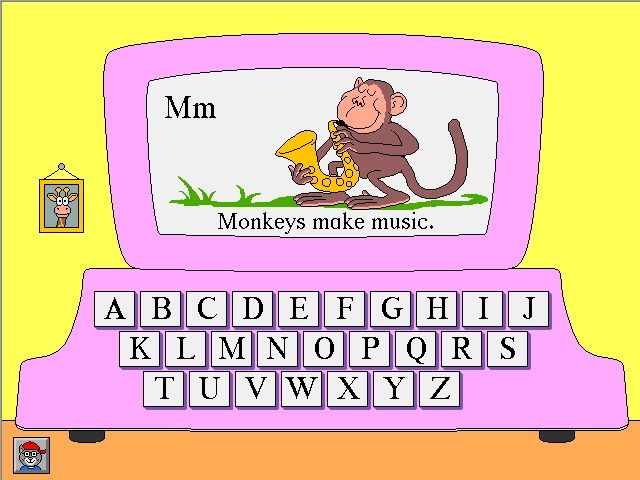
The game offers two distinct modes for most activities: Explore & Discover and Question & Answer. In Explore & Discover, children are free to experiment, click on icons, and see how Bailey or animal friends respond. This unstructured play encourages curiosity and helps build confidence in using the interface. In Question & Answer mode, an on-screen character prompts the child to complete tasks—selecting the correct preposition with Edmo & Houdini, finding letters with the Letter Machine, or supplying rhyming words in Read-A-Rhyme.
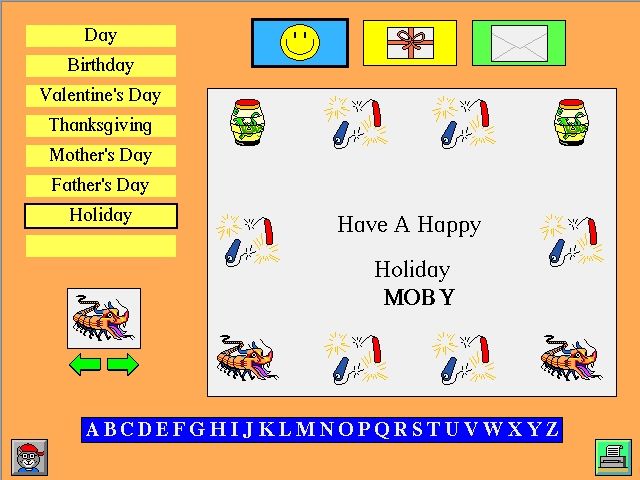
With a total of eight activities—ranging from Make-A-Story and Kid Cards to Three-Letter Carnival and My Friend—the game keeps content fresh and varied. Each activity reinforces a different pre-reading skill, whether it’s letter recognition, vocabulary building, or sequencing. Importantly, there are no penalties for incorrect answers; wrong clicks simply elicit gentle verbal encouragement, so children feel safe to try again.
Graphics
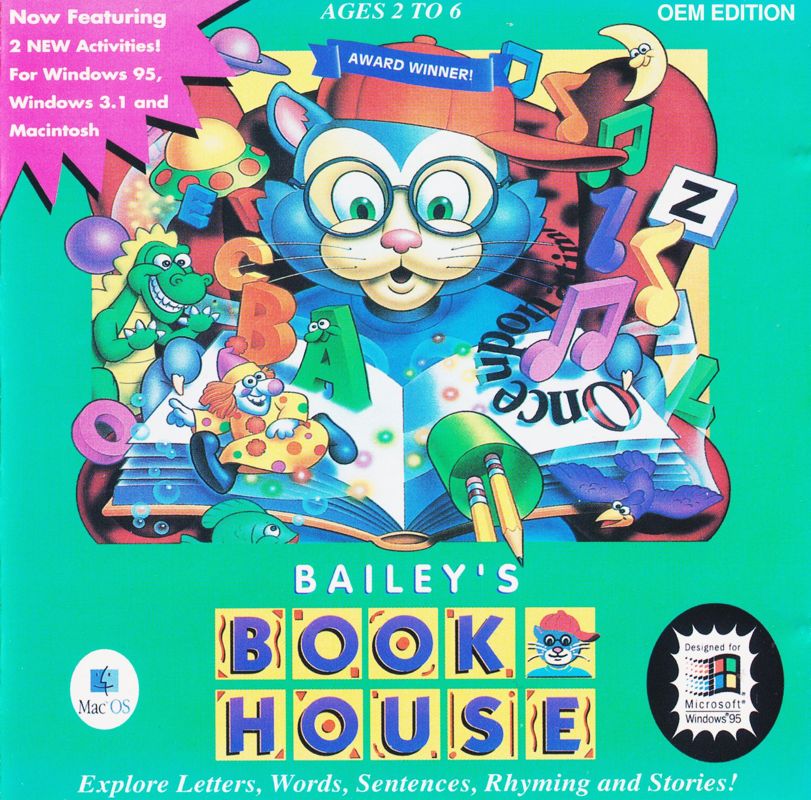
The visual style of Bailey’s Book House is bright, inviting, and playful, featuring hand-drawn illustrations with bold outlines and primary colors. Characters like Bailey, Edmo the Clown, and Houdini the doghouse inhabit a warm, storybook world where every element is large enough for small hands to click easily. Animation sequences—such as a dancing giraffe in the Letter Machine—are short but charming, reinforcing learning points with delightful visual feedback.
Backgrounds remain uncluttered, ensuring that young players are not overwhelmed by too much detail. Interactive objects glow or highlight subtly when the cursor hovers over them, making it clear where players can click. The overall art direction strikes a balance between whimsy and clarity, helping children focus on the educational content rather than getting lost in busy graphics.
On Windows systems updated in 1995, the additional activities benefit from slightly enhanced color palettes and smoother transitions. Whether on Macintosh or Windows, the interface remains consistent, and the printing options for Kid Cards and Make-A-Story produce crisp, easily legible output. For parents who value aesthetics as well as function, Bailey’s Book House presents a visually pleasing environment that encourages repeated exploration.
Story
While Bailey’s Book House does not follow a linear narrative, it frames each educational activity as part of an imaginative day in Bailey’s home. Bailey sits in a cozy chair reading aloud, inviting the player to join in and explore the world of letters, words, and rhymes. This framing device gives a sense of continuity: every activity feels like a natural extension of a child’s reading time.
One standout feature is Make-A-Story, where children choose characters, settings, and plot elements to generate their own printable story. As Bailey reads the custom tale aloud, children experience firsthand how words come together to form narratives. This creative exercise fosters both literacy and imagination, making the “story” aspect of the game as engaging as its more structured learning tasks.
Other mini-stories are woven into activities like Read-A-Rhyme and My Friend, where simple scenarios prompt players to complete rhymes or fill in missing words. These bite-sized narratives reinforce phonemic awareness, word relationships, and comprehension. The lack of a traditional story arc is outweighed by the pleasure of active participation—children become co-authors of the adventures taking place in Bailey’s Book House.
Overall Experience
Bailey’s Book House excels as an educational title for preschoolers and early readers, combining engaging activities with a user-friendly interface. Parents will appreciate the robust adult options—accessible via a simple key combination—which allow you to disable printing, adjust volume, hide the exit button, or set up single-switch input for children with special needs. These settings make the game adaptable to a wide range of home and classroom environments.
The absence of penalties ensures that players remain motivated and curious. Every success is celebrated with a cheerful voiceover and a little animation, and failures are met with gentle encouragement to try again. This positive reinforcement is crucial for young learners building confidence in their budding literacy skills.
Replay value is high thanks to repeatable instructions, randomized prompts in Question & Answer mode, and creative activities like Make-A-Story and Kid Cards that produce tangible, printable keepsakes. With its warm visuals, varied gameplay, and thoughtful educational design, Bailey’s Book House offers a delightful introduction to pre-reading that will keep children coming back for more.



Reviews
There are no reviews yet.