 Retro Replay Retro Replay gaming reviews, news, emulation, geek stuff and more!
Retro Replay Review
Gameplay
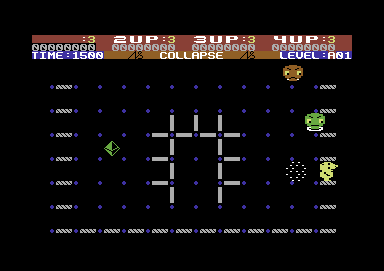
Collapse centers around Zen the Mole and a deceptively simple puzzle core: walk over yellow sticks to turn them blue, then unleash the Rotox to clear them away. At its heart, the game challenges you to balance two distinct states—yellow for painting, red for bridge‐building—as you navigate ever more intricate networks of sticks. The transitions are tight and responsive, giving you a clear sense of control as you switch between exploration and construction.
(HEY YOU!! We hope you enjoy! We try not to run ads. So basically, this is a very expensive hobby running this site. Please consider joining us for updates, forums, and more. Network w/ us to make some cash or friends while retro gaming, and you can win some free retro games for posting. Okay, carry on 👍)
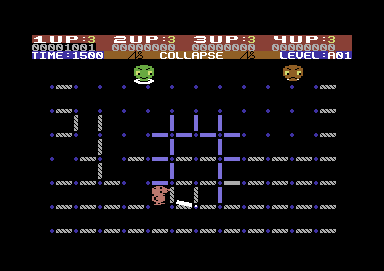
Once all sticks are painted blue, the Rotox—a glowing white line—activates and methodically chews through adjacent blue sticks until the entire formation collapses. The visual feedback of the Rotox snaking around the structure is both satisfying and a useful timer, letting you see exactly which sections are about to vanish. This mechanic provides a playful payoff for careful planning and precise movements.
Of course, nothing is quite so peaceful as it seems. A strict time limit hovers over each stage, ticking down relentlessly as you race to paint, bridge, and trigger the Rotox. Two menacing creatures wander the boards, each contact costing you 100 precious time units. To fend them off, Zen has a limited supply of magic dust that temporarily vanishes his foes, forcing you to choose when it’s worth expending this resource and when it’s better to outrun the threat.
Collectible jewels appear sporadically, replenishing time and rewarding exploration. These bright gems add a risk‐reward layer: detouring for a jewel might shave seconds off your clock, but the extra time could prove crucial on complex layouts. As you progress through screens, the puzzles ramp up in intricacy, demanding tighter routes and more strategic dust usage. Collapse’s gameplay loop remains fresh through a steady escalation in difficulty and clever level design.
Graphics
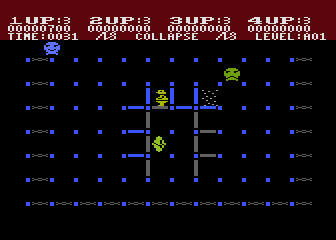
Visually, Collapse adopts a clean, minimalist style that emphasizes functionality over flourish. The playfield is rendered in crisp 2D sprites against a neutral background, ensuring that every stick, bridge, and creature stands out clearly. Color coding is especially important here: the shift from yellow to blue sticks is instantly recognizable, and the bold red bridges pop against the muted palette.
Animations are simple but effective. Zen’s walk cycle is smooth enough to convey momentum, and the brief glow around him when he shifts to red or yellow serves as an intuitive cue. The Rotox effect shines brightest—its whirling, luminescent line brings a burst of energy to otherwise static puzzles, giving you a sense of reward as it dismantles your handiwork in real time.
The two enemy creatures each sport distinct silhouettes and movement patterns, making it easy to identify who’s who even when chaos ensues. Particle effects from the magic dust and the sparkle of collected jewels add small touches of polish. While this isn’t a showcase of cutting‐edge graphics, Collapse’s aesthetic choices ensure that clarity and readability never take a back seat to visual fluff.
Menus and HUD elements follow the same streamlined approach. Time counters, dust meters, and jewel tallies are all neatly displayed without cluttering the screen. This minimal interface lets you focus on puzzle mastery rather than hunting for information, a design choice that underscores the game’s puzzle‐first philosophy.
Story
Collapse doesn’t lean heavily on narrative, but it sets up a charming premise: Zen the Mole ventures out to clear away tangled networks of sticks and restore order one stage at a time. There’s a lighthearted tone to the proceedings, hinted at by playful animations and the mischievous antics of the two roaming creatures.
Each screen represents a new “level” in Zen’s journey, with only minor environmental changes to suggest progression. While there are no cutscenes or dialogue trees, the simple context—collect jewels for extra time, paint sticks, then trigger the Rotox—creates a self‐contained scenario every time you hit “play.” This modular storytelling suits short play sessions and keeps the focus squarely on puzzle‐solving rather than exposition.
The Rotox itself acts as a kind of invisible antagonist, looming over each puzzle with the promise of total collapse. Its arrival marks the climax of your efforts on each screen, giving a sense of narrative payoff even in the absence of characters or plot twists. In this way, Collapse weaves story and gameplay together through mechanics rather than words.
Though light on lore, the game’s consistent theme of creation and destruction gives it a surprisingly cohesive identity. Zen’s mole persona adds a dash of character, and the joy of seeing the Rotox sweep through your handiwork injects emotion into every level. If you’re looking for a puzzle title that tells its story through action rather than exposition, Collapse delivers.
Overall Experience
Collapse offers a crisp, time‐pressured puzzle experience that’s both accessible to newcomers and challenging for veterans. Levels are bite‐sized enough to enjoy in quick bursts, yet the ticking clock and roaming creatures keep your pulse high. The elegant dance of painting, bridging, and triggering the Rotox provides a satisfying feedback loop that hooks you to see just one more stage.
The learning curve is smooth: early levels introduce mechanics gently, and you quickly understand how to exploit Zen’s color states and magic dust. As the puzzles grow more elaborate, you’ll find yourself planning several moves ahead, mapping out routes and timing your dust usage to perfection. This escalating challenge keeps the game engaging across dozens of screens.
Replayability stems from chasing better times and experimenting with alternative paths. Collecting every jewel and optimizing your route for speed adds a competitive edge, even if there’s no built‐in leaderboard. The joy of shaving precious seconds off your best run becomes its own reward.
For puzzle aficionados and casual gamers alike, Collapse delivers a polished, no‐frills package that highlights smart design over flashy extras. Its straightforward presentation, tight controls, and steady difficulty curve make it a reliable choice for anyone seeking a mentally stimulating diversion. Whether you’re on a short break or diving in for a marathon session, Zen the Mole’s colorful world offers plenty of reasons to keep coming back.



Reviews
There are no reviews yet.