 Retro Replay Retro Gaming History, Reviews & Emulation


Retro Replay Review
Gameplay
The first few minutes of Gyropod are likely to feel slightly alien, and that is a compliment. Your gun does not roam the whole screen; it travels up and down the Ranger-class Rim surrounding the supply pod. Enemy ships arrive in waves, shots come back at you, and the key skill is learning where the gun can safely sit before you commit to firing. It is a more nervous kind of shooting than a free-flying space game, because every dodge is constrained by that circular track.
Damage gives those fights real bite. As the rim is hit, holes open in it, making your safe route less dependable. If the gun takes a direct hit or collides with an incoming ship, it is knocked off the rim and you lose a life. That creates a strong escalation: a battle that begins as a manageable aiming exercise can turn into a scramble around a battered ring. You need patience more than constant firing, especially since ammunition will not last forever.
The need to plunder a planet before destroying it is where Gyropod earns its oddball reputation. Detaching the supply pod requires a left-left-right joystick sequence, then the game switches to a Lunar Lander-style descent. Come in too fast and you lose a life. Land successfully and you guide a spaceman around the surface to gather boxes while hostile aliens pursue and shoot at him. It is a lot to ask from one game, but the different stages make each successful planet feel earned rather than routine.
Expect friction. The landing and scavenging sections are not a breather after space combat; they are another chance to lose progress, and the game’s whole structure demands that you stay composed across several very different tasks. Still, that severity fits the design. Set the lives higher while learning, choose an easier difficulty, and use the early attempts to understand the rhythm rather than chase a huge score immediately.

Graphics
Gyropod uses side-view, fixed screens to keep the action focused on the Galaxy Ranger’s rim, the attacking alien craft, and the incoming fire you need to avoid. The damaged-ring idea is especially clear in play: holes appearing in the rim are not decoration, but an immediate picture of how much less room you have to work with.
The planetary sections shift the view to the supply pod’s landing and the spaceman’s trip across the surface for boxes. That change of scene helps the game’s multi-stage structure feel tangible, even though its action remains direct and arcade-like.
Story
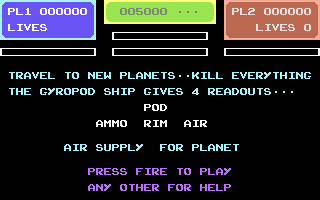
The story is spare, but it gives the action a clean purpose. You pilot the Galaxy Ranger into an alien system with orders to locate and eradicate every planet there. Each world is defended by fanatical alien forces, so the mission never pretends to be a peaceful expedition.
What works is how closely that premise matches the play. You cannot simply blast a planet from a safe distance: you have to fight through its defenders, land a pod, and collect supplies before its destruction. The mission objective therefore becomes a sequence you physically carry out rather than a line of text between levels.
Do not come to Gyropod for character drama or a sprawling science-fiction tale. Its story is an arcade briefing, but a useful one. The hostile system, the vulnerable supply operation, and the final act of planetary destruction give the escalating action a sharper sense of direction than score-chasing alone.
Overall Experience
Gyropod is the kind of 1984 shooter that asks you to meet it on its own terms. Its central rim-gun combat has a learning curve, and the extra landing and collection sequences can initially seem like interruptions. Once the logic clicks, though, they turn each planet into a compact campaign of defense, descent, scavenging, and destruction.
The game is at its best when you are low on ammunition, the rim is opening up around you, and you know that reaching the next stage safely matters as much as clearing the current wave. That pressure makes its simple goals surprisingly involving. The cost is that one mistake can sting, particularly when you have already survived the space battle only to risk a bad landing or an exposed spaceman.
Hot-seat two-player is a good fit for this score-driven tension. Alternating after each player’s first lost life makes every turn a small performance, and the adjustable difficulty, lives, and music let you tune the session to your patience. Gyropod is worth your time if you enjoy inventive early arcade games that mix precision shooting with unforgiving multi-stage objectives; if you want a shooter built around constant movement and instant recovery, its deliberate, punishing structure may wear you down.



Reviews
There are no reviews yet.