 Retro Replay Retro Replay gaming reviews, news, emulation, geek stuff and more!



Retro Replay Review
Gameplay
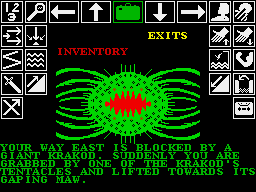
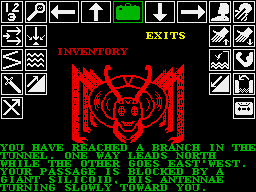
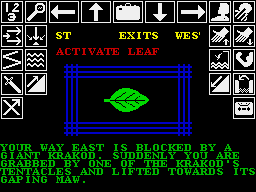
Kobyashi Naru presents a distinctive adventure format that diverges from the classic 1980s text-parser model. Instead of typing commands, you interact with on-screen icons laid out in the top half of the display. These icons handle everything from movement and item manipulation to specialised actions like ascending, throwing, and swimming. Selecting the “analyse” icon and then clicking on specific words in the scene text becomes a crucial tool for uncovering hidden clues.
(HEY YOU!! We hope you enjoy! We try not to run ads. So basically, this is a very expensive hobby running this site. Please consider joining us for updates, forums, and more. Network w/ us to make some cash or friends while retro gaming, and you can win some free retro games for posting. Okay, carry on 👍)
The game’s structure is split into three thematic sections—Knowledge, Wisdom, and Understanding—each acting as a gateway to the next stage of the Kobyashi Naru trial. Your goal is to collect one essential object in each segment: a scroll of lore in Knowledge, a chalice of clarity in Wisdom, and a gem of insight in Understanding. Successfully uniting these artifacts is mandatory to attempt the final trial and achieve immortal status.
Puzzle design in Kobyashi Naru leans heavily on the integration of inventory items and scene descriptions. You might discover a rope in your pack and have to throw it to a distant ledge, or examine a particular keyword in a text passage to reveal a hidden passage. This layering of visual icons and keyword analysis keeps you mentally engaged and rewards careful reading as much as icon-click dexterity.
Movement between different locations is swift, but backtracking can be required if you miss an object or clue on first pass. While some puzzles can feel obtuse—requiring leaps of logic that test patience—overcoming those challenges imparts a genuine sense of achievement. For retro enthusiasts and puzzle aficionados, the gameplay loop of exploring, analysing, and combining items remains deeply satisfying.
Graphics
Visually, Kobyashi Naru strikes a nostalgic chord with monochrome or limited-palette illustrations that accompany each location. Though simple by modern standards, these pictures are meticulously composed, using strong contrasts and clear lines to convey cavernous temples, mist-shrouded valleys, and ornate chambers. The static images serve as evocative backdrops for your quest.
The decision to include one image per scene, highlighting significant objects where applicable, enhances orientation without overwhelming the player. When you pick up an item—a glowing chalice or an ornate key—the illustration subtly shifts to emphasise that object. This visual feedback reinforces your progress in each section of Knowledge, Wisdom, and Understanding.
Even on cassette-based systems, the artwork holds a surprising amount of detail. Textures of stone walls, flickering torchlight, and distant horizons come through clearly despite the hardware constraints. While there’s no animated movement beyond simple fades or crossfades, the effective use of composition and shading ensures that each locale feels alive in its own quiet way.
Overall, the graphics strike a balance between functional clarity and atmospheric immersion. They never overshadow the narrative or puzzles, but instead complement the text descriptions, helping players visualise their surroundings and better understand where to search for the next crucial object.
Story
At its heart, Kobyashi Naru is a journey of transformation. You are an aspirant seeking immortal enlightenment through the eponymous trial. The narrative unfolds in three stages—Knowledge, Wisdom, and Understanding—that parallel your character’s internal growth. Each section is tied to a unique environment and philosophical challenge.
In the Knowledge chapter, you explore ancient libraries and script-filled vaults to recover the scroll of lore. Here, the emphasis is on observation and deciphering old texts. The puzzles demand not only curiosity but also lateral thinking, as you interpret cryptic inscriptions to discover hidden compartments and secret passages.
Transitioning to Wisdom, the setting shifts to misty mountain shrines and reflective pools. The game’s tone becomes more contemplative; puzzles revolve around balance, symmetry, and moral dilemmas. Retrieving the chalice of clarity often requires you to choose which path of action aligns with deeper truths hinted at in the environmental descriptions.
Finally, in the Understanding section, you confront the realm of inner sight—labyrinthine caves illuminated by bioluminescent crystals. Here, the gem of insight awaits, but claiming it means solving some of the most abstract puzzles in the game. Only after uniting all three artifacts do you gain access to the ultimate Kobyashi Naru trial, where your mastery of each theme is put to the test.
Overall Experience
Kobyashi Naru stands out as an atypical yet rewarding entry in the pantheon of 1980s adventure games. Its combination of icon-driven interaction and keyword analysis offers a fresh twist on classic text adventures. Though the learning curve can be steep for newcomers, the sense of discovery and the philosophical framing keep the journey compelling.
For players who appreciate thoughtful puzzle design and atmospheric world-building, Kobyashi Naru delivers an experience that balances mental challenge with narrative depth. The three-stage structure not only provides clear progression but also weaves a consistent thematic thread that elevates each puzzle into a meaningful step toward enlightenment.
While the graphics are modest by today’s standards, they remain endearing and effective. The artwork dovetails neatly with the text, ensuring you never feel lost even when the puzzles grow fiendishly intricate. Combined with a minimalist audio backdrop—echoing footsteps, distant drips, and ambient hums—the overall atmosphere is hauntingly immersive.
Ultimately, Kobyashi Naru is a must-play for retro adventure fans who relish cerebral challenges and philosophical undertones. Its unique interface, thoughtful puzzles, and layered narrative make it a memorable journey toward immortal transcendence—should you have the wisdom, knowledge, and understanding to see it through.


Reviews
There are no reviews yet.