 Retro Replay Retro Replay gaming reviews, news, emulation, geek stuff and more!




Retro Replay Review
Gameplay
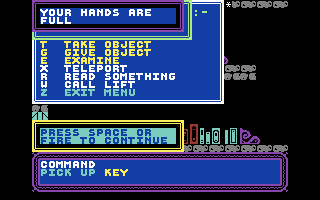
Spellbound builds on the foundation laid by Finders Keepers and introduces a sweeping adventure that challenges players to navigate a vast time-shifting landscape. The core of the gameplay revolves around Windimation, an innovative control system that uses icons, windows, and a pointing finger cursor. This interface allows you to interact with objects, examine them in detail, and combine or use items creatively to progress.
(HEY YOU!! We hope you enjoy! We try not to run ads. So basically, this is a very expensive hobby running this site. Please consider joining us for updates, forums, and more. Network w/ us to make some cash or friends while retro gaming, and you can win some free retro games for posting. Okay, carry on 👍)
Players must manage Magic Knight’s health and energy carefully. Carrying too many items or sprinting across the map without rest will sap his stamina, and if it runs too low, you risk becoming vulnerable to environmental hazards or enemy attacks. The energy mechanic adds a layer of strategy: should you lug every key item at once or make multiple trips to conserve strength?
Puzzles in Spellbound are more intricate and varied than its predecessor. From manipulating time-warp devices to solving lock-and-key riddles, each challenge feels thoughtfully designed. You’ll also need to track down and guide eight trapped characters, including the venerable tutor Gimbal. Directing these NPCs safely through dangerous zones becomes its own mini-game, requiring patience and foresight.
The game’s larger map encourages exploration, with hidden chambers and time portals scattered throughout four distinct epochs. Every era presents unique obstacles—dinosaurs in the Cretaceous, automatons in a distant future—so you’ll frequently toggle between menus in Windimation to switch tools, examine environmental clues, and coordinate rescues.
Graphics
Spellbound marks a significant graphical leap over Finders Keepers. Backgrounds pulse with vibrant color, and the enlarged map gives artists room to render detailed set pieces, from medieval castles to futuristic cityscapes. Each era has its own palette, ensuring the world never feels visually stale.
Character sprites have increased resolution too, with smoother animations for walking, item handling, and spellcasting. Magic Knight’s finger cursor adds personality as it hovers and clicks, making interactions feel tactile. Enemy designs—whether a rampaging stegosaurus or a rogue clockwork knight—are crisply drawn and animated, adding life to every encounter.
The Windimation windows themselves look sharp and intuitive. Icons are clearly labeled and easily distinguishable, speeding up gameplay and reducing frustration. Even lengthy item descriptions are displayed on a clean interface, with text that’s legible without obscuring the action behind the menu.
Spellbound’s visual flourishes extend to environmental effects: flickering torches, swirling time portals, and dynamic weather patterns that subtly alter the mood of each area. Though hardware limitations of the era are evident, the developers push the system’s capabilities to deliver an immersive feast for the eyes.
Story
At its heart, Spellbound tells the tale of Magic Knight’s valiant quest to rescue eight companions, including his mentor Gimbal, who have become frozen in time thanks to a misfired spell. The narrative framework builds tension as you learn fragments of each trapped character’s fate via cryptic scrolls and magical journals.
The time-travel premise enables a richly varied storyline. You’ll leap from ancient ruins to futuristic laboratories, uncovering the cause of the temporal distortions one piece at a time. Each rescued character contributes vital insight—some offer puzzle hints, others provide key artifacts—so the story progresses organically through gameplay.
While the dialogue is minimal compared to modern adventure titles, Spellbound uses environmental storytelling effectively. A smashed clock in a ruined chapel hints at a past catastrophe, while shimmering runes etched into future city walls reveal the spell’s broader consequences. This subtlety invites players to piece together backstory details on their own.
Gimbal’s eventual reunion with Magic Knight is a satisfying payoff, tying together loose narrative threads. The game strikes a balance between whimsical fantasy and genuine peril, ensuring that each rescue feels earned and emotionally resonant. For fans of classic adventure tales, the story’s mix of humor, mystery, and heartfelt loyalty makes every timestamped challenge feel meaningful.
Overall Experience
Spellbound stands out as a landmark title in early adventure gaming, thanks largely to its daring Windimation system and ambitious scope. The larger map and diverse epochs keep exploration fresh, while resource management injects each scenario with strategic depth. Even after decades, the game’s design choices feel forward-thinking.
Although some modern players may find the interface slower-paced than contemporary point-and-click adventures, the tactile satisfaction of selecting icons, opening sub-menus, and watching Magic Knight perform actions has a unique charm. The game rewards patience and careful planning, making breakthroughs feel truly rewarding.
Replay value is high: you can experiment with different rescue orders, puzzle solutions, and time-travel routes. Optional areas containing secret artifacts and hidden characters provide extra challenges for completionists. The blend of exploration, puzzle-solving, and narrative progression strikes an engaging balance from start to finish.
For anyone interested in the evolution of adventure games or seeking a deep, thoughtful quest with memorable mechanics, Spellbound remains a standout experience. Its combination of innovative controls, captivating visuals, and time-bending storytelling makes it a must-play classic for long-time fans and new adventurers alike.


Reviews
There are no reviews yet.