 Retro Replay Retro Replay gaming reviews, news, emulation, geek stuff and more!
Retro Replay Review
Gameplay
The Final Chesscard transforms your Commodore 64 into a formidable chess opponent with a playing strength of around ELO 1600. Whether you’re a beginner learning basic tactics or an advanced club player refining your strategy, the cartridge adapts to your level. Eight distinct modes let you tailor the challenge: from blitz matches with 30 or 60 seconds per move to classical games of 5 or 10 minutes per side, and even full-fledged tournaments. These options ensure a fresh and stimulating experience each time you sit down at the board.
(HEY YOU!! We hope you enjoy! We try not to run ads. So basically, this is a very expensive hobby running this site. Please consider joining us for updates, forums, and more. Network w/ us to make some cash or friends while retro gaming, and you can win some free retro games for posting. Okay, carry on 👍)
Beyond standard play, The Final Chesscard includes a powerful analysis mode that invites you to review your own games move by move. The battery-backed memory means your games—and your progress—are preserved even when the Commodore 64 powers down. By stepping through each variation, you can detect tactical oversights, pinpoint critical moments, and develop deeper insights into your own decision-making process.
One of the standout features is the intuitive pull-down menu system and window dialogues. Rather than wrestling with cryptic key combinations, you navigate settings, choose time controls, and review notation with a joystick or keyboard-controlled cursor. This user-friendly interface brings a level of polish rare for home computer chess software of the mid-1980s.
Whether you prefer a rapid-fire skirmish or a thoughtful practice session, The Final Chesscard’s flexible framework accommodates your rhythm. Its on-board 6502 CPU running at 5 MHz ensures smooth, responsive performance, while the depth of eight playing modes keeps true enthusiasts engaged over many sessions.
Graphics
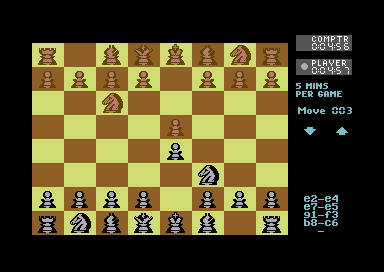
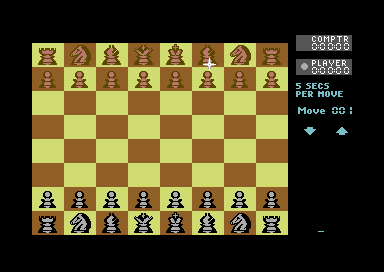
Graphically, The Final Chesscard adheres to the classic Commodore 64 aesthetic: simple yet serviceable. The chessboard is rendered in high-contrast colors that maintain clarity even on older CRT displays. Piece icons are instantly recognizable, ensuring you never misinterpret a knight for a bishop during a tense moment.
The pull-down menus and window dialogues are rendered crisply, with clean lines and straightforward typography. Though minimalist by modern standards, the interface design prioritizes legibility and speed—essential for a chess program where every second can count in timed matches. The absence of flashy animations allows the software to dedicate its resources entirely to engine strength and move calculation.
Subtle shading and alternating square colors provide just enough depth to prevent eye fatigue over marathon analysis sessions. While you won’t find 3D board rotations or zoom effects, the straightforward 2D presentation is perfectly suited to the Commodore 64’s capabilities and keeps the focus firmly on the game itself.
Additionally, the menu overlays do not obscure you from the main board, so you can adjust settings on the fly without losing sight of the current position. This seamless integration of function and form exemplifies the thoughtful design approach taken by TASC B.V.
Story
The Final Chesscard owes its origins to a collaboration between TASC B.V. and chess-computer pioneers like Hegener & Glaser and Fidelity. By embedding its own 6502 CPU running at 5 MHz and a dedicated battery for game storage, the cartridge elevates the Commodore 64 beyond its base capabilities. This hardware-centric approach was groundbreaking in the mid-1980s and set a new standard for dedicated chess peripherals.
At launch, The Final Chesscard filled an important niche: a portable, affordable chess engine that still delivered respectable playing strength. With an ELO rating near 1600, it bridged the gap between hobbyist play and serious training tools. For many aspiring players, it became a steady tutor, helping them refine openings, rehearse endgames, and sharpen tactical vision.
Over the decades, the cartridge has earned a reputation as a dependable training partner. The ability to save and revisit games—even after the computer has been powered off—meant no analysis session was ever lost. This reliability, combined with the thorough menu structure and robust play modes, made The Final Chesscard a staple on the desks of countless chess enthusiasts.
Its legacy persists today as a testament to clever engineering and user-focused design. By offloading computation to its own chip, the cartridge minimized system conflicts and maximized performance—an elegant solution that still resonates with retro-computing aficionados and chess historians alike.
Overall Experience
The Final Chesscard remains a compelling purchase for anyone seeking a solid, mid-level chess engine on the Commodore 64. Its blend of hardware acceleration, user-friendly menus, and comprehensive mode selection makes it equally appealing to casual players and serious students of the game. You’ll find yourself returning to its analysis features time and time again, uncovering new insights.
Installation is a breeze: simply insert the cartridge and power on. The onboard battery backup ensures that your games, settings, and annotations are preserved indefinitely. This plug-and-play convenience underscores the plug-in’s purpose—no complicated disk swaps or lengthy load times, just immediate, uninterrupted play or analysis.
While modern platforms boast advanced engines and polished graphics, there’s a certain charm to The Final Chesscard’s straightforward approach. Its strengths lie in delivering robust chess programming within the constraints of 1980s hardware. For hobbyists, retro collectors, or beginning club players wanting an authentic period experience, it stands as a fine example of effective game design.
In sum, The Final Chesscard offers a balanced mix of performance, features, and ease of use. It remains an excellent companion for those looking to hone their skills on vintage hardware, providing countless hours of strategic challenge and reflective analysis. For Commodore 64 aficionados and chess devotees alike, it’s a timeless addition to any collection.


Reviews
There are no reviews yet.