 Retro Replay Retro Replay gaming reviews, news, emulation, geek stuff and more!
Retro Replay Review
Gameplay
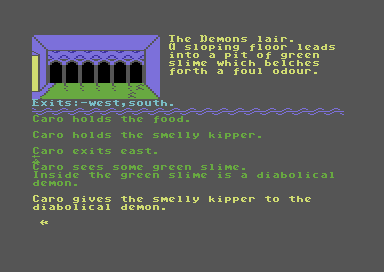
The Magician’s Ball earns attention because it does not treat Caro as the only useful person in the room. Being able to instruct other characters to perform actions gives its puzzles a welcome twist: instead of only asking what you should do, it can make you consider who ought to do it. That is a strong idea for a text adventure, and it lends the game more tactical texture than a straightforward command-and-response quest.
The other major hook is Azul. If Caro dies, the adventure does not necessarily end; you can take over as Azul and still pursue completion. For anyone who has hit a dead end in an old adventure after one bad decision, that is an immediately appealing safety net. More importantly, it makes the game’s alternate character feel like part of the design rather than a mere backup life.
You should come prepared for the deliberate pace of interactive fiction. The satisfaction here lies in working through its character-based possibilities and seeing how far the game lets you recover from trouble, not in fast action. If you enjoy old-school adventures because they ask you to stop, think, and experiment with a strange situation, this is more interesting than its simple rescue setup initially suggests.
Graphics
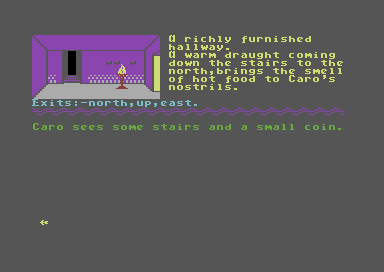
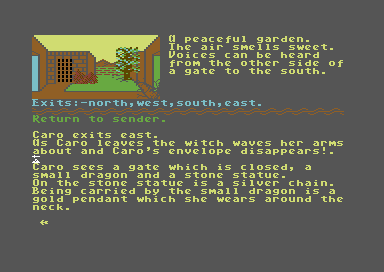
This is a text adventure with graphics on Commodore 64, so the written commands and descriptions remain central to the experience. The graphics accompany that interactive-fiction framework rather than replacing it.
Story
The immediate goal is clear and suitably urgent: a little girl has been turned to stone by an evil wizard, and Caro must kill the wizard to break the spell. It is classic fantasy material, but the directness works. You know what needs to be set right from the outset, which gives the adventure’s exploratory structure a useful sense of purpose.
What makes the premise more than a routine wizard hunt is the presence of other characters who can act and Azul’s ability to carry on after Caro’s death. Those details give the story room to feel less like one magician’s sealed-off journey and more like a problem involving several people with a stake in the outcome.
Mike Oldfield’s Tubular Bells is an especially distinctive companion for this kind of game. In-game music was not a trivial flourish on the C64, and that choice gives the adventure a memorable atmospheric calling card. The familiar piece should help the long pauses spent considering a command feel a little less lonely.
Overall Experience
The Magician’s Ball is worth a look because its most interesting ideas are structural, not decorative. Ordering other characters around and surviving Caro’s death through Azul both push against the usual text-adventure assumption that one mistake ends the entire expedition. That makes it feel unusually forgiving in one sense, while still asking for the patience and curiosity the genre demands.
Its rescue-the-girl setup is traditional, and you should not expect the premise alone to carry you. The payoff comes from engaging with the unusual character control and the possibility of continuing from a setback. When those ideas start clicking, the game stands apart from more solitary fantasy adventures of its era.
Give it a chance if you like Commodore 64 interactive fiction and enjoy puzzles with a little extra human—or magical—coordination. The Tubular Bells score adds real flavor, but the reason to stay is the clever contingency built around Azul. It is a compactly ambitious adventure with a better recovery plan than many of its contemporaries.


Reviews
There are no reviews yet.